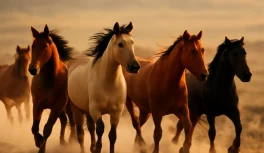
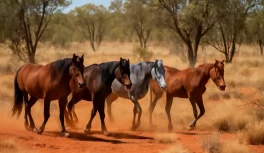
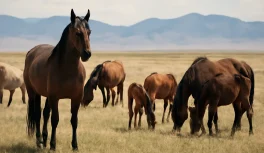
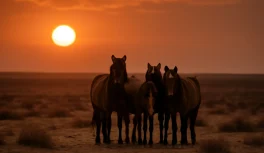
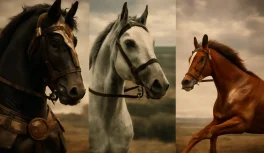
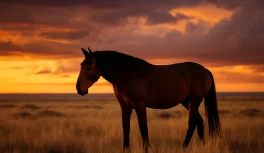
There’s a moment that people who’ve seen it never forget — dozens of horses crossing a wide-open plain with the Nevada horizon stretched out behind them. No bridle. No shoes. No fixed destination. The American Mustang isn’t just an animal; it’s an image the whole world recognizes as shorthand for freedom. But behind that image lies a history far more complex, ancient, and contested than any travel poster would have you believe.
Mustangs descend from horses brought to the American continent by the Spanish in the 16th century. The name comes from the Spanish mestengo or mostrenco — a word that described ownerless livestock. Over centuries, these horses spread across the western continent: captured by Indigenous peoples, released by settlers, crossbred with European stock, and hardened by landscapes that had no patience for the weak. The result is a horse of uncommon resilience.
Where Did Mustangs Come From?
Horses vanished from North America roughly 10,000 years ago, almost certainly due to a combination of climate shifts and hunting pressure. When Hernán Cortés and other Spanish conquistadors arrived in the 16th century, they brought Andalusians, Arabians, and Barbs — horses bred for endurance and speed. Some escaped. Others were turned loose. And over generations, their descendants adapted to the raw geography of the continent.
The Indigenous peoples of the Great Plains — the Comanche, Lakota, Cheyenne, and others — recognized immediately what the horse could mean for them. Within less than a century, equestrian culture became central to societies that had never known these animals before. Horses captured from feral herds, trained, and traded between groups formed the foundation of an entire way of life and economy.
What Is the Relationship Between Mustangs and Native Americans?
The answer runs far deeper than practical use. For many nations, the horse became something spiritual — a ceremonial and identity-defining presence. The Comanche became known as the people of the horse: the finest riders in the Americas, capable of shooting with precision at full gallop. This transformation happened at breathtaking speed. Within roughly 80 years of first contact with horses, certain tribes owned thousands of animals.
The Golden Age and the Collapse
At their peak in the 19th century, an estimated 2 to 5 million Mustangs roamed the American West. The expansion of ranching and the settling of the continent changed everything. Ranches needed pasture, and feral horses were viewed as competitors to cattle. Systematic culling — sometimes carried out on an industrial scale — reduced populations to fewer than 20,000 animals by the early 20th century.
The turning point came through one woman: Velma Bronn Johnston, known as “Wild Horse Annie,” a Nevada activist who in the 1950s led a national campaign to ban the aerial hunting of wild horses. Her efforts resulted in the Wild Free-Roaming Horses and Burros Act of 1971 — the first federal legislation to give these animals legal protection on American soil.
How Mustangs Live Today
Current population estimates range between 60,000 and 80,000 animals, spread primarily across Nevada, Wyoming, Montana, Colorado, and Oregon. The Bureau of Land Management (BLM) is the federal agency responsible for managing these populations — a mandate that includes fertility control, adoption programs, and in some cases, transfers to off-range holding facilities.
What Does a Mustang Herd Look Like?
A typical herd consists of a dominant stallion, three to twelve mares, and their foals. The stallion protects the group and patrols the territory, while the oldest mare typically leads when it comes to movement decisions — where to find water, when to move away from a predator, which routes to take. Young males driven out by the stallion form bachelor bands and stay on the margins until they’re ready to challenge for their own herds.
Hierarchy within the group is constantly renegotiated through body language: ear position, bared teeth, neck posture, hoof threats. It’s a sophisticated communication system that keeps the herd cohesive while minimizing outright physical conflict.
The Fight Over Population Management
Mustangs occupy a paradoxical space: beloved in the popular imagination, yet classified as an invasive species by many land managers and ecologists. The debate over how to manage their numbers is one of the most heated in American environmental politics.
On one side, advocacy groups argue that the horses are an integral part of the western landscape and that any intervention violates a deep historical and cultural bond. On the other, land managers and ranchers point out that unchecked populations degrade pastureland and compete with native species like pronghorn antelope and golden eagles.
The BLM runs an adoption program that allows private citizens to capture and train wild Mustangs — a process that can take months and has a devoted following across the country. Mustangs that have been adopted and properly trained often turn out to be extraordinarily intelligent, tough, and loyal.
The Mustang as Cultural Icon
Few animals carry as much symbolic weight as the Mustang. Ford named its most iconic sports car after them. “Mustang Sally” is a classic of American soul music. Spirit: Stallion of the Cimarron (2002) and its follow-up introduced these horses to a new generation. The long-running series Heartland has made Mustang rescues a recurring storyline for over a decade.
But perhaps the most powerful presence is in the collective imagination: the silhouette of a horse at the top of a red rock ridge at dusk, with no one to direct it. It’s an image that continues to mobilize people, fuel protection campaigns, and inspire artists — reminding us that not everything in the world needs to be managed.