There was one race Man o’ War was not supposed to lose. It was August 1919 in Saratoga Springs, New York, and the field included a horse named Upset. Man o’ War was at a disadvantage at the break — badly positioned, turned the wrong way when the starter’s signal came — and still finished second by less than a head. It was his only defeat across two seasons of racing.
The winner was named Upset. The English language has never used that word quite the same way since.
Man o’ War won 20 of the 21 races he entered. He broke five world records. He won by margins that made clockers doubt their instruments. And when he died in 1947, more than a thousand people came to his funeral — at a time when traveling to pay respects to a horse required considerable effort.
The Making of a Legend
Man o’ War was born on March 29, 1917, on August Belmont II’s farm in Lexington, Kentucky. He was a chestnut colt — the same color as Secretariat, five decades later — with the pedigree of the finest bloodlines in American racing. His sire, Fair Play, was one of the most coveted stallions of the era. His dam, Mahubah, came from equally prestigious lines.
August Belmont II sold Man o’ War as a yearling at auction in 1918 — for $5,000, considered a solid price at the time. The buyer was Samuel Riddle, a Pennsylvania businessman. Riddle never sold the horse for the rest of his life.
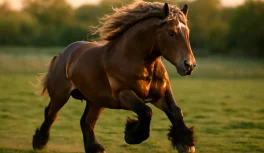
The colt was large, muscular, with an energy his handlers described as genuinely difficult to contain. He was not aggressive, but he was relentless — always moving, always alert. The exercise riders who worked with him during training quickly learned that they needed to tire him deliberately before races so the jockey could manage him at the gate.
Why Was Man o’ War So Hard to Hold Back?
The answer lies partly in biology. Man o’ War, like Secretariat decades later, reportedly had an exceptionally large heart — estimates placed it at around 20 to 22 pounds (9–10 kg), compared to the average 7 to 9 pounds (3.5–4 kg). The same anomaly, most likely transmitted through the same genetic line.
A larger heart means more oxygen delivered to the muscles — but also more general energy, more vitality, less need for rest. Horses with this characteristic tend to be more restless, harder to manage outside the track, more resistant to fatigue. It is the price of biological exceptionalism.
The Races of 1919 and 1920
Man o’ War ran 10 races in 1919, as a two-year-old, and won 9. The single loss was Upset at Saratoga. In 1920, as a three-year-old, he ran 11 races and won all 11.
The 1920 victories included the Preakness Stakes and the Belmont Stakes — two of the three races of the Triple Crown. Man o’ War did not run the Kentucky Derby because Samuel Riddle chose not to enter him, considering the Derby too early in the season at that stage. It remains one of horse racing’s great unanswerable hypotheticals: what would have happened if Man o’ War had run the 1920 Kentucky Derby?
The winning margins in 1920 were in a category of their own. At the Belmont Stakes, he won by 20 lengths — breaking the track record. In a race called the Lawrence Realization Stakes, he finished with a reported 100-length margin over the second-place horse. One hundred lengths. That number is correctly written.
What Happened to Betting When Man o’ War Was in the Field?
A peculiar phenomenon emerged as Man o’ War began dominating the track with such absolute consistency: bettors stopped wagering on his opponents. The odds against his competition became so steep that many tracks simply refused to accept bets against Man o’ War — there was no financial logic in it.
In a match race against a single opponent named John P. Grier — at that point considered the second-best horse in the country — the odds on Man o’ War were 1 to 100. No bookmaker could cover a Grier victory at normal wagering proportions.
Man o’ War won by one and a half lengths, in one of the most compelling races of his career. John P. Grier challenged him into the final stretch — and lost only because Man o’ War simply would not stop accelerating when the rival tried to pass.
Retirement and Life at Stud
Man o’ War was retired from racing in November 1920, at just three years old — a decision by Samuel Riddle that frustrated fans but that Riddle justified on grounds of the horse’s long-term wellbeing. He was installed at a farm in Lexington, Kentucky, where he spent the next 26 years at stud.
The stud years were extraordinarily productive. Man o’ War sired War Admiral, who won the 1937 American Triple Crown. He produced other sons and daughters who dominated American racing for decades. His influence on the modern Thoroughbred gene pool is profound — it is estimated that the majority of American Thoroughbreds carry Man o’ War somewhere in their pedigree.
Riddle’s farm became a destination. Man o’ War, who had learned to distinguish visitors from familiar handlers, was known to perform — turning in the pasture, displaying his extraordinary physique — when groups of people arrived. Period accounts suggest a certain awareness of his own celebrity, though exactly what he perceived remains, of course, unknowable.
Death and Legacy
Man o’ War died on November 1, 1947, of heart failure, at 30 years of age. More than a thousand people attended his funeral, which was broadcast live on radio — the first live radio broadcast of a horse’s funeral in American history.
He was buried in a mahogany casket at Faraway Farm, where he had spent nearly his entire life. His remains were later moved to the Kentucky Horse Park in Lexington, where a monument marks his grave to this day.
The question of who was greater — Man o’ War or Secretariat — is one of racing’s permanently unresolved debates. They ran in different eras, under different conditions, with different timing technology. What can be said with reasonable confidence is that both represented the outer limit of what a Thoroughbred can do. And that those limits, set by two horses separated by half a century, have not yet been surpassed.