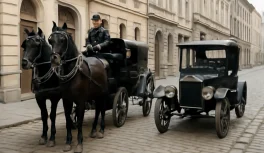
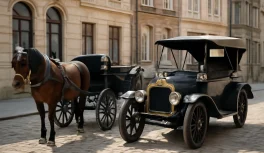
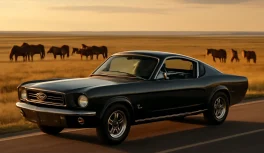
Between 1880 and 1930, in a period of just fifty years, the oldest world humanity had known — one in which movement depended on animals — was replaced by a world of engines. The transition was faster, more violent, and more ambiguous than history usually tells. And its effects on horses were, at the same time, devastating and paradoxically liberating.
The Collapse of an Entire Economy
How large was the equine industry before the automobile replaced it?
To understand the magnitude of the change, you have to understand the size of the world that was replaced. At the end of the nineteenth century, the equine industry was one of the largest economies in the Western world.
In 1900, New York had more than 100,000 horses. London, similar numbers. Berlin, Paris, São Paulo, Buenos Aires — every major city in the industrialized world depended on horses for almost everything: urban transportation, goods delivery, garbage collection, mail service, fire departments, police, construction.
Who were the workers who lost their jobs when cars arrived?
The supply chain that sustained those animals was enormous. Blacksmiths, harness makers, carriage manufacturers, hay and oat sellers, veterinarians specializing in draft animals, professional coachmen — estimates suggest that in a city like New York in the early twentieth century, roughly one in ten people worked in some activity directly related to horses.
When the automobile arrived, this economy entered a gradual but relentless collapse.
The Speed of the Transformation
In how many years did New York’s horse population fall from 130,000 to 2,000?
What surprises historians is how quickly the substitution happened, especially in cities. In New York, the number of horses fell from 130,000 in 1900 to fewer than 56,000 in 1912. To 2,000 by 1920. The drop was vertiginous.
Carriage companies tried to adapt. Some became automobile companies. Studebaker, founded as a carriage maker in 1852, was one of the first to make this transition — and became a respected automaker through the 1960s. The Fisher Body Company, which built carriage bodies, was acquired by General Motors in 1926.
Which carriage companies managed to adapt and become automobile manufacturers?
Other companies simply disappeared. Leather harness makers, carriage metalwork polishers, importers of Dutch draft horses — entire markets evaporated within a generation.
The Fate of the Working Horse
What happened to draft horses when the automobile eliminated their economic function?
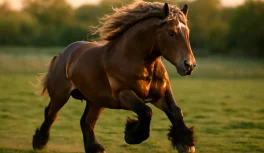
For the animals, the transition was dramatic. Draft horses — large, robust animals bred specifically to pull loads in cities — suddenly had no function. Demand collapsed. Sale prices fell through the floor.
Breeders who had spent decades selecting genetic lines for the endurance and temperament suited to urban work watched the market vanish. Auctions that had once drawn dozens of buyers had few interested parties, and prices fell with every new season.
How many working horses were slaughtered during the automotive transition in the US?
For horses that could not be sold, the fate was frequently slaughter. Estimates suggest that between 1900 and 1920 in the United States alone, millions of working horses were put down simply because they no longer had economic utility. It is an obscure chapter in the history of the automotive transition — rarely mentioned in the enthusiastic accounts of technological progress.
In World War I, horses were conscripted en masse for the military effort in terrible conditions. More than 8 million horses are estimated to have died in the conflict. When the war ended, those that survived returned to a world in which cavalry was already being replaced by tanks and trucks.
The Breeds That Survived — and Those That Did Not
Why did Shire horses nearly disappear while racehorses thrived in the 20th century?
Not all horse breeds passed through the transition equally. Heavy draft breeds — the great Clydesdales, Shires, Percherons, and Brabants that had moved the industrial world — suffered dramatic population declines. In the United Kingdom, the Shire horse population fell from around one million at the start of the twentieth century to fewer than 5,000 by the 1950s. The breed nearly disappeared.
Racehorses and sport horses suffered less — their economic function did not depend on physical labor and was not replaced by motors. Racetracks continued operating, polo and equestrian sport maintained their audiences, and horse racing betting actually grew during the twentieth century rather than declining.
In which regions of the world were working farm horses still common in the 1960s?
Rural working horses — for plowing fields and transporting harvests in areas without adequate roads — remained relevant for decades beyond the urban substitution. In parts of Europe and the Americas, working draft horses were common into the 1950s and 1960s, and in some regions they remain so today.
The Unexpected Revival
Did the automobile free horses from compulsory work and allow them to become more valuable?
The deepest irony of the transition was its long-term outcome: by freeing horses from compulsory labor, the automobile allowed them to become something more valuable and more noble.
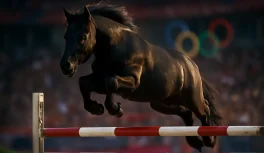
When the horse ceased to be a tool, it became a partner. Equestrian sport exploded in the twentieth century. Show jumping was included in the Olympic Games in 1900 and has never left. Polo gained international glamour. Dressage became a recognized performing art worldwide. New sports such as endurance riding, reining, and cutting attracted entire communities.
Why is a high-performance Lusitano today worth more than any draft horse of the 19th century?
Today’s horse market measures its value not in load carried or distance covered — but in genetic lineage, titles won, beauty and temperament. A high-performance Lusitano for dressage or an elite thoroughbred racer commands sums that no draft horse of the nineteenth century could have imagined.
Equine-assisted therapy — which uses the relationship between humans and horses for therapeutic purposes — has become a recognized medical field, benefiting people with autism, cerebral palsy, physical disabilities, and emotional disorders. The horse found a function that no automobile could ever fill.
What Was Lost, What Was Gained
What did cities lose when they traded the rhythm of horses for the speed of motors?
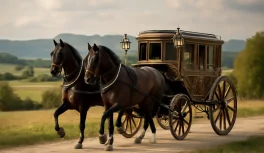
The carriage era ended, and with it, an entire way of life. The pace of cities was different when the fastest available was a horse’s stride. The quiet of the streets — compared to the noise of engines — was different. The relationship between human and vehicle was different: a horse responds, a car does not.
What does the survival of horses through the automotive transition say about the bond between species?
What was gained was obvious: speed, capacity, range, freedom from daily care. A car doesn’t need to be fed when not in use. It doesn’t get sick. It has no temperament.
What was lost is harder to name. The coexistence between humans and powerful animals at the heart of cities. The generalized ability to handle horses — which was once as common as driving is today. The measured slowness, the biological rhythm that imposed a less frenetic timescale.
The transition was irreversible. But the fact that horses survived it — and thrive, on their own terms — says something about the nature of the relationship between the two species. It was never purely utilitarian. It never had been.