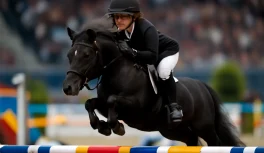
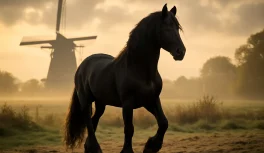
There was something strange about that small black horse. Son of a mediocre trotter and an unqualified Thoroughbred mare, Jappeloup didn’t inspire confidence at first glance. He was nervous, impetuous, difficult to handle — an animal that tested any rider’s limits. The specialists who evaluated him in the early 1980s saw no champion material. Pierre Durand did.
The story of Jappeloup the horse is one of the most moving in show jumping history. Not because it was smooth or predictable — it was exactly the opposite. It was a story of public humiliation, painful restarts, and a partnership forged in failure and perfected through mutual faith. And it culminated in one of the most unforgettable moments in Olympic history, at the 1988 Seoul Games.
Who Was Jappeloup?
Jappeloup was born in 1975 in France. He was a small horse — unusual in top-level show jumping, where taller horses typically have an advantage over vertical obstacles. His coat was black, his build unassuming. What drew attention wasn’t conventional beauty, but an almost supernatural capacity to jump.
Descended from the trotter Tyrol and a Thoroughbred (PSI) mare, Jappeloup inherited the worst of both in temperament and the best of both in athleticism. He was the kind of horse that challenged his rider every training session — and rewarded those with patience and long-term vision.
Pierre Durand was one of those riders.
Pierre Durand: The Man Who Bet Everything
Born in Bordeaux, Pierre Durand grew up in an environment where equestrian sport was not merely a hobby — it was a family passion. After studying law, he was on his way to a solid legal career when he made a decision few understood at the time: he abandoned the law and committed entirely to show jumping.
The support of his father, Roger Durand, was decisive. In a world that valued safe bets, Roger believed in his son — and, by extension, in the strange black horse Pierre had chosen as his competitive partner. That family bond would become one of the central themes of the film released decades later.
The partnership between Durand and Jappeloup lasted ten years. And, like every great partnership, it was tested in ways that could have ended everything before it began.
Los Angeles 1984: The Catastrophe That Became Fuel
The 1984 Los Angeles Olympics were a turning point — but not initially a positive one. The American hosts had built courses intentionally suited to their more agile horses, at the expense of the European horses with greater power. For Jappeloup, the layout was incomprehensible.
The result was one of the most embarrassing moments of Pierre Durand’s career: Jappeloup, disoriented by a course he couldn’t read, threw his rider into a water obstacle and bolted around the arena looking for an exit. The scene went around the world. The French press was merciless — the performance was called a “national catastrophe.” The pair finished in a distant 14th place.
For many riders, that would have been the end. For Durand, it was the beginning of deeper work.
The Turning Point: Nelson Pessoa and Rediscovered Harmony
After Los Angeles, Pierre Durand sought guidance. He found it in an unlikely source for European standards of the time: a Brazilian named Nelson Pessoa.
Pessoa was — and remains — a living legend of world show jumping. A rider of refined technique with a surgical eye for detail in the horse-rider relationship, he identified Durand’s problem with precision: there was too much force in the interventions, too little harmony in the whole.
The advice was simple and transformative. Pessoa suggested that Durand ride with more lightness, more fluidity — that he trust the horse more and intervene less. That he build partnership rather than control.
What followed was work on two fronts: technical, with concrete changes to Durand’s riding, and mental, with psychological preparation to overcome the trauma of Los Angeles. The rider needed to be as ready as the horse.
Seoul 1988: When Perfection Happens
Four years after the humiliation of Los Angeles, Pierre Durand and Jappeloup entered the Olympic arena in Seoul as gold medal contenders. What the crowd witnessed that day was not merely a show jumping round. It was a demonstration of partnership between two beings who had learned to understand each other at a level almost impossible to describe.
Looking at the obstacles, spectators saw only a pair of ears. The horse appeared too small, too slight to clear those barriers. And then — as if obeying a physics of its own — Jappeloup sailed over each obstacle with the ease of complete comprehension. No difficulty. No errors. A clean, harmonious, breathtaking round.
The gold medal was won. The French team celebrated. Pierre Durand wept. The world of show jumping gained one of its greatest icons.
During that same Olympic cycle, the pair had also won the World Championship (1987) and the European title — building a dominance that placed Jappeloup among the greatest show jumpers in history.
The Retirement Beneath the Eiffel Tower
Champions deserve a farewell worthy of their career. Jappeloup received his in one of the world’s most iconic settings: at the foot of the Eiffel Tower in Paris.
At the retirement ceremony, Pierre Durand spoke words that sum up what that partnership was: “With Jappeloup I won many victories over ten years. I learned to respect him — I did much more than that, I cherished him as the best and most loyal friend. A union so noble and close that we ended up defeating our fears and doubts together.”
It isn’t common for riders to speak of their horses in that vocabulary. But Jappeloup was not a common horse, and Pierre Durand was not an ordinary rider. Those words, spoken beneath the Eiffel Tower, were entirely fitting.
Death and Eternal Legacy
Jappeloup lived 16 years. In 1991, he was found dead in his stall after a cardiac arrest — quick, without prolonged suffering, as the greats tend to go. He had fulfilled the mission for which he was made, even if no one knew it at the start.
His legacy did not disappear with him. His statue was installed in the gardens of the Olympic Museum (Musée Olympique) of the International Olympic Committee in Lausanne, Switzerland — an honor reserved for very few horses in Olympic sports history. He stands there still, motionless but eternal, as a symbol of what the partnership between human and animal can achieve when trust replaces control.
In 2013, French cinema immortalized the story in a film of the same name, directed by Christian Duguay and starring Guillaume Canet as Pierre Durand and Daniel Auteuil as father Roger. Over 1.6 million viewers watched the film in its first four weeks in France — a number that speaks to the place Jappeloup still holds in the collective memory of a nation.
Why Jappeloup Still Matters
In a sport dominated by large horses, impeccable bloodlines, and stratospheric prices, Jappeloup was an anomaly. He was small, had a difficult temperament, and inherited questionable genetics. Yet he reached the top — not despite those characteristics, but in part because of them. That nervous, impetuous temperament was the same quality that made his jump explosive and precise.
The story of Jappeloup reminds us that raw talent needs a partnership of equal quality to become achievement. Pierre Durand could have given up after Los Angeles. Nelson Pessoa could have ignored a disoriented rider. Roger Durand could have convinced his son to return to law.
None of them did that. And the result stands cast in bronze in the gardens of Lausanne.