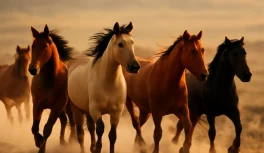
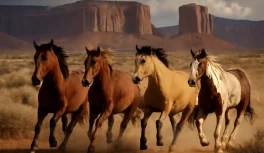
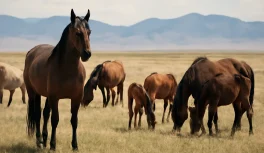
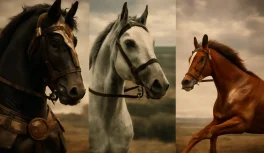
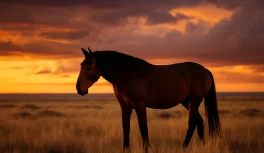
Australia has no ancient history with horses. Before 1788, when the First Fleet arrived on the continent’s eastern coast with seven horses aboard, there wasn’t a single equine animal anywhere on the land — wild or domestic. In less than two and a half centuries, a continent that evolved without horses came to hold the largest population of feral horses in the world: more than 400,000 Brumbies spread across grasslands, mountain ranges, and deserts their hooves had never previously touched.
It is one of the most complex stories in modern ecology, and it doesn’t have a tidy ending.
How Did the Brumby Come to Be?
The word “brumby” has uncertain origins. The most popular theory connects it to James Brumby, a soldier who arrived in Australia in 1791 and left horses behind when he relocated to Tasmania. Other etymologies point to a word from the Pitjantjatjara language — baroomby, meaning “wild” — or to an archaic English term for an ownerless animal.
Whatever the word’s origin, the process it describes was the same across Australia’s colonial history: horses escaped from stations, others were deliberately released when demand fell after wars ended or motor vehicles arrived, and feral populations established themselves in remote regions where the severe climate — droughts, floods, alpine cold — eliminated the weakest animals and toughened the survivors.
The breeds that fed into the Brumby’s genetic makeup are diverse: Thoroughbred, Arabian, light draft English breeds, Percheron, and others depending on the era and region. The result is an animal with no defined breed standard but with remarkable genetic diversity and an adaptive resilience that impresses ecologists who study them.
Where Do Brumbies Live in Australia?
Populations are distributed across four main regions:
Northern Territory — the largest concentration, with estimates exceeding 200,000 animals. The terrain ranges from tropical savannas to sandy plains and arid regions near Uluru.
Kosciuszko — the Snowy Mountains — the most controversial population, with roughly 10,000 to 20,000 horses in Australia’s only true alpine national park. This is where the conservation debate runs hottest.
Queensland — especially the arid southwest and the state’s interior.
Western Australia — smaller, scattered populations across the interior.
The Real Ecological Impact
Australia evolved over millions of years without large hard-hooved herbivores. The kangaroos, wombats, and other marsupials that dominate native fauna have very different feet — and as a result, the continent’s soils, vegetation, and water systems never developed the capacity to absorb the kind of pressure that horses generate.
Horse hooves compact soil, block the regeneration of native plants, and accelerate erosion on hillsides. In wetlands and along riverbanks — critical habitats for biodiversity in dry climates — horses trample and destroy riparian vegetation in ways the local ecosystem has no mechanism to repair.
In the Kosciuszko alpine region, researchers have documented the destruction of high-altitude peat bogs that took thousands of years to form. These are fragile ecosystems that store water, filter nutrients, and support endemic species found nowhere else on the planet.
Do Brumbies Compete with Native Wildlife?
Competition for resources is real, but complex. In open pastoral areas where kangaroos, wallabies, and feral cattle, buffalo, camels, and donkeys also roam, it’s difficult to isolate the specific impact of horses. In alpine areas, however, where native fauna is more specialized and more vulnerable, studies show direct pressure on species such as the mountain pygmy possum (Burramys parvus) — an endangered marsupial that depends on the same peat bog ecosystems that horse hooves destroy.
The Cultural and Emotional Weight
For many Australians — particularly those from the country’s interior — a Brumby is not an ecological problem. It’s a national symbol. The image of wild horses galloping through the outback is deeply embedded in Australian cultural identity.
The poem “The Man from Snowy River” by Banjo Paterson (1890) immortalized the rider who descended the alpine slopes to recapture a colt that had fled to join a Brumby mob. It’s one of the most beloved works in Australian literature, and it spawned two wildly successful films. That emotional inheritance is genuine and powerful.
This creates an uncomfortable paradox: researchers who document genuine ecological damage routinely face intense emotional backlash when they propose management interventions. In 2018, the New South Wales Parliament passed legislation protecting Kosciuszko’s Brumbies — to the outrage of the scientific community, which viewed the move as political interference in a technical conservation question.
The Population Management Debate
Every available management option is unpopular for different reasons:
Aerial culling — the most efficient method at scale, but emotionally unacceptable to much of the public and politically impossible in many contexts.
Removal and adoption — functional at limited scale. There are well-established programs for capturing and retraining Brumbies for recreational riding. Horses that go through this process are consistently described as intelligent, tough, and willing. But the scale of the feral population is wildly incompatible with the demand for adoptions.
Fertility control — immunocontraception using PZP (porcine zona pellucida, a contraceptive vaccine for mares) works in small, accessible populations but is practically impossible to implement at scale across Australia’s remote interior.
No intervention — what some horse advocates propose, on the grounds that the ecosystem will adapt. The science does not support this position for ecologically sensitive areas like the alpine zones.
Is There a Fair Solution to the Brumby Problem?
The honest answer is: not one that will satisfy everyone. This debate is not between people who love horses and people who love nature. It’s between different value systems, different forms of belonging to a land, and competing understandings of what “native” means on a continent colonized by Europeans less than 250 years ago.
What science does indicate clearly is that the absence of management in ecologically sensitive areas — like the alpine slopes of Kosciuszko — carries real costs for species and ecosystems that have no voice in the political negotiations.
The Brumby as a Cultural Mirror
Few animals reveal as much about a society as the Australian Brumby. Embedded in its story are colonization, landscape transformation, the conflict between productive land use and conservation, and the difficulty of separating cultural identity from the ecological consequences of historical choices.
Loving them and managing them are not mutually exclusive options. But looking away from what hundreds of thousands of horses do to Australia’s mountain ecosystems is a choice that future generations will inherit — along with the horses still galloping through them.