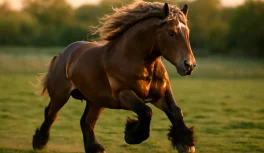
On June 9, 1973, as the television commentators at Belmont Park in New York had already run out of words, Secretariat crossed the finish line 31 lengths ahead of the second-place horse. Thirty-one lengths. In a mile-and-a-half race (2,400 meters), the runner-up was so far back he appeared to be competing in a different event entirely.
The official time: 2 minutes and 24 seconds. No horse has ever covered that distance faster. More than fifty years later, the record stands.
But what makes Secretariat a phenomenon that transcends horse racing is how that race unfolded — and what was found inside the animal after his death.
How Did Secretariat Run That Race?
Most elite racehorses start fast and hold their pace, or begin more conservatively and accelerate at the end. Secretariat did something different — something that, even in the language of sports analytics, remains difficult to explain: he got faster with every furlong.
First quarter-mile: 25.2 seconds. Second: 24.0 seconds. Third: 23.8 seconds. Fourth: 23.0 seconds. Fifth and final: 23.0 seconds. Any athlete — human or animal — typically slows as fatigue sets in. Secretariat was accelerating while the field decelerated.
By the time he hit the final stretch, he was not merely winning. He was pulling away, alone, apparently in a different dimension of the race. The American television broadcaster delivered the line that entered sporting history: “He is moving like a tremendous machine.”
What Explains How Secretariat Could Run Like That?
A partial answer came after his death in 1989 at the age of 19. The necropsy revealed that his heart weighed approximately 22 pounds (roughly 10 kilograms) — reports famously estimated this at nearly three times the average equine heart weight of around 7 to 9 pounds (3.5–4 kg). A hypertrophy so extreme that the veterinarians who performed the examination initially questioned their own measurement.
A larger heart means a greater capacity to pump oxygenated blood to the muscles. In plain terms: Secretariat had an engine larger than any other horse on documented record. It was not training, nutrition, or jockey skill alone — it was a biological anomaly that made him genetically superior for that specific task.
The same anomaly had been identified in Eclipse, an 18th-century English Thoroughbred considered the founding sire of nearly the entire modern racing lineage. Eclipse’s heart was also reportedly abnormally large. There is a theory — not yet fully proven — that a gene linked to the X chromosome transmits enlarged heart size through the maternal line in Thoroughbreds. Secretariat, by that account, inherited the variant.
The 1973 Triple Crown
The Belmont Stakes was the third race of the Triple Crown — the three most prestigious events in American horse racing, held across five weeks. Before Belmont, Secretariat had already won the Kentucky Derby and the Preakness Stakes, making him a candidate to complete the Triple Crown, which no horse had achieved since 1948.
At the Kentucky Derby, he ran 1¼ miles (roughly 2,000 meters) in 1 minute and 59.4 seconds — a record that also still stands. At the Preakness Stakes, 1 3/16 miles (roughly 1,900 meters) in 1 minute and 53 seconds — another record. In each of the three races of the 1973 Triple Crown, Secretariat set a track record. No horse in the history of the Triple Crown has done that across all three events.
The achievement earned him simultaneous covers of Time and Newsweek in the same week — a distinction typically reserved for presidents and geopolitical crises. In a country still scarred by the Vietnam War and the Watergate scandal, Secretariat became a symbol of something pure and absolute: perfection within its own terms, without moral ambiguity.
What Sets Secretariat Apart from Other Champions?
Champions exist in every sport, in every era. What makes Secretariat singular is that his records — especially at Belmont — were not broken by a narrow margin and then forgotten. They have simply remained, through five decades, while training methods, nutrition science, veterinary medicine, and equine genetics have all advanced considerably.
In human track and field, world records fall regularly, sometimes by fractions of a second. In American horse racing, Secretariat’s 1973 marks are still there, untouched. That suggests he was not merely the best of his generation — he was possibly the best of any generation, at least in that specific set of events.
Secretariat’s Early Life
Secretariat was born on March 30, 1970, in Doswell, Virginia, at Meadow Stable. He was a chestnut colt — a reddish bay — with three white stockings and a star on his forehead. His sire was Bold Ruler, one of the most influential Thoroughbred stallions in 20th-century American racing. His dam was Somethingroyal.
From early on, his physical development drew attention. As he began training for races, clockers noticed times that did not seem normal. His trainer, Lucien Laurin, and his owner, Penny Chenery, recognized they had something unusual — but the full scale of the talent would only become clear with the races themselves.
How Many Races Did Secretariat Run?
Secretariat competed in 21 races, between July 1972 and October 1973. He won 16. The five races he did not win carry their own asterisks — in two of them there were irregularities that resulted in the disqualification of the winner or protests resolved in various ways.
In his final race, the Canadian International Stakes, he won comfortably and was retired to stud duty, where he remained until 1989. As a sire, he produced talented offspring, but none who came close to his records. The extraordinary heart does not appear to have been passed on.
What 50 Years of Legacy Looks Like
In the five decades since the 1973 Triple Crown, Secretariat has become a cultural figure that extends far beyond horse racing. He inspired a 2010 biographical film, numerous books, documentaries, and songs. His name is used as a reference point for any athletic performance that seems to exist beyond the limits of its own kind.
At the National Museum of Racing and Hall of Fame in Saratoga Springs, New York, he has his own gallery. His photographs — especially the sequence from the Belmont stretch run, with the horse alone, small in the frame yet completely dominating it — have become iconic images of American sport.
What Secretariat represents is not only speed. It is the idea that, occasionally, a living creature is born with capacities so far outside the normal range that it appears to challenge the rules governing its own species. It is a visual, physical, and chronometric argument that the exception exists.
And it ran in 2 minutes and 24 seconds.