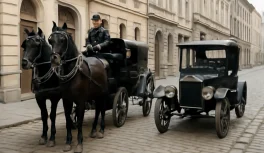
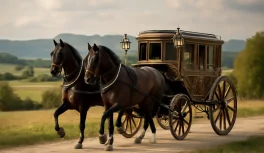
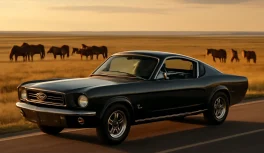
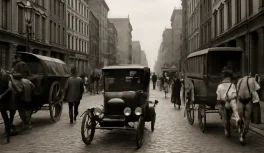
There is an elegant paradox at the birth of the automobile: the vehicle created to replace horses was, in every practical sense, shaped by them. The wheel width, the chassis length, the name it was called in its early years — everything carried the mark of the animals the car would eventually retire. To understand how cars became what they are, you have to go back to the time when the world still ran on hooves.
The Carriage That Learned to Walk on Its Own
What did the first automobile directly inherit from the design of carriages?
When Karl Benz presented the Motorwagen in 1886 and Gottlieb Daimler patented his internal combustion engine that same year, neither man was inventing something from scratch. They were, in practical terms, replacing one component of an already existing system: the biological engine with a mechanical one.
The chassis of the first commercial automobile was directly derived from contemporary carriages. The wheels were the same — wooden rim with iron hoop. The suspension followed the leaf spring principles used in berlinas and stagecoaches. Even the driver’s position replicated that of the coachman: elevated, with a wide forward view, hands ready to steer.
Why were the first cars called ‘horseless carriages’ everywhere in the world?
The name the public gave the new invention confirmed this heritage: in English, the automobile was called a “horseless carriage.” In French, “voiture sans chevaux.” In German, “Motorwagen” — a direct combination of motor and Wagen (wagon). The horse had disappeared from the equation, but the carriage remained plainly visible in the vocabulary.
Roads Built for Hooves
What kind of vehicles were the first paved roads built for?
The infrastructure the first automobiles inherited from horses went far beyond vehicle design. The very roads were built for hooves, not tires.
In the early nineteenth century, Scottish engineer John Loudon McAdam developed what we now call macadam paving — a technique of compacting layers of broken stone to create surfaces resistant to the impact of horseshoes. The goal was to support the weight of horses and iron carriage wheels, not gasoline engines.
When the first automobiles began to circulate, they found these roads perfectly adequate at moderate speeds. The problem appeared when cars got faster: the loose stones, sufficient for horses, became projectiles under high-speed wheels. Asphalt paving emerged as the solution — but the layout of roads, their width and their routes, remained largely inherited from the equine era.
Why do the street widths of New York and São Paulo still reflect decisions from the equine era?
The standard width of urban roads in many historic cities of Europe and the Americas corresponds exactly to the space needed for two carriages to pass side by side. Streets like New York’s Fifth Avenue or São Paulo’s Avenida Paulista have dimensions that reflect urban planning decisions made when traffic was measured in horses per hour, not cars.
The Steering Wheel Learned from the Reins
Why was the circular steering wheel so quickly adopted in early automobiles?
The automobile’s steering mechanics owe a profound debt to the art of guiding horses. The first Benz used a tiller — but the transition to the circular steering wheel happened quickly, and for an intuitive reason: anyone who knew how to guide horses with reins understood instinctively the principle of turning a circle to change direction.
Alfred Vacheron was the first to use a steering wheel in a motor race, at the Paris-Rouen rally of 1894. The idea was adopted by the industry within a few years because it solved an ergonomic problem — but also because it was familiar. The generation that drove the first cars had grown up with reins in their hands.
How do car pedals correspond to a coachman’s reins and spurs?
The brake pedal replaced the voice command that stopped trained horses. The accelerator replaced the spurs. The clutch, the pause before departure. The vocabulary was different, but the body grammar of control was recognizable to any carriage coachman.
Stables Became Garages
How were horse stables converted into the world’s first garages?
The most silent transformation happened in the physical spaces of cities. Stables — structures designed to house horses, store equipment, and keep hay — were, quite literally, the first garages in the world.
In London, Paris, and American cities, when carriage owners acquired their first automobiles, the car simply occupied the space that had belonged to the horse. Stables were adapted: floors were sealed for oil, walls gained tool shelves instead of saddle racks. Water troughs were deactivated. Horseshoe rails were replaced with rubber wheel stops.
How many stables were converted to garages in New York between 1900 and 1920?
It is estimated that in New York, between 1900 and 1920, more than 50,000 stables were converted into garages — a silent urban transformation carried out not with demolitions and construction, but with pragmatic adaptations of spaces that already existed.
The Blacksmith Became a Mechanic
How did blacksmiths from the equine era become the first automobile mechanics?
The supply chain that sustained the carriage era was vast and specialized. Blacksmiths, harness makers, carriage manufacturers, hay and oat sellers, veterinarians specializing in draft animals — an entire economy orbited around maintaining urban horses.
This chain did not disappear overnight. It transformed. Blacksmiths, accustomed to working metal under heat and pressure, were among the first to adapt their skills to automobile maintenance. The logic was the same: identify what is broken, work the material to fix it, test before returning it to the client.
Were the first auto repair shops in Europe and the Americas converted blacksmith shops?
In many small towns across Europe and the Americas, the first auto repair shops were converted smithies. The name of the establishment changed, the sign out front was new — but the blacksmith was the same, and his muscle memory came from years of shoeing horses.
The Measurement That Outlasted Everything
How did James Watt create the horsepower unit and why is it still used today?
Nothing better illustrates the automotive industry’s equine inheritance than horsepower — the unit of power created by James Watt in the eighteenth century to compare the capacity of steam engines to the work that horses could perform.
Watt calculated that an average horse could move the equivalent of 33,000 foot-pounds per minute. When the first automakers needed to describe the power of their engines, the unit already existed and was universally understood.
Is the Bugatti Chiron’s 1,500 HP still measured by the same standard as the Benz Motorwagen?
The first Benz Motorwagen had less than 1 HP. A century and a half later, the Bugatti Chiron has more than 1,500 HP. The scale changed beyond recognition — but the ruler is still equine.
No engineer today literally believes a 400-horsepower engine could replace 400 real horses. The metaphor has lost its practical meaning but survived as convention. And there is something poetically fitting about that: on every spec sheet of every automobile in the world, horses are still present — invisible, immaterial, but fundamental to the count.