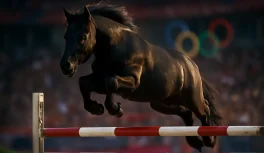
There is a photograph that became famous among equestrian sport fans: Pierre Durand and Jappeloup clearing an obstacle in Seoul, 1988, with the clean harmony of a pair that has overcome every barrier imaginable — including those no one else could see. But to understand what that image represents, it’s necessary to go back to the beginning. And the beginning is a young man from Bordeaux who chose horses over a legal career.
Pierre Durand is one of the most complete figures in 20th century show jumping. Not merely because he won an Olympic gold medal — though that alone would be remarkable — but because of how he won it. Through failure, reconstruction, and a decade-long partnership with an animal few believed in.
Bordeaux, Law, and a Decision Few Understood
Pierre Durand was born in Bordeaux, in southwestern France, in a family where equestrian sport was a genuine passion — not a social accessory or a weekend hobby, but a central part of family life. His father, Roger Durand, was a committed horseman who transmitted to his son not only the technical skills of riding but a vision of what the relationship between rider and horse could be when pursued with dedication.
After schooling, Durand enrolled to study law. He was progressing toward a stable legal career, the kind of path that makes families proud and provides financial security. But the pull of equestrian sport proved stronger than any professional calculation. At a point where most people would have prioritized the certain over the uncertain, Durand chose horses.
Few understood it at the time. The abandonment of law in favor of a full-time equestrian career — in the 1970s, before show jumping became the globally broadcast spectacle it is today — was, by any conventional standard, an eccentric choice.
Roger Durand, however, didn’t see it that way. His support for his son’s decision was unconditional. And that support would prove to be one of the decisive elements in Pierre Durand’s trajectory.
Jappeloup: The Horse Nobody Wanted
Jappeloup entered Pierre Durand’s life in the early 1980s. The horse was born in 1975, son of the trotter Tyrol and a Thoroughbred (PSI) mare — a pedigree that raised no expectations among specialists. He was small, had a nervous and impetuous temperament that made daily handling challenging, and didn’t fit the physical profile of the era’s great show jumping horses.
The equestrian world of the time valued large horses, powerful bloodlines, docile temperaments. Jappeloup had none of those qualities in the expected doses. What he had was something harder to identify on paper: an almost supernatural capacity to read obstacles, an explosive jump that compensated his small stature, and — underneath all the nervousness — a raw athletic quality that Pierre Durand identified before anyone else did.
The bet on Jappeloup was, by any conventional criterion, a bet against the odds. And that was precisely its nature.
Los Angeles 1984: The Humiliation That Changed Everything
The 1984 Los Angeles Olympics were the moment that could have ended Pierre Durand’s career before it ever reached its peak.
The American organizers had built courses designed for their more agile horses, disadvantaging the larger, more powerful European horses. For Jappeloup — already nervous by nature and placed in an unfamiliar competitive environment — the result was catastrophic.
During the team competition, Jappeloup threw his rider at a water obstacle and bolted around the arena looking for an exit. The scene went around the world. The French equestrian press was merciless. The performance was called a “national catastrophe,” and the pair finished in a distant 14th place in the individual competition.
For many riders, that level of public humiliation would have been the end. The sensible choice would have been to find a different horse, or accept that the level wasn’t there.
Durand did neither. He went back to work.
Nelson Pessoa and the Rebuilding
After Los Angeles, Pierre Durand sought guidance. What he found was a Brazilian who, at that time, represented an unusual reference in the European equestrian world: Nelson Pessoa.
Pessoa was — and remains — one of the most technically refined riders in show jumping history. A horseman with a surgical eye for the detail of the horse-rider relationship, he saw with precision what was happening between Durand and Jappeloup: too much force, too little harmony. The rider was trying to control the horse’s nerves with greater intervention. The result was the opposite of what was intended — Jappeloup became more tense, not less.
Pessoa’s advice was, in its essence, simple: ride with more lightness. Trust the horse. Intervene less and communicate more. Build partnership instead of control.
The work that followed was dual. Technical: Durand fundamentally changed his riding — lighter aids, more fluid position, greater trust in Jappeloup’s natural reading of obstacles. Mental: the rider prepared psychologically to overcome the trauma of Los Angeles, to walk into an Olympic arena without carrying the weight of that failure.
It took four years. And when the time came, the transformation was complete.
Seoul 1988: Redemption in Gold
The 1988 Seoul Olympics were the stage Pierre Durand and Jappeloup had been building toward since the humiliation of Los Angeles. What they delivered that day was not merely a clean round — it was a demonstration of what a decade of partnership and four years of methodical reconstruction look like in practice.
Spectators watching the round saw something technically impeccable: a small black horse clearing every obstacle with the fluidity of an animal that understood exactly what was asked of it. No hesitation. No corrections at the last moment. No anxiety transmitted through the reins. Just two beings operating as a single unit.
The gold medal was won. It was France’s first individual show jumping gold in decades. Pierre Durand wept. The French press — the same that had called them a catastrophe four years earlier — acclaimed them as heroes.
In the same Olympic cycle, Durand and Jappeloup had also won the World Championship (1987) and the European title, confirming a dominance that positioned the pair among the greatest in show jumping history.
The Retirement and Words That Define a Partnership
After the 1988 gold, the partnership continued for a few more competitive seasons before Jappeloup’s retirement was announced. The ceremony took place in one of the most symbolic settings imaginable: beneath the Eiffel Tower in Paris.
It was there that Pierre Durand pronounced the words that sum up what that ten-year journey was:
“With Jappeloup I won many victories over ten years. I learned to respect him — I did much more than that, I cherished him as the best and most loyal friend. A union so noble and close that we ended up defeating our fears and doubts together.”
Those words are not the vocabulary of a rider describing a horse. They are the vocabulary of a man describing the most formative relationship of his life. And that distinction matters.
Legacy: Durand After Jappeloup
Jappeloup died in 1991 of a cardiac arrest. His statue was installed in the gardens of the Olympic Museum in Lausanne, Switzerland — one of very few horses to receive that honor.
Pierre Durand continued his career in equestrian sport — as a rider, trainer, and ambassador for show jumping in France. His legacy, however, was sealed the moment Jappeloup cleared the last obstacle in Seoul.
In 2013, French cinema gave their story a new audience. The film Jappeloup, directed by Christian Duguay with Guillaume Canet as Durand and Daniel Auteuil as father Roger, was watched by over 1.6 million viewers in its first four weeks in France. A number that speaks to the place that partnership still holds in French collective memory — and in the memory of all who love equestrian sport.
The story of Pierre Durand is, at its core, a story about what it costs to choose against convention, persist through failure, and discover that the partnership you built in the dark was always capable of performing brilliantly in the light.