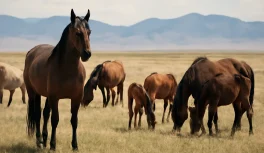
Every species that disappears takes more than a set of genes with it. It takes a behavior no one will ever witness again, a relationship with an ecosystem that existed for millennia, a story the Earth wrote across ages and that now closes its final chapter. In the case of wild horses, that risk is more concrete — and closer — than most people realize.
Przewalski’s horse reached zero in the wild in 1969. It took decades of coordinated international scientific effort to bring it back. Other populations are moving in troubling directions — and unlike Przewalski’s horse, some have no robust conservation programs capable of functioning as a safety net.
The Risk Map
The degree of risk varies significantly across populations. Some are recovering; others are in slow decline; some exist in numbers so small that any disturbance could be catastrophic.
Przewalski’s Horse (Equus ferus przewalskii): listed as Endangered by the IUCN. The wild population, reconstituted through reintroduction, now numbers approximately 800 animals distributed across Mongolia, China, and Kazakhstan. The dependence on continuous monitoring is absolute — without that vigilance, inbreeding problems and losses to predation or drought could reverse decades of progress quickly.
Marismeño Horse: one of Europe’s most vulnerable populations. It inhabits Doñana National Park in southern Spain — one of the largest nature reserves on the Iberian Peninsula. Numbers are small, estimated in the low hundreds, and the population is geographically isolated, limiting genetic exchange.
Pottoka: a primitive breed from the Basque Country, historically semi-wild in the mountains of the Cantabrian Cordillera. The decline of traditional high-altitude ranching practices is reducing populations. Some studies estimate fewer than 2,000 animals remain with genuine breed characteristics.
Sorraia (Portugal): a population in critical conservation status, with some researchers estimating fewer than 200 authentic individuals in the world.
Why Wild Horses Disappear
The causes of extinction or endangerment are rarely simple, and rarely involve a single culprit. In most cases, multiple pressures combine in ways that amplify each other.
Habitat Loss and Fragmentation
The most universal pressure is the shrinking of available territory. Pastureland that sustained equine populations for centuries has been converted to agriculture, urban development, or allocated to domestic livestock. On the Iberian Peninsula, for example, changes in land use patterns throughout the 20th century dramatically reduced the extensive grazing areas where breeds like the Pottoka and the Marismeño historically lived.
More insidious than simple area loss is fragmentation: when populations are divided by roads, fences, dams, or other human structures into small, isolated groups, genetic exchange between them stops. Over time, each fragment becomes more inbred and less capable of adapting to change.
Competition with Domestic Livestock
In virtually every region where wild or semi-wild horses exist, there is direct competition with cattle, goats, or sheep for grazing land. Domestic livestock generally holds the political and economic advantage — ranchers pay taxes, generate employment, produce food. Feral horses have no equivalent representation.
In practice, that means during severe droughts — increasingly common as climate patterns shift — livestock is protected and supplemented while wild equine populations suffer elevated mortality. In Doñana Park, exceptional droughts in recent years have caused significant losses among the Marismeño horses.
Inbreeding and Genetic Erosion
Small, isolated populations face a silent enemy: inbreeding. When the animals available for reproduction are all close relatives — because the founding population was small, or because fragmentation eliminated contact with other groups — crosses between relatives increase the frequency of deleterious recessive alleles and reduce immunological variability.
The long-term result is a population less resistant to disease, less capable of adapting to environmental change, and with higher rates of congenital abnormalities. For Przewalski’s horse, this was a real challenge during the captive decades — managed through the international studbook with great care, but never fully eliminated.
Diseases Transmitted by Domestic Horses
Contact with domestic horses carries specific risks for wild populations. Diseases such as equine infectious anemia, equine influenza, and equine herpesvirus are endemic in domestic populations but not necessarily in wild ones. When contact occurs — through fences that allow close proximity, shared water sources, or during capture and handling — new diseases can enter populations with no prior immunity.
For Przewalski’s horse, the reintroduction protocol includes quarantine and vaccination precisely for this reason. For less-monitored populations like the Pottoka or the Marismeño, the risk exists without equivalent protection.
Climate Change as an Amplifier
Global warming doesn’t directly threaten most wild horse populations — at least not in the short term. But it amplifies every other threat.
More intense and prolonged droughts reduce the availability of pasture and water. More erratic winters — with alternating thaw and refreeze cycles — make it harder to access pasture under snow. Extreme weather events, such as large-scale wildfires or severe floods, can decimate populations confined to geographically restricted areas.
For Przewalski’s horse on the Mongolian steppe, the dzud — a winter phenomenon in which thick snow blankets the pasture following a period of extreme cold — is a cyclically devastating threat. Researchers monitoring the population have documented losses of 20 to 30 percent of animals in particularly severe winters. As climate change makes dzud events more unpredictable, planning for them becomes harder.
In the Camargue, rising sea levels and changes in the delta’s flooding regime affect the availability of pasture and shift the balance between favorable and unfavorable habitat for the semi-wild horses.
What the Most Effective Conservation Programs Have in Common
Analysis of successful conservation programs — particularly that of Przewalski’s horse — identifies several consistent elements:
Studbook and active genetic management: maintaining a record of every individual and planning breeding to maximize genetic diversity.
International cooperation: no single country has sufficient resources or space to manage a species-level recovery alone. Collaboration among zoos, governments, and conservation organizations is indispensable.
Continuous monitoring: small populations require constant vigilance. Shifts in predation dynamics, disease outbreaks, or extreme weather events need rapid response.
Engagement of local communities: programs that ignore the interests and knowledge of the communities living alongside the target populations tend to generate conflict. The most effective ones integrate local knowledge, create economic benefits for communities — ecotourism, for example — and establish compensation mechanisms when conservation creates costs for ranchers and landowners.
What Is Being Done
The picture is not purely one of risk. Active efforts are underway on several fronts.
The Doñana program has invested in monitoring the Marismeño horses and in genetic studies that identified the need to introduce new individuals from outside the local population to reduce inbreeding. The discussion about where those animals would come from — and what genetic characteristics they would introduce — is still ongoing.
In Mongolia, organizations including the Przewalski’s Horse Reintroduction Foundation and the WWF maintain field monitoring programs, predator management in reintroduction zones, and outreach to nomadic communities to reduce conflict with cattle herders.
The Pottoka has found advocates in the Basque Country, where traditional breeder associations work to keep the breed in the mountains, and where the regional government recognizes the horse as part of the region’s cultural heritage.
Why Preserving What Remains Matters
There is a utilitarian argument for wild horse conservation: their genetic diversity may contain adaptations that domestic breeds lost centuries ago — resistance to pathogens, tolerance for extreme climates, hoof and digestive characteristics of value to ranchers in marginal regions.
There is an ecological argument: where wild horses have been part of an ecosystem for centuries, their removal has cascading effects on vegetation, on the predators that depend on them, and on the invertebrates that feed on their dung.
And there is a simpler argument, one that needs no tables or equations: some things are worth preserving simply because, once they are gone, they don’t come back. The silence that follows the extinction of a species is not filled by something else. It is only silence.