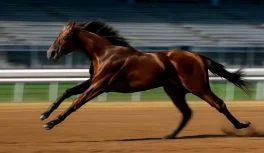
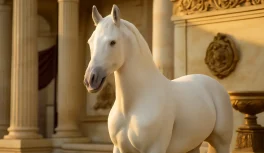
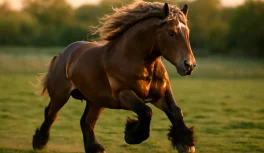
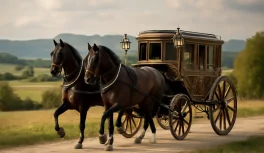
There is an image that repeats itself in royal and imperial portraits from cultures that share almost nothing else — separated by centuries, continents, and languages: the sovereign on horseback. Not standing. Not seated on a throne. On horseback. Louis XIV of France. Peter the Great of Russia. Frederick II of Prussia. Napoleon Bonaparte. Catherine the Great. All were depicted mounted, with an upright posture and a horse in an attitude of power or elegance.
The choice was not accidental. Riding well was considered one of the fundamental competencies of nobility — a skill that combined physical control, grace, courage, and authority. And some of the horses that carried these rulers became as famous as the rulers themselves.
The Horse as a Symbol of Sovereign Power
The association between horses and royal power predates European monarchy by millennia. In ancient Egypt, pharaohs were depicted in war chariots pulled by horses. In Assyria and Persia, horses were among the most valuable prizes of war — capturing an enemy’s horses meant capturing their capacity to make war.
In Imperial Rome, Caligula and Incitatus were the exception — but the norm was that victorious emperors and generals were celebrated in triumphal processions on white horses. White carried special meaning: purity, divine favor, the mark of divine selection. White or pale gray horses were preferred for public ceremonies of power throughout European history.
Why Were White Horses Associated with Royalty?
The preference for white horses in ceremonies of power has roots that go beyond aesthetics. In many European and Asian cultures, white was associated with the divine — and owning a quality white horse was, historically, far more difficult than owning horses of other colors, because pure white coats are genetically rare in horses.
A truly white horse — not light gray, but white with pink skin — is a biological rarity, produced by specific genes that result in the complete absence of pigmentation. For centuries, owning one of these animals was a demonstration of extraordinary resources: only those with access to the finest bloodlines and the ability to pay extraordinary prices could maintain quality white horses.
Louis XIV and the Horses of the Sun King
Louis XIV, the Sun King, transformed Versailles into not just a palace but a theater of power — and horses were a central element of that theater. The royal stables at Versailles, the Grande Écurie and the Petite Écurie, built by Jules Hardouin-Mansart in the late 17th century, were among the most elaborate buildings in the entire complex.
The Grande Écurie had capacity for 600 horses and 200 camels and other exotic animals. That number reveals the scale of the operation: maintaining a court the size of Versailles required hundreds of horses for transportation, royal hunts, military parades, equestrian performances, and the king’s carriages.
Louis XIV’s favorite horse for formal parades was always selected by a combination of temperament and appearance — the animal had to move with calculated elegance, endure crowds without panic, and have a conformation that complemented the king’s posture in official portraits.
What Was Royal Riding in the 17th Century?
The art of high-school equitation — what would today be called Olympic-level dressage — was considered the supreme expression of European nobility in the 17th century. The École de Versailles and the Spanish Riding School in Vienna, established in 1572, taught the movements of haute école: the levade, the courbette, the capriole — exercises in which the horse elevates from the ground with all four limbs, executing controlled leaps.
These movements had military origins — they were ways of training horses to trample or kick enemy soldiers on the battlefield. But at court, they became art. A sovereign who mastered equestrian art was considered better equipped to govern — control over the horse was a metaphor for control over the kingdom.
Peter the Great and the Horses of Russian Modernization
Peter I of Russia, who ruled from 1682 to 1725 and drove the transformation of Russia from a medieval power into a modern European state, had an intense relationship with horses that went well beyond symbolism.
Peter was physically enormous — standing between 6’8″ and 7′ (2.03–2.13 meters), an extraordinary height in any era — and needed especially large horses to be mounted with the proportional dignity that imperial portraits required. His height made riding look visually out of scale on ordinary horses.
The most famous horse associated with Peter is Lisette, a gray mare he rode in several battles of the Great Northern War (1700–1721), who survived him. Lisette was later taxidermied and is on display at the Hermitage Museum in St. Petersburg — one of the oldest preserved equine taxidermy specimens in Europe.
The famous bronze monument to Peter the Great in St. Petersburg — the “Bronze Horseman,” created by Étienne Maurice Falconet at the request of Catherine II — shows the tsar on a rearing horse above a serpent, the symbol of Russian resistance. The model for the statue was a stallion named Brillante, loaned by Count Orlov for the sculpting sessions.
Catherine the Great: The Empress Who Reorganized Russian Horse Breeding
Catherine II, who ruled Russia from 1762 to 1796, was one of the most influential figures in Russian equestrian history — not merely as a rider, but as an administrator of horse breeding on an imperial scale.
Catherine was a skilled horsewoman, having learned to ride in Germany before arriving in Russia as a princess. She rode regularly even after taking the throne — unusual for women of her station at the time.
Her interest extended well beyond personal riding. Catherine reorganized the imperial breeding farms, introducing Arabian and English Thoroughbred bloodlines to improve the quality of Russian horses, and created breeding regulations that influenced Russian livestock management for decades.
Catherine’s Coronation Horse — and the Story It Tells
Catherine’s coronation as empress in 1762 was surrounded by deliberate equestrian symbolism. She rode to the Senate in St. Petersburg dressed in the uniform of a male guard officer — an act that combined a claim to military authority with a demonstration of riding skill.
The horse she rode that day was a white animal, chosen for its symbolic color. The episode became part of the narrative of how Catherine constructed her image of power — not through the position of a conventional queen consort, but through the demonstration that she commanded as fully as any male sovereign.
The Lipizzaner: Horse of the Habsburg Monarchy
No breed is more closely associated with European royalty than the Lipizzaner, the white horse of the Spanish Riding School in Vienna. Originally bred for the Habsburgs in the 16th century at the stud farm of Lipizza (today in Slovenia), the Lipizzaner is a breed whose history is almost entirely inseparable from the history of one royal family.
Lipizzaners are born dark — black, bay, or brown — and gradually lighten through their first several years of life. Most become light gray or near-white by around six years of age. Occasionally a Lipizzaner is born that remains dark; by tradition, the Spanish Riding School always keeps at least one dark horse in the troupe, in honor of an old belief that the school’s good fortune depended on having a dark animal among the white ones.
The Spanish Riding School in Vienna has operated for more than 450 years without interruption — surviving two World Wars, the end of the Austro-Hungarian Empire, and multiple political upheavals. It is the equestrian institution with the longest continuous history in the world.
British Royal Horses: From Function to Symbol
The British monarchy maintains a relationship with horses that combines historical function with contemporary symbolism. The Royal Studs — the breeding farms of the British Royal Household — have existed in their modern form since the 17th century, and Queen Elizabeth II was one of the most influential figures in 20th-century British horse racing.
Trooping the Colour, the annual ceremony marking the British monarch’s official birthday, involves the sovereign mounted — or, in more recent years, in a carriage — in a parade that includes hundreds of horses from the Household Cavalry. It is one of the last military ceremonies in which horses regularly participate as a central element of state protocol.
These ceremonial horses must be trained not only in standard riding, but to tolerate crowds, marching band music, artillery salutes, and television cameras — all without showing signs of nervousness that would affect the solemnity of the event.
What Royal Horses Reveal About Power
Looking across the history of royal horses, one consistent pattern emerges: the animal chosen by a sovereign for public representation was always a deliberate political statement. Color, breed, bearing, behavior in public — all of it was calculated to transmit specific messages about the kind of power that ruler claimed.
A white horse saying “chosen by the gods.” A Lipizzaner in haute école saying “mastery of art and discipline.” A battle Arab saying “conqueror, not merely an heir.” A Thoroughbred racehorse saying “wealth and tradition.”
Royal horses were, in that sense, a language. A nonverbal idiom of power that functioned across cultures, centuries, and spoken languages — because the sight of a human being controlling a powerful animal has never needed translation.