Before the first combustion engine existed, before ABS brakes and paved highways, there were horses. They built cities, won wars, and connected continents. Then came the automobile — and what could have been a final separation turned out to be one of the most curious stories of continuity in human history.
Horses and automobiles are not opposing worlds. They are, in fact, deeply intertwined — in the units of measurement we use, in the names we give our vehicles, in the infrastructure of modern cities, and even in the way Hollywood tells stories. To understand cars, you need to understand horses. And to understand horses today, you cannot ignore the moment the engine changed everything.
When the World Ran on Four Hooves
Why were horses literally the engine of great cities before the automobile?
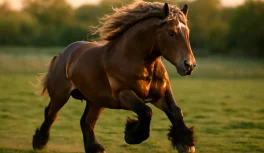
For millennia, the horse was the engine of the world. Not a metaphor — a reality. It pulled plows, carriages, cannons, and cargo. It moved armies and postal routes. It set the pace of cities, the width of streets, and the smell of urban mornings.
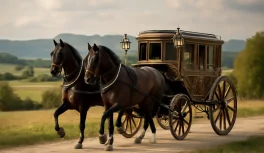
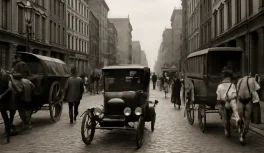
By the nineteenth century, in the world’s great cities — London, Paris, New York, São Paulo — traffic was literally equine. New York is estimated to have had more than 100,000 horses in circulation at the height of the carriage era. The manure produced by that many animals was a serious urban problem, discussed at municipal planning conferences. The city we know today was shaped, in large part, to accommodate horses.
How were 19th-century cities designed to accommodate horses?
Streets wide enough for two carriages to pass side by side. Pavements strong enough to bear the weight of horses and iron wheels. Public water troughs strategically placed throughout. Stables, blacksmiths, hay suppliers — an entire invisible supply chain kept urban life moving.
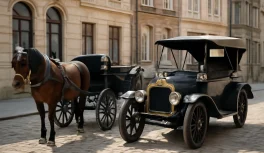
When Karl Benz registered his Motorwagen in 1886 and the first automobiles began circulating on European streets, they were called, in a particularly unflattering way, “horseless carriages.” The name said a great deal about how that society saw the novelty: as an absence, not a presence.
The Inheritance the Car Never Returned
Why did horsepower survive the extinction of the carriage and reach electric cars?
What is most fascinating about this transition is what the automobile chose to inherit from horses — not out of nostalgia, but out of practical necessity.
James Watt, the Scottish engineer who improved the steam engine in the eighteenth century, needed to convince mine owners to invest in his machines. To do so, he created a comparison that any worker of the era understood: the work a horse could do in an hour. And so “horsepower” was born. The unit survived the extinction of the carriage, crossed an entire century of technological evolution, and still appears on every automobile spec sheet in the world today.
The steering wheel also carries the memory of horses. The curvature angle and directional response of the first automobiles were calibrated to mimic the intuitive feel of guiding reins — the same sensation any coachman had mastered. Building something entirely new was hard; building something that felt like what people already knew how to do was genius.
Were modern roads designed for horses or for automobiles?
Even paved roads have equine origins. The standard gauge of North American railway tracks — 4 feet 8.5 inches — was inherited from British carriages, which were themselves shaped by the wheel spacing of Roman wagons, designed for two horses side by side. A decision made two thousand years ago still defined the dimensions of modern vehicles.
The Names We Never Forgot
Why does the auto industry use horse names more than any other animal?
No industry has honored horses more explicitly than the automotive world. Mustang, Bronco, Colt, Pinto, Maverick — Ford built an entire lineup of models with equine names. Dodge chose the Colt and the Charger. Porsche picked the rearing horse as its emblem, inspired by the coat of arms of Stuttgart, a city whose name in old German literally means “horse stud farm.”
This is not coincidence. It is a deliberate emotional strategy. Horses carry centuries of powerful associations: speed, freedom, nobility, raw force controlled by skilled hands. When a marketing engineer names a car “Mustang,” they are borrowing all of that accumulated symbolic capital.
What did the Ford Mustang represent to a generation that had never ridden a horse?
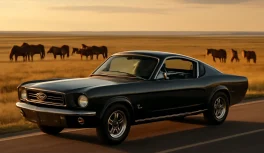
The Ford Mustang, launched in 1964, became the best-selling car in North American history in its first year on the market. The name evoked the prairies, the Wild West, the American spirit of freedom. It was a metal horse for a generation that had never ridden one.
The Moment the Two Worlds Met Head-On
What laws did cities create to manage the coexistence of horses and automobiles?
In the first decades of the twentieth century, there was a fascinating period when horses and automobiles shared the same streets — and not peacefully. Cars frightened horses. Horses slowed down cars. Cities needed new rules to manage this unlikely coexistence.
In several American and European cities, laws were passed requiring automobiles to stop and shut off their engines when a horse approached. In some places, someone was required to walk ahead of the vehicle waving a red flag to warn the animals. The horse was still the reference point — the car, the intruder.
Did the formal horse-vs-car race at the 1900 Paris Exposition change anything?
The race between the two worlds was also literal. In the 1890s and early 1900s, formal contests were organized comparing the speed of horses and automobiles. Results were inconsistent: in short distances, horses won; on longer routes, motors prevailed. The stakes were high — not just money, but the prestige of an entire era.
In 1900, at the Paris World Exhibition, a De Dion-Bouton automobile completed 83 km in just over an hour — a speed impossible for any animal. The result was not celebrated enthusiastically. It was received with a mixture of admiration and mourning. The world knew something was ending.
What Remained
Why did horses survive the automobile by migrating to sport and therapy?
The carriage era ended within a few decades. World War I accelerated the process: motorized armies replaced traditional cavalry, and the automotive industry emerged from the conflict larger and more capable than it entered. In cities, stables became garages. Blacksmiths became mechanics. Draft horse breeders watched their primary revenue source evaporate.
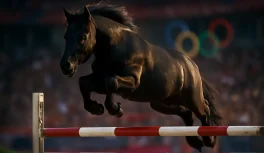
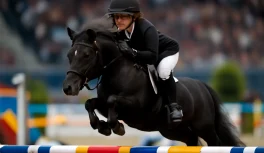
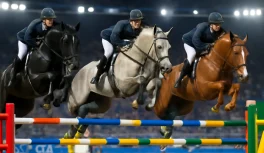
But horses did not disappear. They adapted. They migrated from utilitarian transport to sport, leisure, therapy, and culture. Equestrian sport became Olympic. Polo gained international prestige. Riding transformed into art — dressage, show jumping, endurance racing.
How much is the global equestrian market worth today?
Today, the global equestrian market generates tens of billions of dollars annually. Not because horses are needed for transportation — but because, once freed from that function, they revealed dimensions no automobile can replace: the connection between species, the silent language between rider and animal, the sensation of being on something alive.
A Story Still Being Written
Why are the Tesla and Porsche Taycan still rated in horsepower?
There is a gentle irony in the fact that, while electric vehicles promise to finally break from fossil fuels, the unit we use to describe their power still honors horses. The most powerful Tesla is sold in horsepower. So is the Porsche Taycan. The equine legacy persists even at the frontier of technology.
Was the encounter between horses and cars a substitution or a transmission?
Horses and cars crossed paths at a unique moment in history and came out of the encounter transformed. The automobile borrowed the language, the symbolic heritage, and even the routes of the horse. Horses, in turn, were freed from utilitarian servitude and found a nobler role — as partners, not tools.
The history of these two worlds is not a story of replacement. It is a story of transmission — of how one era hands the baton to the next, and what it chooses to leave behind.