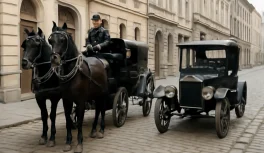
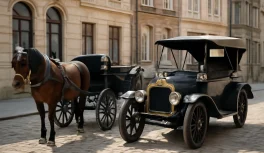
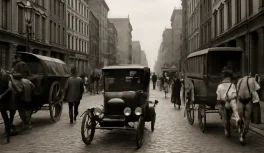
Before the train, the airplane, or the automobile, there was the carriage — and with it, an entire civilization organized around the speed of horses. For centuries, the carriage was the ultimate symbol of mobility, status, and power. Kings used it to demonstrate greatness. Explorers depended on it to cross continents. Doctors were summoned in it before the ambulance existed. The history of the carriage is, in large part, the history of the modern world in motion.
When the Carriage Reigned
Where does the word ‘carriage’ come from and how did it spread to so many languages?
The sprung carriage appeared in the fifteenth century in the town of Kocs, in Hungary — and was so revolutionary that its name gave rise to the word for this vehicle in dozens of languages. The Hungarian “kocsi” became “coach” in English, “Kutsche” in German, “coche” in Spanish. A Hungarian town gave its name to an object that would cross centuries.
What distinguished the carriage from the simple carts that preceded it was suspension — the mechanism that isolated passengers from the irregularities of the terrain. Early versions used leather straps attached to the chassis; later, metal leaf springs replaced the straps. The effect was the same: transforming a grueling journey into something tolerable, especially for the nobility who could not — or would not — ride.
Why was owning a carriage the ultimate status symbol in 18th-century Europe?
The rapid and intense adoption of the carriage among European aristocracy followed immediately. To measure a family’s wealth, one looked at the stable: how many horses it kept, how many carriages it maintained, whether the animals were of good breeding. In eighteenth-century London, maintaining a private carriage cost the equivalent of years of a common worker’s wages. It was a luxury deliberately kept out of reach.
The Types That Shaped the World
What was the difference between a berlina, a stagecoach, and a cabriolet?
The word “carriage” is an umbrella term for dozens of distinct vehicle types. Each with a specific design, horse count, passenger capacity, and social function.
The berlina was the sedan equivalent of its day: enclosed, elegant, with glass windows and room for four passengers. It was the vehicle of aristocratic families for urban travel. The stagecoach, by contrast, was the public transportation vehicle par excellence — large, robust, capable of carrying mail and passengers over distances of hundreds of kilometers, generating the first systems of regular intercity transport in history.
The cabriolet was light, open, and fast — the sports car of the era, drawn by a single horse and driven by its owner. The phaeton was more sophisticated: open, four-wheeled, drawn by two horses, with an elevated driver’s position for better visibility. For everyday use, there was the tilbury, the coupé, the barouche.
Was the 19th-century carriage industry as sophisticated as the automotive industry today?
The variety reflected a mature market capable of meeting each need and each income level with a specific product. The European carriage industry of the nineteenth century was equivalent, in sophistication, to today’s automotive industry.
The Stagecoach and the Conquest of Territory
How did the Royal Mail Coach connect entire cities in 18th-century Britain?
If the berlina was the vehicle of the court, the stagecoach was the vehicle of the world. Before trains, stagecoaches were the most reliable and organized long-distance transportation system the world had known.
In England, the Royal Mail Coach connected entire cities starting in 1784. At its peak in 1836, more than 700 mail stagecoaches traveled British roads daily, each drawn by four horses changed every 15–20 km at specialized stops known as coaching inns. The entire system was so well organized that a letter could travel from London to Birmingham — 100 miles — in under 11 hours.
What was the 24-day stagecoach journey from St. Louis to San Francisco like?
In the United States, the stagecoach was the connective thread of the West. The Butterfield Overland Mail, founded in 1857, operated a 2,800-mile route between St. Louis, Missouri, and San Francisco, California — a journey of 24 days under normal conditions, subject to attacks, river crossings, and roads that barely existed. Passengers slept sitting up, ate with the vehicle in motion, and arrived at their destination with aches that lasted weeks. But they arrived.
The Invisible Infrastructure
What were coaching inns and why do so many still exist today as hotels and gas stations?
For the carriage system to function, far more was needed than animals and vehicles. It required a specialized infrastructure that shaped the physical landscape of cities and roads.
Coaching inns were mandatory stopping points. They offered horse changes, meals, accommodation, and emergency repairs. On busy roads in eighteenth-century England and France, there were inns every 10–12 miles. Many survived the carriage era: converted into hotels, restaurants, or gas stations, they still occupy today the strategic locations chosen two centuries ago to serve tired horses.
How often did a stagecoach horse need to be shod, and what did that mean for blacksmiths?
The blacksmiths who kept horses shod were central figures in any community. A draft horse’s shoes lasted an average of 300–375 miles on normal roads — less on rocky terrain. A horse pulling stagecoaches needed regular shoeing, and the blacksmiths along the main routes had a guaranteed steady stream of work.
The End of an Era
Were railroads what began to end the stagecoach even before the automobile arrived?
The arrival of railways, from the 1830s onward, began eroding the stagecoach’s dominance on long-distance routes. Trains were faster, cheaper, and more comfortable for intercity travel. Stagecoaches retreated to where the rails had not yet reached — and this resistance lasted decades.
The final blow came not from the train, but from the automobile. Between 1880 and 1920, in just 40 years, carriages went from dominant technology to rarity. The process was faster in cities than in the countryside, faster in Europe than in Africa and Asia, faster among the wealthy than among the poor.
In how many years did Central Park carriages go from hundreds to a tourist curiosity?
In 1910, Central Park in New York was still traversed daily by hundreds of carriages. By 1920, dozens. By 1930, they were a tourist curiosity.
Today, carriages appear at events, royal weddings, historic parks, and parades. They are a deliberate symbol of an elegant past — an aesthetic choice, not a practical necessity. The wheel turned. And with it, an entire world.