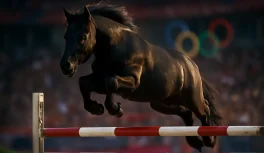
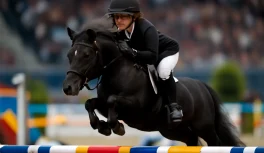
Olympic show jumping has produced, over decades, partnerships between rider and horse that transcend sport and enter the collective memory of world athletics. Famous show jumping horses are remembered not only for the titles they won, but for the stories they built — clean rounds in impossible moments, distinctive personalities, and the bond with the humans who rode them.
Jappeloup is perhaps the most famous of them all. But he is not alone in that pantheon of extraordinary animals.
What Makes a Show Jumping Horse Legendary?
Before presenting the horses, it is worth understanding what sets them apart. Show jumping places horse and rider before courses with obstacles reaching 1.60m in height and considerable width — in jump-off rounds, horses jump at speed and precision, and any misjudgment results in penalties.
To become legendary, a show jumping horse must combine rare physical and psychological qualities:
- Jumping technique: good bascule (back arc), correct limb folding, precise reading of the distance to the obstacle
- Courage: approaching enormous obstacles without hesitation, especially under competitive pressure
- Consistency: maintaining high performance across seasons and different course types
- Partnership with the rider: capacity to communicate and compensate for occasional human errors
- Personality: the most famous horses have strong character — sometimes difficult, but always distinctive
Jappeloup (France, 1975–1991)
There is no talking about famous show jumping horses without starting with Jappeloup. The small French black stallion, ridden by Pierre Durand, is a unique case in the history of the sport: world champion in 1987 and Olympic champion at Seoul 1988, he reached the top despite carrying characteristics that would discourage any rational investor.
His below-average stature, nervous temperament, and modest pedigree made his triumphs all the more extraordinary. The Olympic gold at Seoul — won with a perfect round after the humiliation of Los Angeles 1984 — is considered one of the most emotionally powerful moments in Olympic show jumping history.
Jappeloup’s statue stands in the gardens of the IOC’s Musée Olympique in Lausanne, Switzerland — an honor reserved for very few horses.
Milton (Great Britain, 1977–1999)
Milton is probably the most beloved show jumping horse in British history. A Hanoverian Cremello stallion — with an almost white coat — ridden primarily by John Whitaker, he became the first horse in history to win more than one million pounds sterling in prize money.
What made Milton special was the combination of extraordinary natural talent with a charismatic personality that captivated audiences wherever he appeared. He was consistent, courageous, and technically impeccable — virtues that earned him multiple titles on the European circuits during the 1980s and early 1990s.
John Whitaker described Milton as “the greatest gift equestrian sport ever gave me.” That sentiment was shared by every audience that had ever watched him jump.
Hickstead (Canada, 1999–2011)
Hickstead was one of the most dramatic horses in the recent history of show jumping. The Hanoverian stallion, ridden by Canadian Eric Lamaze, won Olympic gold at the Beijing 2008 Games — and died suddenly during the Verona Derby competition in Italy in 2011, after a jumping round.
Hickstead’s death was broadcast live and provoked worldwide grief. Lamaze collapsed on the track beside his horse. The image captured something beyond sport: the depth of the bond formed between an athlete and their equine partner.
Hickstead had a strong personality, a powerful jump, and a consistency that few horses of his generation could match. His Olympic gold at Beijing is remembered as one of the most beautiful moments of Games marked by great performances.
Gem Twist (United States, 1979–2006)
At the 1988 Seoul Olympics — the same Games where Jappeloup won gold — Gem Twist was the horse who stood out most for sheer talent. Ridden by American Greg Best, the Thoroughbred stallion took individual silver and was part of the American team that won team silver.
Gem Twist was a rarity at the time: a Thoroughbred in elite show jumping, during an era when German and Dutch warmbloods dominated the courses. His jumping technique was considered near-perfect by specialists, and his elegance in the arena influenced sport horse breeders for decades.
Ratina Z (Belgium/Netherlands, 1983–2022)
Ratina Z, the KWPN mare ridden by Dutch rider Piet Raijmakers and later by German Ludger Beerbaum, is one of the most eloquent examples of longevity at elite show jumping level.
Beerbaum won the individual Olympic title with Ratina Z at the Barcelona 1992 Games, in one of the most tense jump-offs in the history of the Games. The mare was known for her explosive jump, her courage before imposing obstacles, and a regularity that kept her competitive for years.
What Qualities Define the Great Olympic Horses?
Examining the history of the most famous horses in Olympic show jumping, certain patterns emerge. None of them became champions through breed or pedigree alone. All combined physical talent with strong personality and, above all, with a human partner who could see and cultivate the best in them.
The great show jumping horses almost always have strong personality — sometimes difficult, like Jappeloup, or charismatic like Milton. They are rarely passive or expressionless animals. It is as if the same intensity that made them challenging in training was the fuel that made them extraordinary in competition.
This places the rider in a crucial position: not as the tamer of an animal, but as the partner of an athlete. The distinction seems subtle, but it changes everything — in the approach to training, in building trust, and ultimately in performance on course.
The Future of Legendary Show Jumping Horses
Contemporary show jumping continues to produce exceptional partnerships. Names like Explosion W (ridden by Ben Maher), Caretino (of Christian Ahlmann), and Luciana (of Kent Farrington) are candidates to one day occupy this pantheon of horses who defined generations.
What the future will say about these partnerships depends, as always, on far more than physical talent. It depends on time, on trust built patience by patience, and on a mutual understanding that no breeder, trainer, or technology can manufacture.
Jappeloup, Milton, Hickstead — they all remind us of this. What makes a horse legendary is not only what it jumps. It is everything that happens between the jumps.