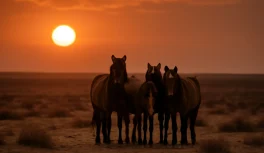
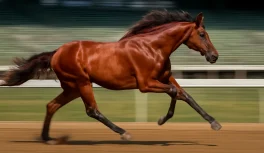
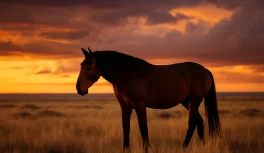
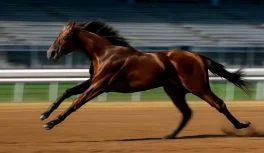
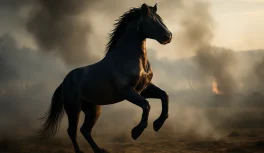
There is an invisible line separating two worlds. On one side stands the horse raised by humans — born in a stall, vaccinated on schedule, fitted with shoes and fed a calculated diet, accustomed to human presence as something normal, sometimes pleasant, rarely threatening. On the other side stands the horse that grew up without any of that mediation — one that learned from its herd where to find water in a dry season, how to catch the scent of a predator before ever seeing it, and that treats humans the way it treats any other unknown threat: with extreme caution, or immediate flight.
Feral horses — technically called ferals — inhabit that second world. And the way they got there says a great deal about the long, complicated history between horses and people.
What Exactly Is a Feral Horse?
A feral horse is a descendant of domestic horses that has returned to a free-living state. It may be an animal that escaped, one that was intentionally released, or one born into an already-established free-ranging herd. The distinction between a feral horse and a truly wild horse — like Przewalski’s horse — is fundamental: the feral carries domestication in its DNA.
That doesn’t make it any less impressive or capable. Over generations, feral horses develop behaviors, abilities, and even physical characteristics that bring them functionally close to animals that were never tamed. But the processes are different. Przewalski’s horse never lost its wild nature; the Mustang, the Brumby, and the Camargue horse reclaimed a nature that had been, at least partially, domesticated away.
How Long Does It Take for a Domestic Horse to Become Truly Feral?
The answer isn’t simple — it depends on several factors: the age at which the animal was released, the conditions of the environment, and the presence of other feral horses to model behavior from.
A foal born into a feral herd has its behavior shaped entirely by the wild environment from day one. A domestic adult turned loose takes far longer to adapt — and may never fully do so. Research on established feral populations shows that three to four generations of completely free-ranging life already produce measurable behavioral differences compared to domestic horses.
The process isn’t irreversible in the other direction, either. Feral horses captured young can be trained successfully — and often prove exceptional, with superior physical endurance and strong motivation for tasks that require problem-solving.
The World’s Major Feral Populations
Dozens of feral populations exist across every inhabited continent today. Some are widely known; others live in relative scientific obscurity.
Mustang (North America) — the most famous of all, with an estimated 60,000 to 80,000 animals across the American West. They descend primarily from Spanish horses of the 16th century, with later contributions from various European breeds. Genotype and morphology vary considerably from region to region.
Brumby (Australia) — more than 400,000 animals, the largest concentration of feral horses on the planet. The genetic diversity is enormous, reflecting the many breeds introduced during centuries of British colonization.
Cimarrón (South America) — feral populations exist across several regions, especially in the Venezuelan and Colombian Llanos, the Argentine and Uruguayan Pampas, and parts of Brazil. In Venezuela, they are commonly called caballos cimarrones.
Camargue (France) — technically semi-feral, with minimal human oversight, these are the most “managed” feral horses in Europe.
Sorraia (Portugal) — a small but genetically interesting population found in the basin of the Sor and Raia rivers in interior Portugal. Whether to classify them as “feral” or a “preserved primitive breed” is debated — some researchers argue they represent a genetic lineage with distinct characteristics predating modern domestic breeds.
Island Mustangs (USA) — populations on barrier islands along the East Coast, such as Chincoteague and Assateague, have their own distinct histories. The annual Pony Penning at Chincoteague — where horses are swum from one island to another for a foal auction — is a folk tradition that draws thousands of visitors every year.
How Feral Herds Are Organized
The social structure of feral horses is remarkably consistent across populations of different origins and geographies — a consistency that suggests these behaviors are deeply embedded in equine biology.
The basic unit is the band: one adult stallion, several mares (anywhere from 2 to 12, depending on resource availability), and foals of various ages. The stallion is not necessarily the leader of day-to-day movements — that role typically falls to the dominant mare, usually the oldest and most experienced female in the group. She knows the routes, the water sources, the seasonal grazing grounds.
Young males, upon reaching one to two years of age, are gradually pushed out by the stallion — who perceives them as potential rivals — and join bachelor bands. In these groups, young males learn the social and combat behaviors they’ll need to eventually win mares of their own.
What Behavioral Research Reveals About Feral Horses
The most detailed behavioral studies of feral populations — many conducted with Mustang herds in Nevada and Wyoming — have revealed levels of social and cognitive sophistication that surprised researchers. Feral horses demonstrate:
- Long-term spatial memory: herds remember seasonal water sources used years earlier, even when they haven’t traveled that route regularly.
- Individual recognition: horses recognize herd members after separations of months, using primarily scent and vocalization.
- Social learning: foals learn feeding behaviors and predator-avoidance strategies by observing adult mares.
- Non-violent conflict resolution: the vast majority of conflicts within herds are resolved through body language — posture, facial expression, subtle movement — without physical contact.
Ferals in Ecosystems That Never Knew Them
The most sensitive question in the debate over feral horses is ecological: what happens when large herbivores appear in ecosystems that didn’t evolve with them?
In regions where horses or their ancestors were present before prehistoric extinctions — such as North America and parts of Asia — the introduction of ferals can be framed as a form of ecological restoration. Ecologists known as “rewilders” argue that Mustangs, for example, fill roles that extinct herbivores filled for millennia: shaping vegetation, creating trails other animals use, and enriching the soil through their carcasses.
In regions like Australia, where there were no wild or domestic horses before 1788, that argument doesn’t hold. The ecological impact there is real, and the debate is harder.
The most interesting intermediate case is New Zealand, where feral horses known as Kaimanawa inhabit the Kaimanawa Plateau in the center of the North Island. The New Zealand debate over how to manage that population closely mirrors the Australian one: charismatic animals of colonial heritage versus ecosystems that never knew them.
What Genetic Studies Are Telling Us
DNA analysis of feral populations has proven valuable both for conservation and for equine history. Genomic studies of American Mustangs have identified contributions from Iberian breeds — Andalusian and Lusitano among them — confirming the colonial Spanish origin, but also traces of British and North American breeds introduced later.
In some isolated Mustang populations — particularly in Utah’s Sulphur Springs range — researchers have identified an unusually high proportion of genetic characteristics associated with ancient Iberian breeds, likely preserved by geographic isolation. These animals are being studied as a possible window into 16th-century Spanish horse breeds before centuries of artificial selection changed them.
Feral horses are not merely a management challenge. They are living genetic archives — libraries of variability that modern selective breeding has been slowly erasing from domestic breeds.