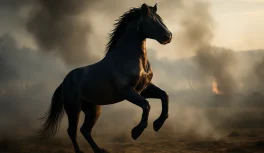
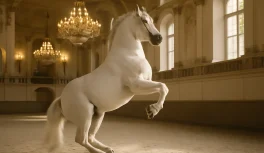
It was June 18, 1815. At Waterloo, in present-day Belgium, two of the greatest commanders of the Napoleonic era met in a battle that would determine the future of Europe. Napoleon Bonaparte, Emperor of France, rode a 15-year-old gray Arab named Marengo. Facing him, Arthur Wellesley, the Duke of Wellington, sat astride a chestnut stallion named Copenhagen. Both horses had seen more war than most of the men who surrounded them — and that day, they carried their riders through the longest and most decisive hours of their lives.
At the end of it, Copenhagen went home with his owner. Marengo was captured by the enemy. Their stories, so different in almost every respect, show how exceptional horses become symbols of the causes they carry.
Marengo: The Arab Who Survived Three Decades of War
The name Marengo comes from the Battle of Marengo in 1800, where Napoleon defeated the Austrian army in northern Italy in one of the most dramatic tactical reversals of his career. The horse who bore that name had arrived in the imperial stable as a pale gray Egyptian Arab — part of a group of animals imported during the Egyptian Campaign of 1798 or 1799.
Arab horses were prized by European armies for the same reasons breeders in the Middle East had cultivated them for centuries: extraordinary endurance, the capacity to maintain pace on long marches with less water and feed than other breeds, and an active but manageable temperament. Marengo had all of those qualities — and more.
Why Did Napoleon Prefer Marengo Over Other Horses?
Napoleon was a capable but not exceptional rider — he acknowledged this himself. What he demanded from his horses was reliability and stamina, not brilliance. Marengo offered both.
The emperor was known for riding horses to the point of exhaustion, dismounting and remounting repeatedly during long campaigns, and switching animals when necessary. But Marengo was the horse with whom he built his longest and best-documented relationship — the Arab survived the battles of Austerlitz (1805), Jena (1806), Wagram (1809), and Waterloo (1815), along with countless smaller engagements.
By some accounts, Marengo was wounded at least eight times in battle and survived every time. The animal’s resilience became part of his legend — an Arab who carried the man who nearly conquered Europe across the most intense battlefields of the modern era.
Marengo’s Fate After Waterloo
When Wellington’s forces broke the French line in the late afternoon of June 18 and Napoleon fled the battlefield, Marengo was left behind. The horse was captured by the British — a considerable prize of war.
Taken to England, he was acquired by a British officer, General Angerstein, who kept him as a living piece of history. Marengo spent the rest of his life in England, dying in 1831 at around 38 years of age — a remarkable longevity that attested to the toughness of the Arab breed.
His hooves were preserved as relics. Two of them are on display at the National Army Museum in London. A third was fashioned into a snuff box — one of the most macabre and fascinating artifacts of the Napoleonic era.
Copenhagen: The Adversary Who Outlasted Him
Copenhagen, Wellington’s horse at Waterloo, had a different origin story. He was a 15-year-old chestnut Thoroughbred that day, bred for speed — his maternal grandmother was a horse also named Copenhagen, winner of the 1801 Epsom Derby, whose name he inherited. An animal built for speed and stamina, with the pedigree of Britain’s finest racing lines.
Wellington acquired Copenhagen during the Peninsular Campaign and developed a genuine affection for him. The horse was known for a quality rare in battle animals: the ability to maintain energy and focus across extraordinarily long days without showing signs of collapse.
How Long Did Wellington Ride Copenhagen at Waterloo?
At Waterloo, Wellington rode Copenhagen for more than sixteen hours — from dawn until well after sunset. Sixteen hours in a battle of extreme intensity, moving between positions, galloping between regiments, staying in constant motion while the battle resolved itself around him.
At the end, when the duke finally dismounted, Copenhagen kicked sharply into the air — a gesture Wellington himself interpreted as the horse finally expressing what he had endured in silence throughout the entire day. According to contemporary accounts, the duke embraced the horse’s neck and wept.
Copenhagen lived to 28, retired to Wellington’s estate at Stratfield Saye in Hampshire. When he died in 1836, Wellington ordered him buried with full military honors. A gravestone in the garden of the property remains there to this day.
What the Comparison Between the Two Reveals
Marengo and Copenhagen were animals of entirely different breeds and origins — the enduring Arab from the East against the swift Thoroughbred of the British racing tradition. The military philosophies of their owners differed just as sharply: Napoleon was the tactical genius who bet on bold maneuver and speed of decision; Wellington was the master of defensive position and patience.
Notably, the postwar fates of both horses seem to mirror the fates of their riders. Napoleon was exiled to Saint Helena, where he died. Marengo was taken to England as a trophy. Wellington returned home in power, and Copenhagen spent his final years in the comfortable pastures of his estate.
Did the Two Horses Actually Meet at Waterloo?
There is no historical record indicating that Marengo and Copenhagen were close enough for their riders to have seen each other directly that day. Wellington held his position in the Allied defensive lines; Napoleon observed portions of the battle from further back. But both animals were present on that roughly four-square-mile (ten square kilometer) field where the fate of Europe was decided in less than twelve hours.
The idea of the two horses as the silent protagonists of Waterloo became part of how the battle is imagined — captured in paintings, books, and historical discussions ever since. It is a humanizing angle — or more precisely, an animal one — for a confrontation that conventional historical narrative tends to tell in terms of strategy and troop counts.
Why These Stories Persist
Two hundred years after Waterloo, Marengo’s hooves are in a museum in London and Copenhagen’s grave is in a garden in Hampshire. That material persistence — physical objects that connect the present to a moment of historical transformation — is part of what makes these horses fascinating beyond their own stories.
They are not simply animals who were present at an important event. They are witnesses to human experience at its most extreme: war, power, defeat, survival. And they endured, in different ways, to attest to all of it.