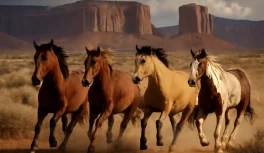
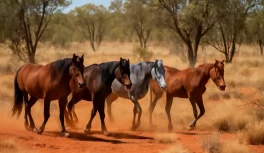
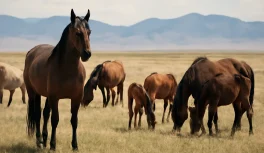
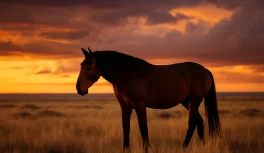
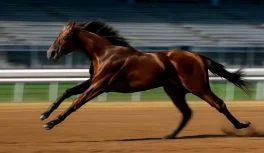
There’s a moment that stops you cold the first time you witness it — a herd of wild horses in full gallop. It isn’t just the speed, or the dust they kick up as they pass. It’s the feeling of standing before something the modern world tried to erase and failed. Wild horses exist on every inhabited continent, thriving in landscapes as different as the steppes of Mongolia, the marshes of the Camargue, and the high desert of the American West. Every population tells a different story of survival, and all of them share one thing in common: they held on.
But what exactly is a wild horse? The answer is more complicated than it might seem — and reaches far beyond what most people assume.
What Makes a Horse Truly Wild?
The most important distinction in the equine world is the one between horses that are genuinely wild and horses that are feral. The first category covers animals whose lineage has never been domesticated at any point. The second refers to descendants of domestic horses that — through abandonment, escape, or deliberate release — returned to living without human oversight.
In the world today, only one population of genuinely wild horses exists: Equus ferus przewalskii, known as Przewalski’s horse, native to the steppes of Central Asia. Every other population commonly called “wild” — the American Mustang, the Australian Brumby, the horses of the Camargue — is technically feral, meaning descended from once-domesticated animals that readapted their behavior to a life without humans.
That distinction matters scientifically, but in practice it does little to change the experience of watching them: these are animals that live by nature’s rules, form herds with their own hierarchy, raise their young without human intervention, and face predators, droughts, and brutal winters entirely on their own terms.
The World’s Most Iconic Populations
The Mustang: An American Symbol That Came from Europe
No image of wild horses is more recognizable than the Mustang racing across the American West. The irony is that these horses aren’t native to the continent — they descend from horses brought over by the Spanish in the 16th century, animals that spread across the territory over the course of centuries.
Today, an estimated 60,000 to 80,000 Mustangs roam free across the western states, primarily Nevada, Wyoming, and Montana. They’ve been protected under the Wild Free-Roaming Horses and Burros Act since 1971, but the management of their populations remains one of the most fiercely contested debates in American environmental policy — a tug-of-war between conservationists, ranchers, and federal agencies that shows no signs of resolution.
Przewalski’s Horse: The Unlikely Survivor
If the Mustang is the most famous wild horse in the world, Przewalski’s horse is the most extraordinary. Declared extinct in the wild in 1969 — when the last wild individual was spotted in the Gobi Desert — the species survived only because European zoos had maintained the last remaining bloodlines in captivity.
The turnaround began in the 1990s, when groups of animals were reintroduced to the steppes of Mongolia, China, and Kazakhstan. Today, more than 2,000 individuals exist worldwide, with around 800 living in the wild. It stands as one of the most successful recovery stories in the history of modern conservation.
The Brumby: Australia’s Contentious Wild Horse
Australia had no horses before European colonization. The first arrived with the British in 1788, and over the centuries that followed, many escaped or were turned loose — building feral populations that now number over 400,000 animals. That makes Australia home to the largest concentration of feral horses on the planet.
Brumbies are beautiful, resilient, and fascinating — but they represent a genuine ecological challenge for Australian ecosystems that never evolved alongside large hard-hooved herbivores. The debate over how to manage these populations is among the most politically charged conservation issues on the continent.
The Camargue: White Ghosts of the Marshes
In the delta of the Rhône River, in southern France, lives one of Europe’s oldest equine populations. Camargue horses are small, sturdy, and inevitably white in adulthood — they’re born dark and lighten as they age. They inhabit a world of saltwater marshes, biting winds, and shifting light that has shaped an exceptionally tough breed over thousands of years.
References to these horses go back to antiquity. Today they are semi-wild: they live freely across the delta, but are monitored by traditional horsemen called gardians, and some are put to work managing local cattle herds.
How Wild Herds Live
What Is the Social Structure of a Wild Herd?
A typical wild horse herd revolves around one dominant stallion — a mature male — along with three to ten mares and their foals. The stallion is responsible for protecting the group and for breeding, but he isn’t necessarily the one who decides where the herd moves. That role typically falls to the oldest mare, who knows the best water sources, the richest grazing grounds, and the fastest escape routes.
Young males who reach maturity are driven out by the dominant stallion and form bachelor bands until they’re ready to challenge a herd stallion of their own and claim their own mares.
Communication within the herd is sophisticated: body posture, ear position, vocalization, and even facial expressions convey messages that determine who eats first, who stays alert, and who gets to rest.
Wild Horses and Conservation
Wild horse populations occupy a nuanced position in the environmental debate. In regions where they are native or historically established — such as Central Asia — they serve a real ecological function as grazers that shape vegetation and support predators like wolves and mountain lions. In places where they are relatively recent introductions — like Australia — they can compete with native species for food and habitat.
Which Wild Horse Populations Are at Risk?
Przewalski’s horse remains in a vulnerable position, with every wild population dependent on continuous monitoring. The Camargue horses face growing pressure from tourism and climate change, which is altering the flood cycles of the delta. The Marismeño horses of Spain, which inhabit the marshes of Doñana National Park, live in a protected area, but their population remains small and isolated.
The American Mustang faces a paradox all its own: at risk from overpopulation in some areas, threatened with culling in others — a contradiction that captures the full complexity of managing animals that straddle the line between the wild and the symbolic.
Why They Captivate Us
Wild horses carry something that goes beyond biology. These are animals that, despite millennia of living alongside humans, found their way back to freedom — and that resonates with something deep in anyone who watches them. They represent the possibility of existing outside the structures that organize us, of moving without permission, of belonging only to the land and the group.
That’s why they appear so persistently in mythology, cinema, literature, and art — from Epona, the Gaulish goddess of horses, to “Mustang Sally,” to Spirit: Stallion of the Cimarron. They are animals that never completely shed the look of something untameable.
To know each of these populations is to understand not just horses, but the story of how life finds its own path — even when everything conspires to close it off.