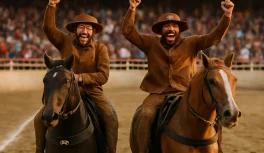
Vaquejada is, by definition, Brazilian. It was born in the northeastern sertão, took shape on farms across Pernambuco and Bahia, and is so bound to the identity of that region that it has been recognized as the country’s intangible cultural heritage. But culture travels with people — and wherever Brazilians go, vaquejada follows.
The movement of vaquejada beyond the borders of the Northeast, and gradually beyond the borders of Brazil, is a relatively recent phenomenon that says something about how diasporas carry their culture — and about the genuine interest that cattle-work sports generate in international contexts.
Expansion Within Brazil: From the Sertão to the Whole Country
Before discussing the international picture, it’s important to recognize how far vaquejada has already spread within Brazil itself. What was essentially a northeastern sport in the 1970s and 1980s now has an active presence in nearly every state in the country.
The expansion partly followed the flow of northeastern migration to the Center-West and Southeast. Workers who moved their families to Brasília, Goiânia, São Paulo, and other major cities brought vaquejada with them. Arenas were built. Regional circuits emerged. Competitions in states like Goiás, Minas Gerais, and Mato Grosso do Sul now attract audiences and deliver a technical level comparable to northeastern events.
São Paulo — home to a large northeastern population — has active arenas and an organized circuit. The São Paulo scene doesn’t carry the same cultural weight as the northeastern version, but it has serious riders, a growing audience, and events that draw participants from across the country.
Why Did the Center-West Take to Vaquejada So Quickly?
Brazil’s Center-West has a strong agricultural culture — large farms, cattle, experienced riders. The Quarter Horse, the dominant breed in vaquejada, was already widely bred in the region before the sport arrived. When vaquejada came, it found fertile ground: skilled riders, horses with the right profile, and an audience with a rural identity that felt immediately at home with the sport.
Vaquejada in Brazilian Communities Abroad
Brazil has significant communities in several countries — the United States, Portugal, Japan, the United Kingdom, Italy, among others. In these communities, vaquejada exists as a cultural practice of identity preservation, though at a far smaller scale than in Brazil.
Vaquejada in the United States
The United States has the largest Brazilian community outside of Brazil, estimated at over one million people, concentrated especially in Florida, Massachusetts, New York, and Texas. Within that community — particularly in southern Florida and Texas, where there is a tradition of cattle work — small vaquejada competitions take place on private farms and rural properties.
These are not professional circuits. They are community events that bring together northeastern families, riders who have brought performance-bred horses to the US, and people who feel a nostalgic pull to the sertão. In these events, vaquejada functions simultaneously as sport and as a ritual of belonging.
Texas has a natural connection to the sport: American cowboy culture has clear parallels with northeastern vaqueiro culture. Cattle work, high-performance horses, leather gear — the two worlds recognize each other. It’s no coincidence that some Brazilians living in Texas have found natural interlocutors in American team roping, the equestrian sport structurally closest to vaquejada.
Portugal: An Iberian Encounter
Portugal has a significant Brazilian community, especially in Lisbon and Porto. The country’s relationship with the equestrian world is intense — Portugal has a cattle-work tradition on the plains of the Alentejo that carries historical parallels to the northeastern sertão. The garraiada and other Portuguese mounted cattle-work practices create a context of mutual recognition.
In Portugal, informal vaquejada events take place in the context of Brazilian cultural festivals. Portuguese receptivity to the sport is greater than in most other European countries precisely because of this shared cultural background.
Vaquejada and Its Sibling Sports Around the World
Vaquejada has no direct equivalent in any other country, but there are equestrian practices around the world that share cultural DNA with the Brazilian sport — all born from the practical need to work cattle from horseback in different regions.
Team Roping (United States)
Team roping is probably the practice closest to vaquejada in terms of structure. It also involves two riders working as a pair to immobilize a bovine — one ropes the animal’s head (the header) and the other ropes the hind legs (the heeler). The key difference lies in technique: team roping uses a lasso, while vaquejada uses direct physical contact with the bull’s tail. The objective also differs: in team roping, the bull is immobilized standing; in vaquejada, it is brought to the ground.
The Quarter Horse dominates team roping just as it dominates vaquejada — which creates a natural connection between the two sports at the level of equine genetics.
Charreada (Mexico)
The Mexican charreada is an equestrian sport that originated in colonial hacienda cattle work — a direct historical parallel to northeastern vaquejada. Charreada includes several events, among them “colas” — where the rider brings down a steer by spinning it by the tail — which bears an obvious technical similarity to vaquejada.
Charreada has been recognized as UNESCO intangible cultural heritage since 2016, placing it in a relevant international context for discussions about culturally embedded practices that involve animals.
Campdrafting (Australia)
Australian campdrafting is an equestrian sport in which a rider cuts a single cow from a group (the “camp”) and guides it through a course. The dominant breed in campdrafting is the Australian Stock Horse — an animal with characteristics close to the American Quarter Horse. Campdrafting is less well-known internationally but has a dedicated following in the Australian interior.
What Would It Take for Vaquejada to Reach a Global Audience?
Vaquejada faces two main obstacles to broader international expansion.
The first is structural: the sport requires specific infrastructure — arenas, trained horses, suitable bulls — that is difficult and expensive to replicate outside the context in which it developed.
The second is cultural: vaquejada is so tied to a specific regional identity that part of its strength comes precisely from that locality. Transporting it to other contexts without losing that essence is a genuine challenge.
The most likely path of international expansion is the one already underway: northeastern diaspora communities carrying the sport with them wherever they settle, building bridges between the sertão’s tradition and the places where they come to live. This is not globalization in the conventional sense — it is the way cultures move when people move.