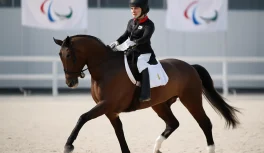
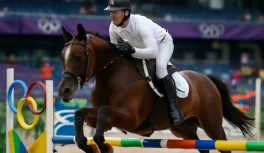
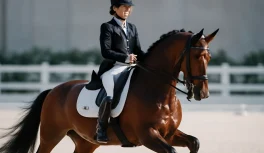
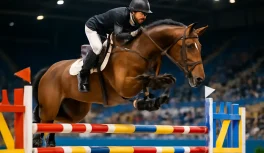
Open any Olympic equestrian result and look at the breeds. The pattern is immediate: KWPN, Hanoverian, Oldenburg, Westphalian, BWPN. With small variations by discipline and era, these breeds that dominate Olympic equestrian are European warmbloods — and their dominant presence is neither accident nor cultural favoritism. It is the result of centuries of breeding directed at specific objectives.
Understanding why certain breeds dominate Olympic equestrian means understanding how the sport arrived where it is — and what breeders did across generations to produce animals ever more suited to the demands of a competition that has existed for little more than a hundred years.
What Is a Warmblood, and Why Does It Dominate?
The term “warmblood” describes sport horses developed by crossing cold-blooded breeds (heavy working horses, such as Clydesdales and Percherons) with hot-blooded breeds (Thoroughbreds and Arabians). The historical goal was to produce horses light and agile enough for sport, but with the more stable temperament of working breeds.
Modern European warmbloods are the result of 200 years of this selection — with a progressive refinement that incorporated increasing percentages of Thoroughbred blood to enhance athleticism and movement quality, while preserving the cooperative temperament needed for working alongside humans.
The result is a type of horse that does not exist in nature: large (typically between 16 and 17.2 hands), athletically powerful, with naturally elevated movement, and a temperament stable enough to perform in high-pressure environments. This profile is ideal for all three Olympic equestrian disciplines.
KWPN: The Most Decorated Breed on the Olympic Podium
The KWPN — Koninklijk Warmbloed Paard Nederland — is the Dutch warmblood, and over the last three decades it has become the most represented breed on Olympic equestrian podiums, in both dressage and show jumping.
What distinguishes the KWPN from other warmbloods is the rigor of its stallion approval system. The KWPN Society evaluates hundreds of candidates each year and approves a small fraction — typically less than 10% of those tested — for breeding. These stallions are assessed not only on conformation and movement, but on their offspring: a stallion that produces horses with orthopedic issues or difficult temperaments is removed from the studbook.
The result of this rigorous system is a breed with extraordinary genetic consistency. Top-line KWPN horses are not just good on paper — they are measurably and consistently good in competition. Valegro was KWPN. The vast majority of Dutch horses that competed at the Olympics over the past twenty years were KWPN.
Hanoverian: The Breed That Built Modern Olympic Equestrian
If the KWPN dominates the present, the Hanoverian built the foundations of modern Olympic equestrian. Developed in the Lower Saxony region of Germany, the Hanoverian has a studbook dating to the 18th century — one of the oldest among European warmbloods.
The Hanoverian was the horse that dominated German Olympic equestrian in the 1960s, 70s, and 80s, when West Germany was the undisputed powerhouse of the equestrian world. Horses like Ahlerich — with whom Reiner Klimke won dressage gold at Los Angeles 1984 — or the show jumping horses on German Olympic teams of that era were frequently Hanoverians or Hanoverian crosses.
The modern Hanoverian remains one of the most sought-after breeds in elite equestrian. Its reputation for producing consistent dressage horses and solid jumpers keeps breeders and buyers interested worldwide.
Oldenburg: Show Jumping and Genetic Flexibility
The Oldenburg is a German warmblood with a distinguishing characteristic: its registry accepts approved stallions from other breeds, making it genetically more diverse and adaptable.
Historically associated with show jumping, the Oldenburg has produced some of the most valuable jumping horses of the past several decades. The flexibility of its registration system means the best available genetics — regardless of origin — can be incorporated into the breed when they make a positive contribution.
For buyers seeking an elite show jumper, the Oldenburg offers a wide range of options, from horses with more blood and speed to those with more technical precision and focus.
Irish Sport Horse: The Eventing Specialist
In eventing, the breed picture looks different. Continental warmbloods still have significant presence, but Irish Sport Horses — crosses between the Thoroughbred and the Irish Draught — are represented far out of proportion to Ireland’s size as an equestrian nation.
The Irish Sport Horse combines the athleticism and stamina of the Thoroughbred with the solidity and temperament of the Irish Draught — producing horses that are naturally bold, enduring, and instinctively confident with humans. These are precisely the qualities that cross-country demands.
Ireland, the United Kingdom, and Australia — countries with strong traditions of open-country horses — have a historical presence in Olympic eventing that reflects both cultural tradition and the inherent suitability of their horses to the discipline.
The Thoroughbred: The Percentage That Changes Everything
No discussion of breeds in Olympic equestrian is complete without mentioning the Thoroughbred. Though it rarely competes in Olympic dressage or modern show jumping as a pure breed, the Thoroughbred is the invisible component present in most warmbloods.
In eventing, Thoroughbreds or horses with a high percentage of Thoroughbred blood still appear regularly — especially in cross-country, where the natural speed and desire to run are a genuine advantage. Several Olympic eventing pairs throughout history have competed on horses with 50% or more Thoroughbred blood.
The balance between Thoroughbred athleticism and warmblood cooperation is one of the oldest conversations in sport horse breeding — and each European warmblood breed represents a different answer to that equation.