If there is a region in the world where the horse is not just an animal but a cultural symbol of deep identity, that region is Andalusia. In southern Spain, between ancient olive groves, whitewashed hill villages and cities layered with centuries of Moorish history, the relationship between people and horses has a density that goes beyond equestrian tourism and sport. It is part of how Andalusia understands itself.
The Pura Raza Española: the Heart of Andalusian Horse Culture
The Pura Raza Española — the PRE — is the breed that defines the equestrian identity of Andalusia and, by extension, of the Hispanic world. Developed over centuries in the plains and sierras of southern Spain, the PRE has documented history back to the 16th century, when Andalusian breeders began recording and selecting their lines systematically.
What makes the PRE unique is not a single characteristic — it is the combination. Physically, it is a horse of immediate presence: an arched neck, characteristic convex profile, powerful musculature, with coat colors ranging from dapple grey to golden bay. Temperamentally, it is considered one of the most manageable among heavy breeds — brave but not explosive, sensitive but not nervous.
In dressage and classical horsemanship, the PRE is one of the world’s most respected breeds. The aerial movements — the levade, courbette, capriole — were originally developed as war maneuvers, and Andalusian riders refined them over centuries into art. The Royal School of Equestrian Art in Jerez keeps this tradition alive with performances among the most moving equestrian demonstrations that exist.
The Great Equestrian Festivals of Andalusia
Feria del Caballo de Jerez de la Frontera (May)
The Jerez Horse Fair is Spain’s largest equestrian festival. Held each year in May, it brings together tens of thousands of visitors, hundreds of horses and a celebration combining equestrian competition with Andalusian culture in full expression.
During the six days of the festival: morphology contests (physical evaluation of the horses), doma vaquera competitions, enganche (paired horses harnessed to ornate carriages) and classical horsemanship. But equally important is what happens in the casetas — the pavilions where families receive friends, serve fino and manzanilla sherry, and riders parade in period costume.
Watching an Andalusian rider in traditional dress — the cordobés hat, short jacket, gaiters — driving a grey PRE in harness down a tree-lined avenue at dusk is one of those images that never leaves you.
Feria de Sevilla (April)
The April Fair in Seville is not specifically an equestrian festival — it is Andalusia’s largest popular celebration. But the horse has a fundamental presence: the cavalcades along the Calle del Infierno on opening Sunday are a spectacle in themselves.
Where to Ride Horseback in Andalusia
Doñana Natural Park
Doñana National Park, on the banks of the Guadalquivir delta, is one of Europe’s most important ecosystems and the habitat of Marismeño horses — a semi-wild breed that has lived in the park’s marshlands for centuries. Visiting Doñana on horseback is one of the few ways to access certain areas of the park.
Serranía de Ronda
The mountainous region around Ronda — the city built over a gorge in the Sierra de Málaga — offers horseback trails through ancient olive groves, oak forests and the famous “pueblos blancos” (white villages). Routes of one to three days depart from regional farms.
Sierra Nevada
The Sierra Nevada, with the Iberian Peninsula’s highest peak (Mulhacén, at 3,479 m), has equestrian trails in its lower and middle zones — especially in the Alpujarras valleys, the ancient Moorish irrigation terraces covered with orchards and vineyards.
Doma Vaquera: Functional Riding That Became Art
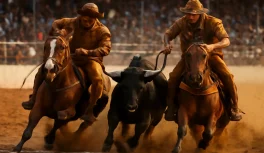
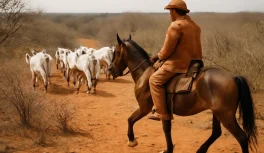
No equestrian visit to Andalusia is complete without understanding doma vaquera. Developed by Andalusian cattle workers for ranch work, it is a form of riding where the horse is trained to respond to commands given with a single rein — the other hand stays free. With time, the precision and lightness of doma vaquera became its hallmark, and what began as functionality became spectacle and competition.
Practical Information
When to go: Spring (March to May) is the best season — mild temperatures, equestrian festivals and fields of wildflowers. Andalusian summers are extremely hot; autumn is good but has fewer festival options.
Where to stay: Fincas — traditional farms converted to guesthouses — are the best base for equestrian tourism in Andalusia.