Two cowboys. One bull. A chalk line drawn in the sand. In seconds, everything happens: the animal is chased at full speed, pinned between two galloping horses, and brought down with precision on the mark. The crowd erupts. The pair raises their arms. That moment — tense, fast, full of dust and adrenaline — is the essence of Brazilian vaquejada.
Vaquejada is an equestrian sport born in Brazil’s northeastern scrubland that grew from farm work into one of the country’s most popular sporting events. Understanding what it is, where it came from, and why it matters means going beyond the arena — and recognizing a practice with more than three centuries of continuous history.
What Vaquejada Is and Why It’s Unique
Vaquejada (pronounced vah-keh-ZHA-dah) is a Brazilian equestrian sport in which a pair of mounted cowboys works together to chase, corral, and bring down a bull onto a white chalk line. Unlike American team roping, Mexican charreada, or Australian campdrafting, vaquejada has no direct equivalent anywhere else in the world. It emerged from a specific need — handling wild cattle in Brazil’s semiarid northeastern region — and evolved into a sport with its own identity, dedicated following, and established economy.
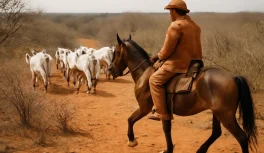
The name comes from “vaqueiro,” the cowboy who cared for cattle on northeastern Brazilian ranches. The practice was, originally, part of everyday work: separating, branding, and controlling cattle across open pastures. The rivalry between ranches over which had the best cowboys and horses was the embryo of the sport.
From Farm Disputes to National Championships
The earliest vaquejada competitions were informal — contests between neighboring ranches with no standardized rules. What mattered was skill: who brought down the bull most efficiently, who had the best horse, which pair worked with the most synchronism.
Over time, the sport gained structure. The ABVAQ (Brazilian Vaquejada Association) and the ABQM (Brazilian Quarter Horse Association) began regulating competitions. Dedicated arenas replaced open fields. Rules were standardized. And the sport began crossing regional boundaries.
Today, vaquejada has its own annual calendar, categories by skill level (from amateur to professional), state and national championships, and live broadcasts on specialized channels. The Northeast remains the heart of the sport, but active circuits now exist in Minas Gerais, Goiás, Mato Grosso, São Paulo, and other states.
Is Vaquejada Brazil’s Cultural Heritage?
Yes. In 2014, IPHAN (Brazil’s National Historical and Artistic Heritage Institute) recognized vaquejada as an intangible cultural heritage of Brazil. The recognition formalized what vaqueiros in the Northeast had known for centuries: it is an identity practice, passed from generation to generation, inseparable from the culture of the sertão.
The cultural recognition also had important legal consequences. In 2016, Brazil’s Supreme Court (STF) struck down a state law protecting the sport, citing animal welfare concerns. In response, Congress passed Constitutional Amendment No. 96/2017, which placed vaquejada under explicit constitutional protection as a cultural practice — as long as properly regulated. The sport has operated legally under those regulations ever since.
The Pair of Cowboys: Roles and Strategy
In vaquejada, the two riders have distinct and complementary technical functions that are key to understanding any race.
The puxador (puller) positions his horse to the right of the bull. His job is to press and direct the animal toward the chalk line and — at the decisive moment — grip the base of the bull’s tail to guide the fall. Skill lies in measuring speed and approach angle without destabilizing his own horse.
The batedor (closer) rides on the bull’s left side, acting as the other half of the pair. He pushes the animal toward the puxador and helps maintain a straight line during the run. Without a capable batedor, the bull can escape before reaching the chalk.
The quality of a pair is measured in synchronism — between the two riders and between each rider and their horse. The best duos develop something close to nonverbal communication: the closer knows when the puller is about to make his move; the puller knows how far the closer will press. That unspoken coordination is built over years of competing together.
How Is a Vaquejada Competition Scored?
The scoring system has variations by organizer, but the central principle is consistent: the pair scores when the bull falls with all four legs in the air within the chalk line. A fall outside the line, or with fewer than four legs raised, results in reduced or no score.
Each pair typically has two or three runs per competition, and the total determines their placement. Major events run multiple elimination rounds before the finals.
The Vaquejada Horse: Speed, Strength, and Instinct
The horse used in vaquejada needs to combine specific qualities that few animals naturally possess: explosive starting speed, lateral strength, high-speed maneuverability, and a controllable temperament under intense pressure.
The Quarter Horse dominates the sport. Originally developed in the United States for short-distance racing, the breed arrived in Brazil and found a perfect application in vaquejada: explosive acceleration over the first fifty meters, powerful hindquarter musculature, quick response to directional changes, and a balanced temperament capable of working in tandem with another animal.
Crossbred horses with Quarter Horse blood are also common — especially crosses with the Brazilian Mangalarga Marchador or the Criollo, which add heat resilience without sacrificing the explosiveness the sport demands.
Training a vaquejada horse begins between two and three years of age and can take years to reach consistent competitive performance. Elite animals regularly command prices exceeding R$500,000 (roughly USD 100,000), with champion bloodlines driving a substantial breeding market.
Vaquejada as an Economic Sector
Vaquejada drives a significant economic sector in Brazil. Industry estimates point to over R$20 billion in annual economic activity, encompassing horse breeding and trading, arena construction and operation, apparel, equipment, veterinary services, tourism, and sponsorship.
Major events attract tens of thousands of spectators and generate significant local economic activity. In some northeastern towns, the vaquejada calendar is the single most important annual event — surpassing all other local celebrations in attendance and economic impact.
Why Vaquejada Matters Beyond the Sport
For an outside observer, vaquejada might look like just another equestrian sport. For those who know the Northeast, it is something different: a way to transmit knowledge between generations, to celebrate a relationship between human, horse, and environment that shaped sertão culture over centuries.
The cowboy competing today carries an identity. The horse running the arena is the product of a carefully built lineage. The stands are packed with families who grew up with the sport. It is this cultural fabric — inseparable from the economic and social history of the Northeast — that makes vaquejada more than a competition.
For a first-time visitor, the horses’ speed, the pair’s precision, and the crowd’s explosion are a powerful introduction to an expression that exists in no other place in the world in exactly this form.