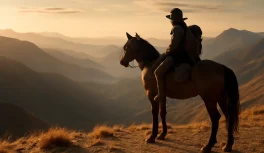
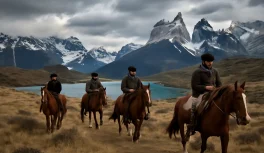
There is a moment during a horseback trip across Mongolia’s steppes when the geographical reality of the place finally settles in. Not when the guide points to the horizon and says the next camp is twelve kilometers away. It’s when you stop counting distances, because the horizon looks the same in every direction and your sense of scale simply stops working as expected. You are at the center of a plain that seems infinite, on a horse that weighs less than half of any European horse you’ve ever ridden, and somehow all of it makes sense.
Horse riding in Mongolia is unlike any other equestrian tourism in the world — not because of the landscapes, though they are extraordinary, but because the Mongolian horse is still a functional animal, not a tourist attraction. When you ride in Mongolia, you are not visiting an experience created for you. You are entering, for a few days or weeks, a world that existed long before tourism and will continue to exist long after.
The Mongolian Horse: Small, Resilient, Impossible to Ignore
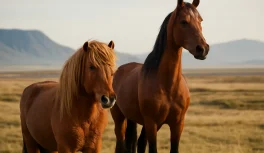
Those who visit Mongolia with experience on European or American horses are surprised by the Mongolian horse. They are small — generally between 1.30 and 1.40 m at the withers, which by Western taxonomy would classify them as ponies. But calling them ponies in front of a Mongolian nomad is a cultural mistake of considerable proportions.
The Mongolian horse is a direct descendant of equids domesticated by steppe tribes around five thousand years ago. Genetically little altered by human artificial selection, it is considered one of the domestic animals closest to its ancestral form. In practice: they are resilient in a way Western breeds simply are not. They can cover 60 km a day for weeks, feeding exclusively on steppe vegetation. They tolerate temperatures of -40°C in winter and +40°C in summer.
How a Horseback Trail in Mongolia Works
Equestrian tourism in Mongolia operates primarily between June and September. Routes typically depart from Ulaanbaatar or nearby cities and head to the central steppes, northern mountains or southern deserts. Duration varies from three days to three weeks.
The basic logistics include: each rider receives a designated horse for the entire trip. In serious routes, the guide is always a local Mongolian, frequently born into a nomadic family. Most routes include overnight stays in gers — traditional round Mongolian tents — either in fixed tourist camps or with actual nomadic families.
The Naadam Festival and Horse Racing
If your travel window includes the second week of July, the Naadam Festival in Ulaanbaatar is a must-see experience. The festival celebrates three traditional nomadic disciplines: wrestling, archery and horse racing.
Naadam horse racing bears no resemblance to the Kentucky Derby or the Grand National. Jockeys are children between five and twelve years old, riding horses that cover 15 to 30 km in open terrain with no track. The tradition is over eight hundred years old.
What Riding Experience Is Required?
Horse riding in Mongolia is, without ambiguity, an activity that requires more than beginner experience. Mongolian horses have different gaits than what Western riders expect. The trot is generally short and uncomfortable — most Mongolians avoid it and prefer the canter, which in open terrain is surprisingly smooth. If you’ve never cantered in open country, the first time on the Mongolian steppe can be more intense than expected.
Recommended: at least comfortable experience with sustained trot and some open-field canter. Physical conditioning is also fundamental — Mongolian saddles are wood and leather without Western ergonomics, and eight daily hours in them require real muscular preparation.
What Does It Cost?
Three to five-day routes cost USD 300–600 per person in basic camp setups with food included. Ten to fifteen-day routes with nomadic family stays reach USD 1,500–2,500 per person.
The Steppe That Doesn’t Forget
Travelers who have ridden horseback in Mongolia describe the experience with surprising uniformity. They don’t talk about the Naadam festival or the landscapes — though they mention both. They talk about the silence. The kind of silence that only exists when there is no city within hundreds of kilometers and the only sound is wind and hoofbeats on the grass.
That silence has an effect on time. Days that begin before dawn and end with the stars — no phone, no signal, none of the urgencies that organize modern life — create a kind of clarity that most travelers didn’t expect to find.