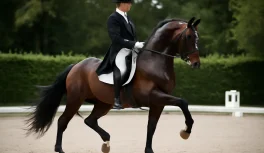
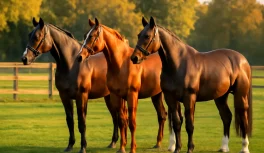
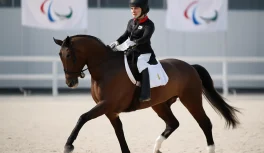
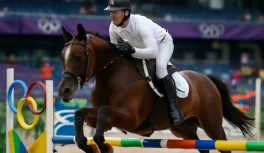
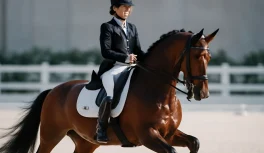
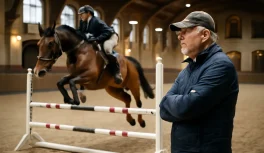
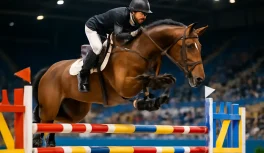
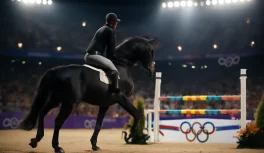
First-time viewers of Olympic eventing often don’t realize they’re watching three different sports over three days. On day one, horse and rider perform a precise dressage test. On day two, they gallop a cross-country course with fixed obstacles at nearly 570 meters per minute. On day three, back to show jumping.
Eventing is universally recognized as the most demanding equestrian discipline — not because it is the most technically refined, but because it requires the same combination to be technical, brave, fit, and precise in sequence, with only partial recovery between phases.
How Eventing Scoring Works
Olympic eventing starts at zero and accumulates penalties. The winner is the combination with the fewest penalties across all three phases.
In dressage, the pair performs a set test evaluated by judges. Eventing dressage is deliberately less technical than pure Olympic dressage, because the same horse must remain fit for cross-country the next day.
In cross-country, the pair covers 5 to 6 kilometers of natural terrain with fixed obstacles — solid wood, stone, or water features. Refusals cost 20 penalty points. Rider falls result in elimination. The goal is to complete within the optimum time.
In show jumping on day three — with the horse carrying accumulated fatigue — each knocked rail adds four penalty points.
Why Cross-Country Defines Eventing
The cross-country is eventing’s soul, and where the most remarkable horses emerge. It demands that the pair face fixed natural obstacles with no option to refuse without penalty, across irregular terrain, in any weather.
Olympic cross-country obstacles are designed to demand bravery, technique, and trust. Banks that drop sharply into water. Ditches where the horse cannot see the landing. Combinations requiring two or three obstacles in rapid sequence with split-second decisions.
A hesitant horse never reaches Olympic eventing. But a brave horse without judgment doesn’t make it either — recklessness causes falls. The intersection of bravery and technique, combined with genuine trust in the rider, defines a great eventing horse. That trust is built progressively over years of shared work.
Zara Tindall and Toytown: When Royalty Competes for Real
One of Olympic eventing’s most beloved partnerships is Zara Phillips — now Zara Tindall, granddaughter of Queen Elizabeth II — and her horse Toytown. The combination wasn’t popular only for dynastic reasons: it was genuinely competitive.
Zara and Toytown won the 2006 Eventing World Championships and competed at Athens 2004 and Beijing 2008. At Beijing, the pair contributed to Britain’s team silver in conditions considered among the most challenging in recent Olympic eventing history.
Toytown was a 17-hand Irish Sport Horse — large, calm, and exceptionally brave across country. His association with Zara was one of the most documented horse-and-rider relationships in modern eventing.
Andrew Nicholson and the Art of Making Eventers
Few riders in eventing history have developed as many high-level horses as New Zealand’s Andrew Nicholson. With over forty years at the top of the sport, Nicholson is known for taking young horses and building them into Olympic competitors through what his peers call “an ability to read horses that can’t be taught.”
His defining characteristic: he doesn’t accelerate development to reach results quickly. Horses that reach the top with Nicholson often take five or six years before competing at the major events. That patience produces horses that last longer and compete with deeper confidence.
Badminton and Burghley: Where Careers Are Made
To understand Olympic eventing, you need to know Badminton Horse Trials and Burghley Horse Trials — both in England, both the most prestigious eventing competitions in the world. Completing either with a strong result is considered, in eventing circles, equivalent to a medal-level performance.
The cross-country courses at Badminton and Burghley are long, technically demanding, and historically unforgiving. Completion rates in difficult years fall below fifty percent. Horses that finish in the top ten at these events see their market value multiply and become natural Olympic team candidates.
What Kind of Horse Wins Olympic Eventing?
Medium size and athleticism. The best eventers stand 16 to 17 hands — athletic conformation, well-developed musculature, agile enough for technical fences.
Balanced temperament. The same horse must be calm enough for dressage and brave enough for cross-country. Too hot and the dressage suffers. Too quiet and the cross-country stalls.
Cardiovascular fitness. Olympic cross-country demands exceptional aerobic capacity. Horses not in peak condition arrive at show jumping on day three with compromised reserves — and that’s when rails fall.
Built trust. More than any other equestrian discipline, eventing depends on a deeply established partnership. Horses that don’t fully trust their rider rarely complete Olympic cross-country clean.