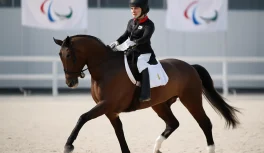
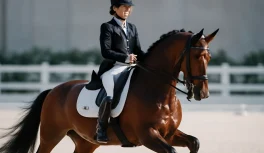
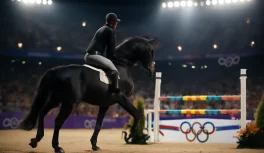
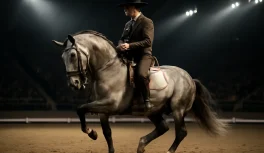
There is a scene that anyone who follows Olympic dressage knows by heart: a horse moves through a white arena in what looks like a choreographed dance. Each movement is technically precise yet completely natural. The rider barely moves. And the audience, often unfamiliar with the rules, goes quiet.
Dressage is the oldest and most technical Olympic equestrian discipline. Present at the Games since Stockholm 1912, it demands years of development for both horse and rider, and a synchronization between the two that few sports can replicate. The horses that reach Olympic level represent the most refined expression of what the equestrian world can produce.
How Olympic Dressage Is Judged
Olympic dressage takes place in a rectangular arena, 60 by 20 meters. The horse-and-rider combination performs a prescribed test — or, in the most prestigious events, a freestyle to music — and is scored by a panel of judges who rate each movement from 0 to 10.
The highest-scoring movements include the piaffe (trot in place), the passage (a highly elevated, slow trot), pirouettes (full turns at canter), and tempi changes (the horse alternates leading legs at the canter in a precise, rhythmic sequence — every four strides, every three, every two, every one).
The final score combines technical execution with overall performance quality — what German tradition calls Schwung: energy, elasticity, impulsion. A horse can execute every movement correctly and still receive average marks if the quality of movement is not exceptional.
Valegro and Charlotte Dujardin: The Partnership That Redefined What Was Possible
No discussion of Olympic dressage is complete without Valegro. The dark bay Dutch KWPN gelding — trained in the United Kingdom by Carl Hester and later Charlotte Dujardin — set world records between 2012 and 2016 that reset the parameters of the entire sport.
At the London 2012 Olympics, Valegro and Dujardin won individual gold with a score no one had reached before. At Rio 2016, they repeated the achievement. Between those Games, Valegro broke his own world record three times.
What made Valegro extraordinary? Technically, his biomechanics were unusual: long limbs, highly flexible joints, and a capacity to elevate movement that gave his passage a quality judges rarely saw in competition. Temperamentally, he was stable and cooperative — qualities that are rare in horses with his level of athleticism.
When Valegro retired in 2016, he was gifted to Dujardin by his owner — a gesture that captures the kind of relationship Olympic equestrian sport builds between humans and animals who have spent years breathing at the same rhythm.
Totilas: The Horse That Split the Dressage World
If Valegro was universally loved, Totilas — the black Dutch stallion who dominated dressage from 2009 to 2011 — was adored and contested in equal measure.
Ridden by Dutch rider Edward Gal, Totilas broke every existing world record in under two years. His Grand Prix Freestyle scores were so high they read as statistical outliers. The quality of his trot — particularly its elevation and amplitude — was unlike anything judges had seen at that scale.
But the debate Totilas generated was about the nature of that movement. For many specialists, the degree of neck flexion and extreme collection appeared artificially induced and potentially harmful to the horse. For others, it was the natural expression of an exceptional athlete. The question was never fully settled — and it permanently altered the conversation around animal welfare in high-level dressage.
Totilas sold for a reported price of ten to fifteen million euros and was transferred to German rider Matthias Alexander Rath. He never returned to the level he had shown with Gal. The story of Totilas is, among other things, about how the same biomechanics can produce entirely different results depending on who is in the saddle.
Rembrandt: The First to Win Back-to-Back Olympic Golds
Before Valegro, there was Rembrandt. The German Westphalian stallion ridden by Nicole Uphoff won individual dressage gold at Seoul 1988 and Barcelona 1992 — a feat Valegro would not match for more than two decades.
What set Rembrandt apart, according to judges of the era, was the quality of contact and his responsiveness: the horse answered nearly invisible aids, creating the impression of moving entirely on his own initiative.
How Olympic Dressage Horses Are Developed
Building an Olympic dressage horse is one of the longest development arcs in any sport. From the beginning of training to reaching Grand Prix level — where Olympic tests are performed — typically takes eight to twelve years.
That progression follows the Training Scale: rhythm, relaxation, contact, impulsion, straightness, and collection. Each stage must be established before advancing to the next. The transition from piaffe to passage, which appears effortless to a spectator, can require two or three years of dedicated work.
Which Breeds Dominate Olympic Dressage?
Olympic dressage is dominated by European warmbloods — the Dutch KWPN, the German Westphalian, the Hanoverian, and the Oldenburg. These breeds were developed specifically for arena work, with emphasis on elevated movement, elasticity, and cooperative temperament.
The Lusitano — a direct descendant of the Iberian horses that founded classical equitation — has significant presence, particularly in Portugal and Spain. Its natural capacity for collection and its intelligent temperament make it well-suited for upper-level work, though its movement style differs from the modern European warmblood.
What all these breeds share is a multigenerational selection process aimed at the specific demands of dressage. An Olympic dressage horse represents decades of directed breeding decisions concentrated in a single animal.