At the Olympics, almost everything comes down to fractions of a second, millimeters, tenths of a point. But in Olympic equestrian sports, the result depends on two beings — and one of them has no concept of medals, flags, or four years of anticipation. The horse simply runs, jumps, dances. And in that unguarded offering, sometimes, history gets made.
Equestrian sport is one of the very few Olympic disciplines where humans and animals compete together as equal partners. There is no victory without the horse. And across more than a century of Olympic equestrian history, certain animals left a mark that extends far beyond podiums — they transformed the way we understand what partnership between different species can look like at its highest.
Three Disciplines, Three Distinct Worlds
Olympic equestrian sport isn’t one sport — it’s three, each with its own identity, demanding radically different qualities from the horse.
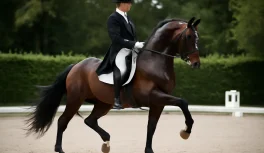
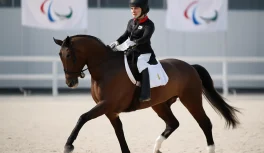
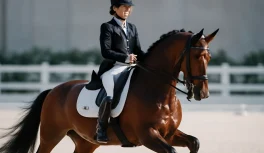
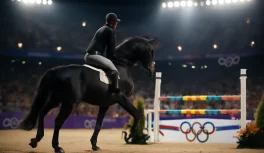
Dressage is the discipline of absolute precision. Horse and rider perform an intricately timed technical choreography — transitions, piaffe, passage, pirouettes — that must appear spontaneous and effortless to the observer. Of the three Olympic equestrian disciplines, it comes closest to dance. Dressage horses must bring power, elasticity, and a rare capacity to work in complete sustained concentration.
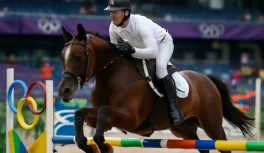
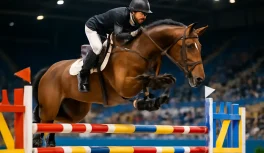
Show jumping is speed, courage, and coordination. A course of obstacles up to 1.65 meters high, timed to the hundredth of a second, where a knocked rail means penalty and a fall can end careers. Jumping horses must be brave without being reckless, explosive without being uncontrollable.
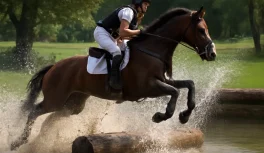
Eventing — sometimes called the triathlon of equestrian sport — unfolds over three days: dressage, cross-country, and show jumping. The cross-country phase is an endurance and bravery test across natural terrain with fixed obstacles — falls can be serious, and the horse-and-rider combination needs a mutual trust that goes beyond any technical training program.
Valegro: The Highest-Scored Horse of All Time
If one horse defines what Olympic dressage can be, it’s Valegro. The Dutch KWPN gelding, ridden by British rider Charlotte Dujardin, didn’t just win gold at the London 2012 and Rio 2016 Olympics — he rewrote the world record book at a frequency that made competitors uncomfortable.
Valegro was extraordinary because of a rare combination: exceptional biomechanics, a cooperative temperament, and a connection with Dujardin that judges described as “almost telepathic.” His piaffe had a lightness that seemed to defy physics — 1,100 pounds of muscle oscillating in place with the delicacy of a metronome.
When he retired in 2016, Valegro was gifted to Dujardin by his owner — a gesture that captures the kind of relationship Olympic equestrian sport creates between humans and animals who have spent years breathing in the same rhythm.
Gem Twist: The Horse That Seemed to Have No Ceiling
In show jumping, few horses impressed as consistently as Gem Twist. The American gelding ridden by Greg Best became famous at the Seoul 1988 Olympics for his technique over the fence — the way he folded his front legs created clearance that looked almost excessive, almost aesthetic.
Gem Twist won two silvers at Seoul, but what lingered in memory were the images of the horse approaching each fence with what looked like deliberate seriousness. He watched the obstacles. He calculated. Then he jumped with room to spare.
In the years that followed, Gem Twist continued competing and winning, building a reputation that outlasts his results: a horse that made his riders better, because he demanded of them the same level of focus he himself brought to every course.
The Cross-Country That Defines Eventers
In Olympic eventing, the cross-country phase is the heart of the competition — and where the most remarkable horses emerge. It demands that the pair face natural obstacles with no option to refuse without penalty, across irregular terrain, under any weather condition.
The history of Olympic eventing is punctuated by horses that, at the decisive moment of the cross-country, chose to trust the rider and give everything. The quality that defines a great eventing horse is not just athleticism — it’s the willingness to enter the unknown with a human on their back and treat it as safe.
Why Equestrian Sport Is Unlike Anything Else
There is one detail that separates Olympic equestrian sport from every other: the primary athlete doesn’t sign a contract, doesn’t receive a trophy, doesn’t give interviews. The horse competes through instinct, training, trust — and sometimes through something riders describe as “something that came from the horse itself.”
This asymmetry creates dynamics no other sport has. A rider can arrive at the Olympics in perfect form while their partner has an off day — and there is no verbal communication that resolves that in the moment. Or the reverse: a horse that “shows up” and carries a nervous rider beyond what they would have managed alone.
This is why Olympic equestrian sport produces stories that resist time. They are not stories about human athletes alone. They are stories about partnership.
Olympic Equestrian Today: More Competitive, More Global
For decades, Olympic equestrian sport was dominated by European nations — Germany, Sweden, the Netherlands, France, Great Britain. Access to elite horses was essentially European, and the technical dominance of those federations was uncontested.
Over the last twenty years, that changed. Brazil entered the world equestrian map with Rodrigo Pessoa, who won individual gold in show jumping at Athens 2004. The United States grew in technical depth and competitive reach. Countries across Asia and the Middle East began investing seriously in the sport.
The result is that today’s Olympic field is more competitive than it has ever been — and horses need to be better than ever to belong there.
What Makes an Olympic Horse?
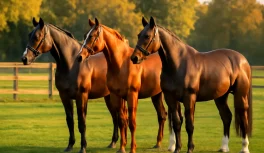
There is no single answer, because each discipline demands a different combination. But the best Olympic horses across all three disciplines share certain qualities.
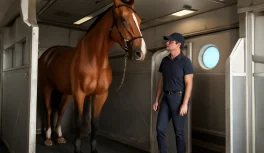
Adaptability. An Olympic horse flies on planes, sleeps in unfamiliar facilities, and competes in environments full of sounds, smells, and crowds that bear no resemblance to daily life at home. Horses that destabilize with environmental change rarely reach the highest level.
Emotional intelligence. The best Olympic horses seem to read the rider’s state. When the human is nervous, they settle. When the human is confident, they push forward.
Exceptional biomechanics. Each discipline has its own physical requirements — but in all three, horses with naturally superior movement and conformation have a structural advantage.
Partnership. Horse and rider who don’t fully trust each other rarely reach the podium. That trust is built over years of shared work — and it is the hardest variable to manufacture.