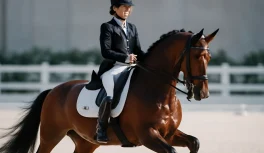
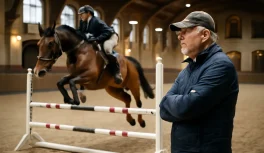
There is a reason why, in barrel racing and pole bending arenas across Brazil, you see the Quarter Horse far more often than any other breed. It is not a coincidence, not a trend, and not marketing. It is physics, genetics, and selection working in unison. The Quarter Horse was built — literally — to be what it is in these events: the horse that breaks hardest, turns tightest, and arrives fastest.
If you have never understood why this breed dominates western sports in Brazil, this article will settle that question for good.
What Are Barrel Racing and Pole Bending?
Barrel racing and pole bending are two of the most popular events in Brazilian rodeo and western equestrian sport. Both test speed and agility on fixed-obstacle courses inside an arena.
Barrel Racing (Três Tambores): The course forms a cloverleaf pattern. The rider circles three metal barrels arranged in a triangle inside the arena, following a defined pattern, then returns in a straight line to the exit. Time is recorded from the moment the horse crosses the entry line to its return. Knocking over a barrel results in a time penalty.
Pole Bending (Seis Balizas): Six vertical poles are lined up in a straight row. The rider weaves through them in a slalom pattern — entering from the far end, threading between the poles, and returning the same way. The event demands rhythm, precision, and extreme agility through the direction changes.
In both events, the difference between a podium finish and falling off the leaderboard is often measured in hundredths of a second.
Why Does the Quarter Horse Dominate These Events?
There are four concrete physical reasons:
1. The Start The burst of speed at the beginning of barrel and pole events demands maximum explosion in the first strides. The Quarter Horse’s wide, muscular hindquarters — its natural “engine” — generate that propulsion with an efficiency few other breeds can match.
2. Agile Hindquarters for Turns Each time the horse rounds a barrel or changes direction between poles, it must “sit” — transferring weight to the hindquarters and using the rear end as a pivot. The Quarter Horse is one of the horses most naturally suited to this movement, thanks to its specific physical conformation.
3. Acceleration Out of Turns After a turn, the horse must immediately accelerate toward the next barrel or pole. The ability to produce repeated bursts — not only from the starting line — is a Quarter Horse hallmark that heavier or less muscular breeds struggle to equal.
4. Balance and Body Awareness A well-trained Quarter Horse “feels” where the obstacles are and adjusts its stride independently. This sense of positioning — developed over centuries of selection for cattle work in tight spaces — translates directly into precision turns without knocking obstacles down.
How Is Training Structured for These Events?
Training a Quarter Horse for barrel racing and pole bending is gradual and requires patience. Rushing rarely produces the best results — and horses pressured too early develop resistances that are difficult to correct.
Typical training phases:
- Phase 1 — Familiarization: the horse is introduced to barrels and poles without pressure. The goal is that it becomes comfortable with the obstacles without fear or tension.
- Phase 2 — Walk and trot: the horse walks and trots the pattern to learn the course and develop motor memory for the turns.
- Phase 3 — Progressive lope: speed is increased gradually, always prioritizing turn quality before maximum speed.
- Phase 4 — Competition: only when the pattern is solid at a lope does the horse begin to compete. The pressure of a competition environment differs from training and requires adaptation.
Experienced trainers typically take 6 months to 2 years to develop a competitive Quarter Horse in barrel racing and pole bending events — depending on age, genetics, and the individual animal’s history.
Which Quarter Horse Bloodlines Excel in Western Events?
Not all Quarter Horse bloodlines are equally gifted for barrel and pole events. Some are specifically recognized for producing horses with exceptional aptitude:
- Dash For Cash: one of the most celebrated bloodlines for speed and western sports events in Brazil and the US
- First Down Dash: a descendant of Dash For Cash, with enormous influence in racing and barrel racing events
- Frenchmans Guy: the reference bloodline for barrel racing in the United States
In Brazil, Quarter Horse auctions focused on western sports events place strong value on descendants of these bloodlines — and the best individuals reach significant prices, especially when they already have a podium record.
More Than Speed
Anyone who watches a barrel racing or pole bending event live realizes it is not about raw speed alone. There is a constant conversation between rider and horse — rein adjustments, leg pressure, body positioning — happening in fractions of a second, and that conversation can be the difference between a championship time and a penalty.
The Quarter Horse that dominates these events is not just fast. It is a partner that understands the course, trusts its rider, and delivers its maximum on every turn. That level of connection is built through time, method, and an animal with the right genetics for the job.
If you are thinking about entering the world of western events, the starting point almost always has four legs, a muscular hindquarter, and a name that is easy to recognize: Quarter Horse.