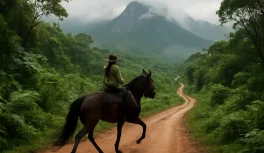
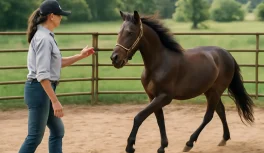
Imagine arriving at the Olympics after four years of preparation and, hours before your most important event, meeting for the first time the horse that will determine whether you reach the podium. You have twenty minutes to understand this animal — its fears, its responsiveness, its tendency to spook or stand calm before unfamiliar obstacles. And then you compete.
This is modern pentathlon and its relationship with the horse — one of the most fascinating and most unsettling scenarios in Olympic sport. In no other discipline does the result depend so heavily on a variable completely beyond the athlete’s control.
What Is the Modern Pentathlon?
The modern pentathlon was created by Pierre de Coubertin — the same man who founded the modern Olympics — as a tribute to the complete soldier: a warrior who would need every skill in a combat situation. The discipline combines five events: swimming, fencing, equestrian, shooting, and running.
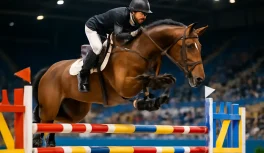
The equestrian event in the modern pentathlon is show jumping — not dressage or eventing. Athletes navigate a course of sequential obstacles, with penalties for knocked rails, refusals, and falls.
The rule that makes pentathlon equestrian unique — and controversial — is that horses are drawn by lot among athletes. Each horse is ridden by only one athlete during the competition, but the pairing is random. The athlete receives the horse at most 20 minutes before competing.
Why Draw Horses by Lot?
The original logic was democratic: to ensure no athlete had an advantage through owning or training with a high-level horse. The pentathlon is a test of the athlete’s skill — not the quality of the equipment.
In practice, this creates situations where exceptionally prepared athletes lose to competitors who drew more responsive horses — or vice versa. Luck is an explicit, structural component of the result.
For defenders of the rule, that is precisely the point: the complete soldier must work with what they have, not with the ideal. For critics, the system penalizes athletes who did everything right simply because they drew the wrong animal.
The Twenty Minutes That Define Olympiads
The twenty-minute familiarization period is the dramatic heart of pentathlon equestrian. The athlete meets the horse, mounts, walks the familiarization course, and attempts in minimum time to establish functional communication.
Specialist riders describe this process as “a very fast conversation in a language you have to invent on the spot.” Every horse has its quirks — one that responds better to the rein, another to the leg, one that needs constant rider support at obstacles, another that prefers freedom at the head.
Elite pentathletes develop a specific skill that exists in no other discipline: the rapid reading of an unfamiliar horse. The best describe the first familiarization trots as a diagnostic process — feeling the sensitivity of the mouth, the response to leg aids, the tendency to accelerate or decelerate on the approach to obstacles.
Memorable Cases: When Chance Decided Olympic Medals
At the London 2012 Olympics, German athlete Alexander Lesun drew a horse that was clearly uncomfortable with the crowd and competitive atmosphere. The horse refused multiple obstacles — penalties that cost him a podium position that his performance in the other events would have justified.
The most dramatic case in recent history came at Tokyo 2020, when German athlete Annika Schleu was leading the competition heading into the equestrian event — and drew a horse named Saint Boy who refused to jump. Images of Schleu attempting to urge the horse forward and breaking down in tears went around the world and sparked a global debate about the draw system.
Public reaction was divided. Many sympathized with Schleu — an exceptional athlete watching a medal slip away over a variable she did not control. Others pointed to Saint Boy: a frightened horse being pushed beyond what he was demonstrating a willingness to do. Animal welfare entered the debate with force — and led the FEI to launch a review of animal welfare rules in modern pentathlon.
The Post-Tokyo Reform: What Changed?
After the Tokyo Games, the International Modern Pentathlon Union (UIPM) announced that the equestrian event would be replaced by another discipline for Los Angeles 2028. The initial proposal was to replace it with obstacle racing — a physical obstacle run without horses.
The decision generated significant controversy in the equestrian world — because equestrian was the most iconic identity of the pentathlon, the component that set the sport apart from everything else. The UIPM argued that the difficulty of accessing horses made the sport less inclusive internationally.
The debate continues: how do you preserve Coubertin’s original idea — the complete soldier — without imposing on athletes and horses the risks of a partnership formed in twenty minutes under maximum pressure?
What the Pentathlon Teaches Us About Horses
The modern pentathlon crisis at Tokyo accelerated a conversation that the equestrian world needed to have: what do horses experience as involuntary participants in Olympic events?
A horse that refuses to jump in competition is not being stubborn. It is communicating that something — the environment, the rider, the obstacles, its physical state — is outside what it considers safe. The refusal is a communication, not a failure.
The twenty-minute familiarization system assumes that well-trained horses can perform adequately with any rider under any conditions. Experienced riders know that is not always true — and that pushing a horse beyond what it communicates a comfortable willingness to do involves risks for both animal and athlete.
What modern pentathlon placed on the table — dramatically and publicly — is a question that all of Olympic equestrian faces to some degree: where is the line between athletic partnership and excessive demand on an animal that did not choose to be there?