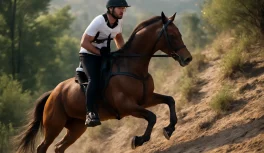
In 20th century world show jumping, few names commanded as much respect as Nelson Pessoa. Brazilian by birth, European by adoption, he is one of the most influential figures equestrian sport has ever produced — and one of the least known outside the inner circle of elite show jumping.
The role of Nelson Pessoa in show jumping extends far beyond his victories in the ring. There is one specific episode that captures his influence almost perfectly: when French rider Pierre Durand, humiliated at the Los Angeles Games in 1984, sought technical guidance, it was Pessoa who identified the problem and gave the advice that changed the trajectory of Jappeloup — the horse who would become Olympic champion in Seoul, 1988.
Who Is Nelson Pessoa?
Nelson Pessoa was born in Rio de Janeiro in 1935. He grew up in an equestrian environment, developed a deep relationship with horses from an early age, and began his competitive career in Brazil while still young. But it was in Europe that his trajectory gained the dimension that would make him a legend.
Established in Belgium since the 1960s, Pessoa competed on the best circuits of world show jumping at a time when South American presence in European elite sport was exceptional. His riding was elegant, his reading of courses strategic, and his relationship with horses carried a harmony that more technically minded riders rarely achieved.
Among his most celebrated horses was Gran Geste, with whom he won some of his most important titles. But what Pessoa bequeathed to show jumping was not primarily a record of victories — it was a way of thinking about the sport.
Pessoa’s Philosophy: Harmony as Method
At a time when European show jumping tended to value physical power and the domination of the horse by the rider, Nelson Pessoa represented something different. His philosophy was closer to the idea of partnership than control — the rider as facilitator of the horse, not its operator.
This vision had deep roots. Pessoa was a careful reader of each animal he worked with, and understood that different horses require different approaches. There was no single formula. There was listening, adjustment, and the building of a common language between rider and mount.
When Pierre Durand came to him after the disaster of Los Angeles, Pessoa identified the problem with an objectivity those around Durand had been unable to achieve: the rider was intervening too much. He was trying to control an animal that needed trust, not control. The strong interventions Durand thought were necessary to guide Jappeloup were, in fact, increasing the horse’s tension and compromising the quality of his jump.
The advice was surgical: ride with more harmony. Intervene less. Trust more.
Why Was That Advice Transformative?
To understand the magnitude of that advice, you need to understand Jappeloup. The horse was nervous by nature — any excess of pressure from the rider amplified his tension, created resistance, and compromised the natural fluidity of his extraordinary jump.
Durand had developed, over the years, a riding style that tried to compensate for the horse’s unpredictability with more control. It was understandable logic but counterproductive: more control produced more tension; more tension produced more unpredictability; more unpredictability demanded more control. A cycle that fed on itself.
Pessoa broke that cycle with a single shift in mindset. By trusting more in Jappeloup’s natural instinct — in his reading of obstacles, in his athletic capacity — Durand began to ride with less interference and more presence. The result was a harmony that would become the visual signature of the pair in Seoul: rider and horse as one being, flowing over obstacles with apparent ease.
This type of technical intervention — simple in formulation, profound in execution — is the mark of great coaches. Not the complex instruction that confuses, but the precise diagnosis that simplifies.
Nelson Pessoa as a Builder of Generations
Nelson Pessoa’s impact on world show jumping was multiplied by his career as a trainer. Over decades, he worked with riders of multiple nationalities and trained some of the most important names in European and South American show jumping.
His son, Rodrigo Pessoa, became himself one of the greatest riders in world show jumping history — a three-time world champion and Olympic medalist. The transmission of knowledge was direct, from father to son, but also amplified through the circle of riders who passed through Nelson’s influence over the years.
One of the qualities that separates great sports coaches from good ones is the ability to adapt the teaching to the student. Nelson Pessoa had that ability in full measure — he understood that the same philosophy cannot be applied in the same way to riders with different temperaments, histories, and horses. This explains the diversity of athletes who benefited from his guidance.
The Brazilian Legacy in World Show Jumping
The story of Nelson Pessoa is also the story of a Brazilian who was a pioneer in a predominantly European sport — and who, rather than passively adapting to the continent’s conventions, brought his own perspective that enriched the sport as a whole.
Brazil is not a show jumping power in the way it is in football or Formula 1 racing. But its presence in elite equestrian sport has a rich history, of which Nelson Pessoa is the most important chapter. His son Rodrigo is the chapter that came after — and which is still being written.
When the story of Jappeloup is told — the small black horse who reached the top of the Olympic world — it is impossible not to include the Brazilian who, with a simple phrase and a precise vision, helped make that possible. Ride with more harmony. It sounds simple. It was revolutionary.
What Do Today’s Riders Learn from Nelson Pessoa?
Pessoa’s influence persists in contemporary show jumping in ways not always explicitly cited. His philosophy of harmony influenced trainers who in turn influenced others, in a cycle of transmission that rarely leaves a written trail but is present in the way excellent show jumping is practiced today.
For riders dealing with difficult horses — nervous, sensitive, unpredictable animals like Jappeloup — Pessoa’s legacy is a reminder: the solution to difficulty rarely lies in more control. It lies in more listening. More trust. More harmony.
It is a philosophy that works in show jumping. And it works far beyond it.