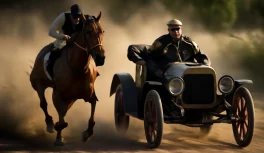
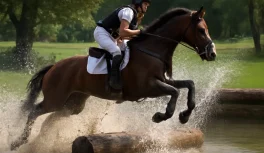
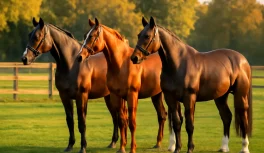
There’s a kind of horse that, on any terrain you can think of, “has seen worse.” The mustang on the trail carries centuries of adaptation to conditions that would create real problems for horses raised in managed pastures — hooves that have never needed extra care, a metabolism calibrated to do more with less, and a presence of mind that doesn’t panic unnecessarily.
All of that, applied to trail riding, becomes a genuine advantage.
Why the Mustang Is Different on the Trail
The mustang was not selectively bred by a horseman with a specific discipline in mind. It was selected by nature — by terrain, by scarcity, by the herd. The survivors had hard hooves, enough stamina, sure-footedness across uneven ground, and the mental composure not to waste energy on unnecessary reactions.
That’s not romanticism: it’s natural selection working toward exactly the qualities a serious trail rider needs.
Hooves: The First Concrete Advantage
Serious trail riders know that the hoof is where a ride begins or ends. A weak, sensitive, or poorly maintained hoof turns rough terrain into a real problem.
The mustang, having gone without shoes across rocky, arid, and mixed environments for generations, developed hooves that are dense, compact, and thick-soled. Many mustang owners report that their horses do well barefoot on terrain that would require specialized shoeing for other horses.
This isn’t universal — every animal is an individual — but it is a well-documented trend.
Efficient Metabolism: The Trail’s Easy Keeper
Modern purpose-bred horses often require supplementation, specific feed plans, and careful nutritional management to maintain ideal body condition. The mustang, as an adaptation to survival, tends to be an easy keeper — a horse that maintains weight and energy with fewer feed resources.
For long trail rides or multi-day expeditions, that metabolic efficiency is more than convenient — it can be decisive.
Self-Preservation Instinct: A Two-Sided Advantage
On difficult terrain, the mustang’s self-preservation instinct is an ally. A horse that grew up choosing where to place its feet, assessing ground stability, and managing energy across long distances will naturally take better care of itself in challenging situations than a horse that has always had its path managed.
The flip side: that same instinct can lead the mustang to override a rider’s instruction when it perceives genuine risk. For experienced riders, this is collaboration. For riders who expect complete obedience, it can feel like resistance.
Learning to trust the horse’s judgment — within a context of clear communication — is part of what trail riding with a mustang teaches.
Stamina and Endurance
The mustang is not a racehorse in any discipline. But it’s the kind of horse that, across long distances and varied terrain, holds condition while others fade.
This comes from generations of daily movement in search of water, forage, and safety — sometimes covering significant ground. That evolutionary history leaves its mark on the cardiovascular system and musculature.
Does the Mustang Need Physical Conditioning for Trail?
Yes. An evolutionary foundation helps, but it doesn’t replace progressive conditioning. A recently adopted mustang that spends years in a paddock without regular aerobic work will need gradual conditioning before demanding trail rides — like any horse.
The differentiator is the starting point: mustangs often begin with a recovery capacity and musculoskeletal resilience that exceeds purpose-bred alternatives. Better starting point — not automatic result.
What to Check Before Taking a Mustang on Trail
- Solid gentling foundation: the horse must be reliable in varied situations before any trail ride
- Response to external stimuli (cyclists, wildlife, sudden sounds): test in a controlled setting first
- Hooves verified: even hard hooves need assessment if the trail surface differs significantly from what the horse is used to
- Progressive conditioning: start short, increase gradually
Mustang on Trail vs. Purpose-Bred Trail Horses
Direct comparisons depend heavily on the individual animal. But in general terms:
| Trait | Mustang | Purpose-Bred Trail Horse | |—|—|—| | Hooves | Often dense and hard | Depends on breed and management | | Metabolism | Efficient, easy keeper | Varies — many need supplementation | | Independent judgment | High — makes its own calls | More dependent on rider direction | | Learning curve | Longer if feral | Usually faster if trained from youth | | Stamina across distance | Consistent | Varies by breed |
The Conversation Between Rider and Mustang on Trail
What trail riders with mustangs often describe isn’t just “a good trail horse.” It’s a different kind of partnership: an animal that participates in the journey with its own awareness, that signals what it perceives, manages energy with intelligence, and — when trust has been built — carries its rider with a dignity that wasn’t bought, but earned.