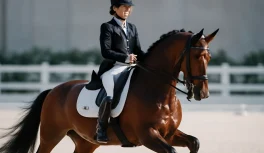
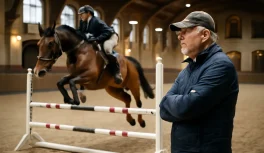
There are two ways to see a Mangalarga Marchador at its best. The first is on a show ring track, rider in formal attire, the horse gaiting in perfect cadence before the judges. The second is on a three-day trail through Brazil’s cerrado, the rider relaxed in the saddle, the horse covering kilometers with the same regularity as the first stride.
The versatility of the Mangalarga Marchador in competition and trail riding is one of the breed’s strongest arguments. Few horses are equally competitive in a formal arena and equally comfortable in extended field adventure.
Prova de marcha: the heart of the breed’s sport
The primary competitive event for the Mangalarga Marchador is the prova de marcha — a judged competition in which horses are evaluated on gait quality, conformation, and overall breed type.
These events take place at local, regional, and national levels, organized by the ABCCMM and its affiliated state associations. The annual calendar includes hundreds of events throughout Brazil, concentrated especially in Minas Gerais, São Paulo, Goiás, Mato Grosso do Sul, and Paraná.
The National Mangalarga Marchador Exposition, held annually in Belo Horizonte, is the season’s pinnacle. It brings together the country’s finest breed representatives, drawing breeders, riders, and visitors from across Brazil — and determines the national champions who carry the greatest market impact on the breeding industry.
How does show judging work?
In marcha competitions, judges evaluate the horse in motion — typically on a packed-earth track, gaiting with a rider — and at halt, for conformation analysis.
Gait (marcha): the highest-weighted criterion. The judge observes rhythm regularity, hindquarter impulsion, balance between front and rear, absence of excessive lateral movement, and clarity of gait type (batida or picada, per the entry category).
Conformation: skeletal and muscular structure, including overall proportions, limb and joint quality, neck shape and set, wither development, topline, and hoof quality.
Breed type: the combination of characteristics that give the animal the visual identity of a Mangalarga Marchador — that blend of elegance, expression, and type recognizable from a distance.
Aplomb: limb alignment. Well-aligned limbs indicate appropriate weight distribution and reduce the risk of joint problems throughout the animal’s life.
Categories vary by sex (stallions, mares, geldings), age group (foals, young horses, adults), and gait type (batida or picada).
Cavalgadas: where the gait meets the landscape
If shows are the space for technical precision, cavalgadas are the space for experience. And it’s in the cavalgada that the Mangalarga Marchador’s gait finds its most natural environment.
A cavalgada is an event that gathers groups of riders to cover trails over one or more days. In Brazil, cavalgadas range from weekend outings with twenty or thirty riders to large events with hundreds of participants covering one hundred kilometers or more over consecutive days.
The Mangalarga Marchador is by far the most present breed in this context. The reasons are clear:
Endurance: the marcha’s energy efficiency allows the horse to cover long distances without rapid fatigue accumulation. A well-conditioned Mangalarga can complete 30-40 km daily stages over varied terrain without compromising health or willingness.
Rider comfort: long daily journeys are incompatible with gaits that cause impact. A rider spending six to eight hours per day in the saddle of an irregularly gaited horse arrives in poor physical condition. The marcha eliminates this problem.
Temperament: on a cavalgada, the horse will encounter dozens of other animals, sounds, river crossings, different surfaces, and multiple unpredictable situations. The Mangalarga’s balanced temperament is a clear advantage in this context.
Endurance riding: the frontier of distance
Endurance riding is a competition format in which horse and rider cover set distances — typically 40 to 160 km in a single event — within a maximum time, with periodic veterinary checks throughout the route.
The Mangalarga Marchador has found growing space in this discipline. The combination of efficient gait, good limb conformation, and focused temperament produces competitive animals in events that demand endurance over speed.
The main adaptation needed for endurance is aerobic conditioning — a progressive preparation over months that builds the animal’s cardiorespiratory and muscular capacity. Well-conditioned Mangalarga horses arrive at endurance events in condition that consistently surprises practitioners accustomed to other breeds.
Trail obstacle and ranch riding: international formats
As the breed expands internationally, Mangalarga practitioners have entered disciplines that don’t exist in traditional Brazilian equestrian sport — especially in the United States.
Ranch Riding evaluates the horse in practical farm activities: lopes, transitions, maneuvering around obstacles, arena work. Mangalargas adapted to this discipline demonstrate the versatility that extends beyond the marcha.
Trail equestrian involves executing natural or artificial obstacles on a course — bridges, logs, gates, water. The Mangalarga’s calm temperament and physical balance are real advantages in this discipline.
The cavalgada as cultural event
In Brazil, the cavalgada is far more than a sport. It’s a social event that brings communities together, celebrates equestrian culture, and keeps alive a way of seeing the world from horseback.
In interior towns of Minas Gerais, Goiás, Mato Grosso do Sul, and São Paulo, annual cavalgadas are anticipated events — entire families participate, from grandparents to children, experienced and beginning riders alike. The Mangalarga Marchador is at the center of these celebrations not just as a mount, but as a symbol of regional identity.
For anyone who hasn’t yet participated in a cavalgada on a good, well-gaited Mangalarga, the experience is hard to describe precisely. There’s something in the cadenced rhythm of the marcha repeating for hours, the landscape passing at the horse’s steady pace, the easy conversation the gait allows — that turns a displacement into something close to meditation.
It’s why riders who experience it rarely go back to anything else.