There is a way of riding that answers to no competition rulebook. That chases no stopwatch, no judge’s score. That seeks, above all, a perfect harmony between human and horse — a silent conversation expressed in movements that look impossible and, at the same time, utterly natural. That way of riding has a name: classical equitation. And it has a breed inseparable from it: the Lusitano.
The relationship between the Lusitano and classical equitation is not coincidence or marketing. It is history — centuries of tradition codified in texts, passed from teacher to student, and kept alive in schools that have survived wars, revolutions, and the shifting values of the modern world.
What Is Classical Equitation and Why Does It Matter?
Classical equitation is the equestrian tradition developed in Renaissance Europe, rooted in Xenophon’s writings (4th century BC), refined in the Italian academies of the 16th century, and brought to its highest expression by the Iberian schools of the 17th and 18th centuries.
Its central principle is lightness: the horse executes every movement without resistance, without tension, responding to increasingly subtle aids until the communication becomes almost telepathic. The rider does not force — the rider invites. The horse does not obey from compulsion — it collaborates through understanding.
The characteristic movements of classical equitation — piaffe, passage, levade, croupade, capriole, courbette — are the same movements that medieval war riders developed for mounted combat. In the modern context, they are performed as equestrian art and as the ultimate expression of training harmony.
The distinction from modern competition dressage is important: while FEI dressage seeks standardization and comparative scoring, classical equitation seeks individual perfection — what is possible for this specific horse with this specific rider.
The Portuguese School of Equestrian Art
The school that most faithfully represents the classical tradition with the Lusitano is the Portuguese School of Equestrian Art (EPAE), founded in 1979 and headquartered at the National Palace of Queluz, outside Lisbon.
The school maintains a group of riders and Lusitano stallions who perform regular public exhibitions, perpetuating movements that have existed for centuries. Riders wear 18th-century dress — tricorn hat, embroidered uniform jacket, white leather breeches — while horses wear elaborately decorated leather and metal tack. The complete presentation is a total aesthetic experience: baroque music, the natural light of the palace courtyard, white horses that seem to float above the arena floor.
Alter Real stallions: The EPAE works primarily with stallions of the Alter Real sub-line — bred at the Herdade de Alter do Chão since 1748, specifically developed for high school work. Alter Real horses are recognized for their exceptional aptitude for the airs above the ground and their commanding stage presence.
UNESCO recognizes Portuguese classical equitation practices as Intangible Cultural Heritage — a marker of cultural value that transcends sport.
Nuno Oliveira: The Master Who Redefined Equestrian Art
No discussion of Lusitano classical equitation is complete without Nuno Oliveira (1925–1989) — regarded by many as the greatest rider of the 20th century.
Oliveira devoted his life to studying and practicing classical equitation, teaching generations of riders who traveled specifically to Portugal to learn from him. His philosophy was radical in its simplicity: the horse is always right. If something is not working, the problem is with the rider, not the horse.
His books — Reflections on Equestrian Art, On Classical Equitation, Horses and Riders — are considered foundational texts of equestrian thought worldwide, translated into more than ten languages. Riders from traditions as different as German competition dressage and American western riding found in Oliveira insights that transformed how they understood horsemanship.
Oliveira’s legacy lives in his direct students — Bent Branderup (Denmark), Philippe Karl (France), Bettina Drummond (USA) — and in the countless riders touched by his writings without ever meeting the master in person.
The Airs Above the Ground: What Are They and Why Do They Impress?
The airs above the ground are movements in which the horse elevates part or all of its body from the ground. They represent the ultimate expression of classical training — and executing them with genuine quality is rare even among high-level riders.
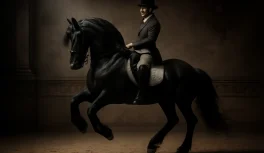
Levade: The horse raises the forehand from the ground, balancing on deeply flexed hindquarters with the body at 35–45 degrees from the ground. It is the foundation of every other air — and the most demanding in terms of the horse’s strength and balance.
Croupade: The horse jumps and draws all four legs under the body, remaining parallel to the ground at the peak of the leap.
Capriole: The most spectacular of the airs. The horse leaps, reaches the highest point of the jump, and kicks the hind legs out behind in full extension — a position that historically served to clear enemies from the rider’s flank in battle.
Courbette: The horse in levade position advances in successive jumps on the hindquarters, without touching the ground with the front legs.
The Lusitano has conformation particularly suited for the airs: powerful hindquarters, hind leg joint angles that support deep engagement, and a natural balance that other breeds require far more training to approach.
Where Can Someone Learn Classical Equitation with a Lusitano Today?
Classical equitation is experiencing something of a renaissance in the 21st century, even as it navigates tension with the modern competition world. Growing numbers of riders are seeking out classical masters, academies, and specialized clinics — a reaction, in part, to what many perceive as the increasingly mechanical quality of modern competition dressage.
Organizations dedicated to classical equitation exist across Europe, the Americas, and Australia. Many offer clinics with visiting masters from the Portuguese and Spanish traditions. Online teaching has expanded access to riders who cannot travel.
For the Lusitano, this movement is an opportunity. In a community that values classical tradition, the breed forged by that tradition needs no adaptation — it simply needs to be what it already is.