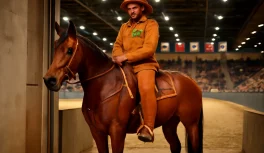
Watching a vaquejada run for the first time is a high-speed experience. In a matter of seconds, two riders burst forward at a gallop, a bull is chased and cornered, and the fall happens — or it doesn’t. To a newcomer, the scene can look chaotic. To someone who knows the rules, every second is a technical read: riders’ positioning, approach angle, synchronism, and the mathematical precision of bringing a several-hundred-kilogram animal down exactly where it needs to land.
This article explains how vaquejada works step by step — from the moment the bull enters the track to the final score.
The Vaquejada Track: Dimensions and Structure
A vaquejada competition takes place on a rectangular sand track. The standard length is 150 meters, with a width of 15 to 20 meters. At the far end of the track, two parallel chalk lines are drawn in the sand, separated by approximately 10 meters — this is called the “cal” (chalk) or “linha” (line). Everything is decided here.
The bull must fall within this space for the pair to score. Simple in concept. Demanding in execution.
The track has containment structures on the sides and at the far end — rails and barriers — ensuring the safety of riders, cattle, and spectators. The entry corridor, where the bull is released, is at the starting end of the track, opposite the chalk line.
The Bull: the Third Athlete in Vaquejada
The bull used in competitions is a central element of vaquejada — and one of the most discussed aspects when examining the sport. The animals are typically zebu cattle or crossbreeds, weighing between 180 and 300 kilograms. Their agility and speed inside the track introduce an irreducible element of unpredictability into every run.
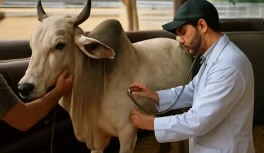
Competition bulls are prepared for the events: vaccinated, weighed, and evaluated for health. Association regulations establish minimum animal welfare standards, including rest periods between runs and on-site veterinary care during events.
How Many Times Can the Same Bull Run?
Rules vary by organizing body, but there is a maximum number of runs per animal in each event — typically between two and four, depending on the size of the competition. This limit exists both for welfare reasons and because a bull that has run multiple times begins to “learn” the track, changing its behavior in ways that affect the fairness of the contest.
The Start: How the Bull Is Released
The run begins with the bull being released into the entry corridor. The two riders wait behind an initial gate, aligned with the animal. When the bull crosses the starting line, the gate opens and the riders take off in pursuit.
The bull has a head start of several meters. Part of the pair’s skill lies in rapidly closing that gap, reaching the animal, and positioning the horses correctly for the corralling phase that leads to the throw.
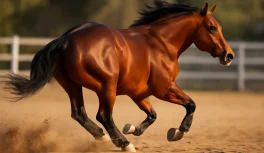
The horses’ starting speed is explosive — the Quarter Horse, the dominant breed in the sport, can reach 55–65 km/h within the first few meters of the track.
Puxador and Batedor: Roles Inside the Run
In vaquejada, the two riders have distinct technical functions that complement each other.
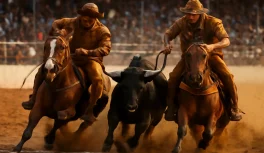
The puxador (puller) positions his horse on the bull’s right side. He is the one who makes the decisive physical contact with the animal — typically gripping the base of the bull’s tail in a technique called the “puxada” (pull). This contact, applied with force and at the correct angle, generates the animal’s fall to the left, where the chalk line is positioned to receive it.
The batedor (closer) rides on the bull’s left side. His primary function is to push the animal toward the puxador — ensuring the bull stays between both horses during the run and cannot escape sideways. The batedor also helps regulate the pace of the group, preventing the bull from pulling too far ahead or the pair from arriving at the chalk in a poor position.
What Does “Closing the Bull” Mean?
“Closing the bull” describes the moment when both riders press their horses against the bull’s flanks, forming a “sandwich” that eliminates the animal’s lateral escape options. It is the prerequisite for the throw: without effective closing, the bull can break free before reaching the chalk.
The quality of the close depends entirely on rider synchronism. Horses with incompatible speeds or riders who read the bull’s movement differently produce failed closes — and unsuccessful runs.
The Throw: Technique and Timing
The throw is the climax of the run. With the bull between both horses and the chalk approaching, the puxador executes the movement that will either score for the pair or not.
The most common technique is the tail pull: the rider firmly grips the base of the bull’s tail and, at the right moment, applies a lateral pull that unbalances the animal to its left side. Raw force is less important than angle and timing — it is the speed of the combined movement and the geometry of the pull that determine the efficiency of the fall.
Timing is critical. Pulling too early means the bull falls before the chalk — no score. Pulling too late means the bull passes through the scoring zone still standing. The perfect window lasts milliseconds, and it is in that interval that good pairs separate themselves from great ones.
How Scoring Works
The vaquejada scoring system is based on two main criteria: where the bull falls and how it falls.
To score, the bull must: 1. Fall within the chalk line — with at least part of the body on the marked zone 2. Fall with all four legs up in the air — the “queda com as quatro” (four-leg fall)
Maximum score (10 points): bull falls completely within the chalk line, all four legs raised.
Reduced score: bull falls partially within the line, or falls with fewer than four legs raised. Intermediate scores — typically 8, 6, or 4 points — vary by regulation depending on fall quality.
Zero points: bull doesn’t fall, falls completely outside the line, or the judges rule the fall invalid.
The Role of the Line Judges
Each competition has judges positioned at the chalk line with direct sightlines to the fall point. They determine the score of each run immediately. In high-level competitions, video cameras provide review support for disputed calls.
Categories and Competition Format
Vaquejada has categories for different experience levels and age groups:
- Infantil and mirim: children and teenagers, with smaller animals and adapted tracks
- Amador (Amateur): practitioners without professional registration
- Profissional (Professional): athletes registered in national circuits
- Senior/Master: veterans of the sport
Major competitions run multiple rounds. In a typical state or national championship, pairs go through eliminations — usually two runs per round — before semifinals and finals. Only the highest scores advance.
What Distinguishes an Elite Pair?
Technically, high-level pairs distinguish themselves in three areas:
Bull reading: identifying the animal’s behavior from the start — speed, direction, reaction to being closed — and adjusting strategy in real time. Different bulls require different approaches.
Inter-rider synchronism: the best pairs develop nonverbal communication during the run. Small speed, position, and angle adjustments happen without verbal cues — pure reading of a partner built over years of shared competition.
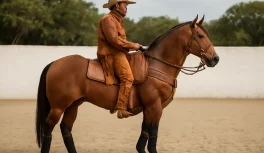
Horse preparation: a well-trained animal anticipates the bull’s movement, holds position without constant correction, and has the physical explosiveness needed for rapid in-track adjustments.
The combination of these three factors, executed in runs lasting 8 to 15 seconds, is what makes vaquejada a high-precision technical sport.