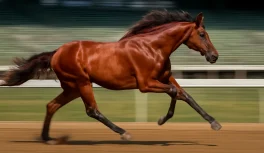
When HeartMath Institute researchers began mapping the electromagnetic fields generated by the hearts of different species, their findings about horses surprised even those who expected large numbers. A resting adult horse’s cardiac field is approximately five times more intense than the field generated by the human heart — and can be detected at distances no conventional animal monitoring equipment was designed to measure.
To understand why, you have to start with the organ itself. The horse’s heart isn’t simply a larger heart. It’s a bioelectric machine of proportions that, among terrestrial mammals, has no rival in terms of electromagnetic field generated per heartbeat.
How much does a horse’s heart weigh?
An average adult horse — weighing between 1,000 and 1,200 pounds — has a heart that weighs between 7.7 and 11 pounds. For comparison: the average adult human heart weighs about 10 ounces, and a medium-sized dog’s heart weighs between 3 and 4 ounces.
In terms of raw weight, the horse’s heart is roughly 13 to 16 times heavier than ours. But it’s the electrical power generated by a muscle of that magnitude that matters most here.
The heart functions as a generator. Each muscular contraction produces an electrical current that propagates through the body and, by extension, beyond it. The more muscle mass, the more powerful the signal. In horses, that signal is strong enough to be detected by sensitive instruments at distances that would be impossible with human cardiac monitoring equipment.
The field that extends beyond the skin
In humans, the cardiac electromagnetic field can be measured at up to about 5 feet from the body using high-sensitivity magnetometers. In HeartMath Institute studies with horses, the field was detected in humans positioned up to 6 feet away from the animal — with no physical contact between species.
This has concrete implications: it means that before a human touches a horse, sits in its saddle, or even makes direct eye contact, a bioelectromagnetic exchange is already occurring between the two systems. The horse’s field enters the space where the human nervous system operates — and vice versa.
What happens in that exchange depends on the state of both parties. A horse in a state of high cardiac coherence — calm, secure, with a regular HRV pattern — emits an organized, rhythmic field. When that field interacts with a human’s autonomic nervous system, it can induce a tendency toward synchronization. The human system, in other words, tends to “listen” to the horse’s rhythm.
What makes the horse’s heart anatomically different?
Beyond size, the equine heart has structural characteristics that explain its power as a field generator.
The horse’s left ventricle — the chamber responsible for pumping oxygenated blood into systemic circulation — is proportionally larger and more muscular than in any other comparably sized terrestrial mammal. This chamber is the primary generator of the cardiac electromagnetic field: the greater the ventricular muscle mass, the more intense the emitted signal.
High-performance athletic horses can show even greater variation in ventricular musculature — the so-called “athlete’s heart,” a physiological adaptation that increases pumping capacity and, consequently, the power of the generated field.
Is there a legendary horse heart?
Yes — and the story of that heart helps illustrate how much individual variation within the species matters.
Secretariat, the American Thoroughbred who in 1973 won the Triple Crown with records that remain unbroken decades later, had an extraordinary heart. Discovered during necropsy, the organ weighed approximately 22 pounds — more than double the species average. Conservative estimates put it at 13 to 15 pounds, but all accounts point to an organ far outside normal parameters.
The veterinarian who performed the autopsy described the heart as “perfect” — no sign of disease or abnormality, simply enormous. This unusual size is attributed in part to a genetic variant associated with a gene informally called the “X factor” — first identified in the bloodline of Eclipse, the 18th-century English Thoroughbred. The variant increases heart size and, according to researchers, is transmitted through the maternal line.
From an electromagnetic field perspective, a larger heart generates a more intense field. Secretariat didn’t just run faster — electromagnetically, he was emitting a signal more powerful than any other horse of his era.
Is there a relationship between heart size and emotional capacity?
This is the question that most intrigues researchers working at the intersection of equine physiology and animal psychology.
There isn’t yet sufficient evidence to claim that a larger heart makes a horse emotionally “more capable.” What exists are indications that horses with high cardiac coherence — regardless of absolute heart size — show greater behavioral stability, lower stress reactivity, and greater capacity to maintain presence in challenging situations.
Coherence, more than size, appears to be the relevant factor for the quality of human-horse interaction. A horse with high coherence emits a field that the human nervous system interprets as a “safety signal” — and this has measurable effects on cortisol levels and HRV of those nearby.
The horse’s heart isn’t just an engine. It’s a communicator. And the message it broadcasts — regulated by the animal’s internal emotional state — is received by the nervous systems of those around it, well before any word or gesture is exchanged.
What does this change about how we care for horses?
If the horse’s cardiac electromagnetic field has measurable effects on humans, the reverse is equally true. The human field affects the horse’s nervous system — and that effect can be positive or negative.
A chronically anxious rider, a trainer working under constant pressure, a caretaker arriving at the barn with their mind elsewhere: all are emitting low-coherence fields. The horse is receiving that signal, processing it as environmental information, and potentially increasing its own sympathetic nervous system activation.
This suggests that caring for the emotional wellbeing of people who work with horses isn’t just a human issue — it’s also an animal welfare issue. The field a person brings to the barn enters the horse’s space before any physical action begins.