There is something that happens the first time you sit on an Icelandic horse and ask for the tölt. The horse shifts gait, but what really changes is the saddle movement. The horse accelerates into something that seems impossible — faster than a walk, smoother than any trot you’ve ever experienced — and the rider simply… goes along with it. No impact, no effort to absorb the movement, nothing but speed and smoothness at the same time. For those coming from conventional equestrian backgrounds, it’s disorienting in the best possible sense.
The tölt is the gait that defines the Icelandic horse, and the Icelandic horse is what defines equestrian trails in Iceland.
The World’s Purest Horse Breed
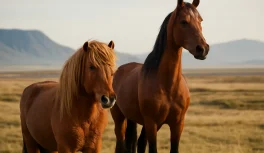
The Icelandic horse arrived in Iceland with Viking settlers in the 9th century. By around 982 AD, the Althing — Iceland’s parliament — banned the importation of horses to Iceland. This law, which remains in force today, was the most consequential decision for the genetic purity of any domestic horse breed in the world. For over a thousand years, the Icelandic horse developed without external crossbreeding.
The International Federation of Icelandic Horse Associations (FEIF) oversees the breed in more than twenty countries — because Icelandic horses have been exported worldwide but cannot return. An Icelandic horse that leaves Iceland can never go back. The breed is preserved in its country of origin with absolute isolation.
The Gaits of the Icelandic Horse
The conventional horse has three natural gaits: walk, trot and canter. The Icelandic horse has five. The tölt and the flying pace are the two additional gaits, and it is mainly for them that equestrian tourism in Iceland exists.
The tölt is a four-beat gait where the horse always has at least one foot on the ground — eliminating the suspension phase of the trot and, with it, the impact the rider must absorb. The result is an extremely smooth motion allowing speeds between 20 and 30 km/h with the comfort of a fast walk.
The flying pace (skeið) is rarer and faster — the horse moves both legs on the same side simultaneously, creating a lateral sway allowing speeds up to 45 km/h. Not every Icelandic horse has developed flying pace, and those who do are especially valued.
Where to Ride in Iceland
Snæfellsnes
The Snæfellsnes peninsula, west of Reykjavík, is one of Iceland’s most photographed landscapes. Dominated by the Snæfellsjökull volcano — whose glacier is the entry point to the center of the Earth in Jules Verne’s novel — the region offers routes past black sand beaches, moss-covered lava fields, waterfalls and small fishing villages.
Highland Interior
Iceland’s Highlands are one of the most remote regions in Europe — vast volcanic plains with minimal vegetation and almost no human settlements. Only accessible in summer, they can only be reached by 4×4 vehicles or horses. Equestrian routes crossing the Highlands are for experienced riders and typically last more than a week.
South Iceland (Suðurland)
The southern region between Reykjavík and the Vatnajökull glacier concentrates many of Iceland’s most visited attractions: Seljalandsfoss and Skógafoss waterfalls, Reynisfjara beach, Þórsmörk national park. Several equestrian operators in the region offer one to three-day routes combining visual attractions with trails across lava fields.
Northern Lights on Horseback
Riding under the northern lights is one of the most common items on equestrian bucket lists. Iceland lies within the auroral oval and in autumn and winter, with long nights and clear skies, aurora chances are high.
Most equestrian tourism in Iceland happens in summer, when nights are too bright to see auroras. But some operators offer autumn evening rides (September through November) specifically to ride under the northern lights.
When to Ride in Iceland
For equestrian tourism, June through August is most recommended — long days, Highland trails open, and generally more stable conditions. September and October have less stable weather but offer the possibility of auroras and fewer tourists.
What to Bring
Waterproof technical layers are essential — Iceland’s wind penetrates cotton clothing. Operators generally lend or rent equestrian rain capes. Boots with an appropriate sole for stirrups are required.
Iceland: an Experience Worth Repeating
Riding in Iceland is not cheap — one-day routes cost EUR 100–200, and multi-day experiences reach EUR 400–800 per day including accommodation. But the combination of extreme geological landscape, a unique animal and the hypnotic smoothness of the tölt creates something that exists nowhere else on Earth.