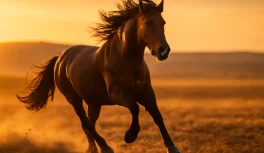
There’s a sound that stops every horse person in their tracks: hooves striking the ground at the canter, fast and rhythmic and alive. But trail cantering is not simply about going faster. Terrain shifts, space narrows, the unexpected appears — and that’s exactly when three things matter above all else: safety, control, and stamina.
The good news is that it absolutely is possible to experience the thrill of cantering on the trail in a way that’s both conscious and beautiful — no rush, nothing to prove, just respect for the horse and the path ahead.
What Changes When the Canter Leaves the Arena?
In more controlled settings — arenas, familiar open fields, clear straight lines — predictability is your ally. On the trail, you have the opposite: constant variation.
Ground can shift from firm to soft within a few strides. Loose rocks, holes, roots, mud, and sand appear without warning. The path may narrow, curve sharply, or run through shadow that tricks the eye. You may encounter hikers, cyclists, other animals, fences, bridges — any of it, at any time.
That’s why trail cantering is more about rhythm than speed. It’s the “measured” canter: the one you can adjust and bring back down smoothly, without a battle.
Is the Horse-Rider Pair Ready for the Trail?
Is the Horse Conditioned for Trail Work?
This isn’t just about having energy. It’s about physical preparation: muscle, cardiovascular capacity, coordination, and confidence.
A horse returning from a long rest, one that only ever walks on trail rides, or one that tires quickly at the trot — that horse shouldn’t be asked for a sustained canter on the trail. Build progressively: an active walk, controlled trot, and short canters only once everything feels easy and forward.
What About Hooves and Shoeing?
Different surfaces demand hooves in good condition. An overly worn hoof, a loose shoe, sensitivity on rocky ground — all of these become real risks outdoors. If you’re not a hoof expert, that’s fine — but make it a habit to check, and consult a farrier or veterinarian whenever something seems off.
And You — Are You Balanced and Stable?
On the trail, the horse will compensate for every ground irregularity. If the rider is loose, off-balance, or tense, they become dead weight in exactly the wrong place.
The key is balance and lightness. Control starts in your own body before it ever reaches the reins.
Trail Canter Safety Starts Before You Mount
Equipment That Isn’t Optional
- Helmet: the non-negotiable baseline.
- Boots or proper footwear: secure in the stirrup, no slipping.
- Gloves (optional but useful): improve grip and protect against rein burns.
- Protective vest (optional): many riders use one on more technical trails.
If you’re a beginner — especially a younger rider — the safest rule is simple: always ride with an experienced adult or guide, on trails appropriate to your level.
A Quick Pre-Ride Checklist
- Girth well-adjusted (snug but not overtightened)
- Breastplate if the terrain involves significant hills (when recommended)
- Stirrups at the right length
- Reins and bit comfortable for the horse
- Saddle seated correctly (no risk of shifting)
This quick check prevents most of the situations that turn a good ride into a bad day.
Know the Trail Before You Canter It
Ask or find out: are there slippery sections? Bridges? Narrow passages? A lot of elevation change?
Trail cantering and “I have no idea what’s coming” do not mix well.
Control in the Canter: The Brake That Doesn’t Fight the Horse
If the horse learns that you only know how to stop by pulling hard, the reaction often gets worse — and that’s how a dispute starts. The goal is layered control built over time.
1) Rhythm Before Speed
Think of it this way: “I choose the rhythm, and I can come back whenever I want.”
Practice transitions:
- Walk to trot and back
- Trot to short canter and back
- Canter back to trot (smooth, no jolt)
Smooth transitions keep the horse “in your hand” — and calmer overall.
2) How Do You Steer Without Pulling?
Your body is always communicating with the horse:
- Eyes lead the direction.
- Torso follows the line of the trail.
- Legs stabilize (not clamping in panic).
- Hands steady and soft, not locked.
One detail that changes everything: don’t lean back as if you’re braking a bicycle. That usually stiffens and unbalances. Keep your torso organized and use transitions instead.
3) In a Group, Safety Is Distance
On the trail, horses feed off each other’s energy when riding close. Keep space between horses. Agree on signals with your guide before you go: who leads, who stops, where trotting and cantering are allowed.
Stamina: How to Manage Energy Across Different Terrain
Here’s a simple truth: the terrain sets the rhythm. Your goal is to take care of the horse so they finish the ride well — sound and confident.
Uphills: Less Is More
Climbing significantly increases muscular effort.
- Prefer a strong trot or a very short canter, only if the terrain allows it.
- Let the horse find its own body — don’t push for acceleration.
- If you notice the horse losing wind, come back to walk and recover.
Uphill is not a place to test endurance. It’s a place to use it intelligently.
Downhills: Control and Patience
Descending increases the risk of slipping and losing balance.
- In most cases, the walk is your best friend.
- If the horse wants to rush, use a transition and redirect — not a fight.
- Let the horse look at the ground and choose where to place its feet.
A canter on an uneven downhill can become an accident in seconds. Experienced trail riders respect the descent.
Sand and Soft Ground: More Tiring Than It Looks
Sand drains energy and makes every stride harder.
- Keep a conservative rhythm.
- Short canters with recovery time between them.
- Watch the horse’s breathing and sweat pattern.
Mud and Slippery Ground: Time for Humility
If the footing is slick, slow down. Cantering on mud is an open invitation to a slip. Even the most sure-footed horse can lose traction.
Rock and Gravel: Mind the Impact
Hard, uneven ground demands care:
- Avoid sustained cantering over long stretches.
- Prioritize a safe, measured rhythm.
- If it’s very rocky, the right call is to walk it through calmly.
Narrow Paths and Dense Brush
Curves, low branches, shadow, sections with limited sightlines…
- Canter only when the path is genuinely safe and open.
- Double your attention and control.
- If something unexpected appears, the horse needs to be able to come down — and so do you.
When Is It Time to Slow Down?
Signs in the Horse
- Heavy breathing that takes a long time to normalize.
- “Heavy” strides with no elasticity.
- Reluctance to continue forward, head high, visible tension.
- Unusual excessive sweating.
- Repeated stumbling — a possible sign of fatigue.
Signs in the Rider
- You start gripping hard and getting stiff.
- You lose your balance on the uneven ground.
- Growing fear and the feeling of “I’m losing control.”
- Breathlessness and fatigue affecting your decision-making.
On the trail, slowing down is not weakness — it’s experience.
How to Build Trail Cantering Without Rushing It
For beginner riders, this progression works well — always with an experienced person alongside:
1. Active walk for several minutes (warm-up). 2. Controlled trot on safe, straight sections. 3. Short canter (a few seconds) on firm, open ground only. 4. Return to trot, then walk (recovery). 5. Repeat a few times, always watching the horse.
The goal is not to “canter a lot.” It’s to canter better.
Common Trail Cantering Mistakes (and How to Avoid Them)
- Confusing canter with race pace: the trail calls for control, not speed.
- Cantering without knowing the terrain: the unexpected arrives fast.
- Stopping with force: creates tension and can startle the horse.
- Ignoring fatigue signs: a tired horse loses coordination.
- Trying to match a more experienced horse’s pace: every horse-rider pair has its own moment.
If you take one thing away: “The best trail rider is the one who comes home with a horse that’s well — and ready to go again.”
Trail Cantering: Freedom With Awareness
Cantering on the trail is one of the most beautiful feelings in riding: freedom, wind against your face, real connection with an extraordinary animal. And it becomes even more beautiful when it arrives with safety, control, and stamina.