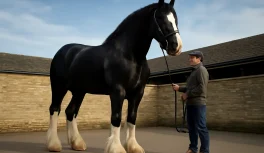
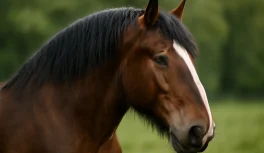
Stand next to a Shire horse for the first time and the sensation is difficult to describe. It is not simply about size — though the size is undeniable, with some animals topping 18 hands and pushing past 2,000 pounds. It is the combination: a creature built on a scale that suggests raw industrial power, moving through the world with the unhurried patience of an animal that knows exactly how strong it is and sees no reason to prove it. The Shire horse is, by most measures, the largest domesticated horse breed on Earth — and, paradoxically, one of the gentlest.
The Breed That Built Modern England
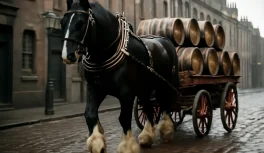
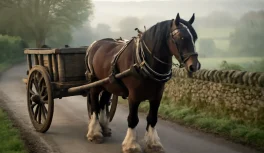
The Shire’s story is inseparable from the story of industrializing Britain. For two centuries — from roughly the mid-1700s through the early 1900s — these horses were the engines that moved the nation. They hauled coal from mines, timber from forests, and goods from docks to warehouses. They pulled brewery wagons through the cobblestone streets of London and Birmingham. They worked the fields of the English Midlands through every season, every weather condition, year after year.
Before the internal combustion engine displaced them, Shire horses were genuinely indispensable — not interchangeable units of labor, but specific, irreplaceable animals with established routes, regular handlers, and accumulated years of training. A well-seasoned Shire on a brewery delivery route knew its stops as well as its driver did.
What Defines the Breed
The Shire is classified as a heavy draft breed, meaning it was developed specifically for pulling loads rather than speed or agility. The defining physical characteristics flow directly from that purpose.
A Shire’s bone structure is massive, with broad, flat knees, large round hooves, and thick cannon bones that can withstand the stress of pulling thousands of pounds over hard pavement. The chest is exceptionally deep and wide, giving the lungs and heart room to support sustained heavy effort. The hindquarters — the engine of a draft horse’s pulling power — are broad, heavily muscled, and rounded. Adult Shires typically stand between 16 and 18 hands at the withers, though exceptional animals have reached 19 or even 20 hands.
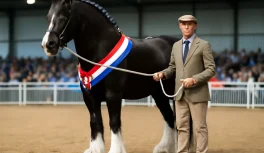
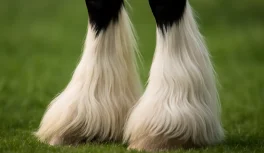
Then there is the feathering — the long, silky hair that flows from the knees and hocks down over the hooves. In well-kept animals, particularly dark-colored Shires with white feathering, the contrast between the dark coat and the flowing white hair creates one of the most visually striking silhouettes in the horse world.
Temperament: The Other Half of the Equation
No amount of physical power would have made the Shire useful in urban and agricultural settings without an equally remarkable temperament. Working horses in Victorian-era cities faced daily exposure to traffic, crowds, sudden noises, tight spaces, and unpredictable situations that would unsettle many animals. A nervous or reactive horse in those conditions was a genuine danger to everyone around it.
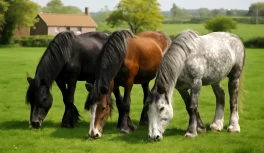
The Shire’s characteristic docility is not accidental — it is the product of centuries of selective breeding, in which generations of handlers consistently favored animals that were calm, trainable, and reliable over animals that were merely large or powerful. The result is a breed that tends toward patience and steadiness, willing to stand quietly for long periods, comfortable around people of all ages and experience levels, and rarely given to unprovoked agitation.
This combination of size and gentleness is what makes Shires particularly well-suited for certain modern roles. Equine therapy programs regularly use Shires or Shire crosses precisely because a large, calm animal provides sensory experiences and therapeutic benefits that smaller horses cannot replicate.
From Industry to Near-Extinction — and Back
The Shire’s relationship with the 20th century was nearly fatal. As internal combustion engines gradually replaced horses in agriculture and urban transport, the economic rationale for breeding and maintaining large, expensive heavy horses disappeared. By the mid-1950s, a breed that had numbered well over a million animals at its peak had collapsed to fewer than a thousand registered individuals.
The recovery came slowly, driven by a small community of breeders who maintained the breed out of passion and commitment rather than profit. International export to the United States, Canada, and Australia diversified the genetic pool and expanded the community of people who knew and cared about the breed. Today’s global Shire population is estimated between 3,000 and 5,000 — a long way from the breed’s peak, but a genuine recovery from the brink.
The Shire Today
The modern Shire has found a place in the world entirely different from its historical role. Competitive showing — evaluating conformation, movement, and presentation — is the breed’s primary showcase. The annual Shire Horse Spring Show in the United Kingdom remains the world’s largest event dedicated to the breed.
Beyond showing, Shires appear in equine therapy programs, agritourism operations, historical recreations, and the occasional sustainable farming application where their ability to work terrain inaccessible to tractors gives them practical relevance. A handful of British breweries still maintain Shires for ceremonial and marketing purposes, maintaining a connection to the breed’s most iconic historical role.
The Shire is unlikely to return to its Victorian numbers — that era, with its specific economic requirements, is gone. But a breed that was nearly written off as an industrial artifact has demonstrated remarkable resilience. The Shire persists not because it is economically necessary but because the people who have spent time with these animals find them impossible to forget.