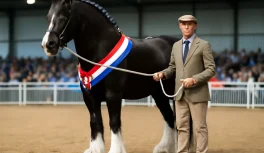
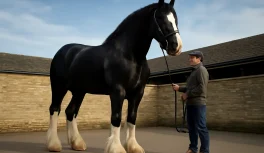
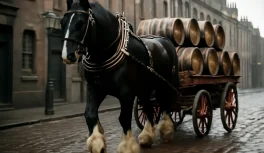
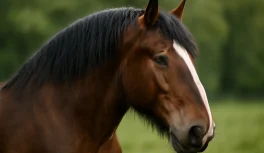
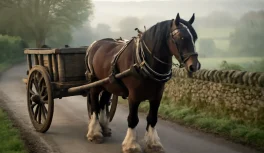
There is a moment at Shire horse shows that never loses its impact, no matter how many times you have seen it: a jet-black horse the size of a small car walks into the arena, and its legs — from the knees downward — appear to be wearing white silk skirts that billow and flow with every step. The contrast between the horse’s massive, muscular body and the ethereal lightness of those flowing white hairs produces a visual effect that seems almost impossible. Something this large should not move like that.
The feathering — as this long, silky leg hair is called in equestrian terminology — is the most immediately recognizable feature of the Shire horse. It is also considerably more than a visual signature.
What Feathering Actually Is
What exactly is horse feathering and where on the Shire does it grow?
Feathering consists of long, silky hair that grows from the lower legs, specifically from the area below the knees on the front legs and below the hocks on the rear legs. This growth area corresponds roughly to the metacarpal and metatarsal bones — what would be, in human anatomy, the region from the mid-forearm or mid-shin down to the wrist or ankle.
In Shires with well-developed feathering, this hair can grow long enough to completely cover the hooves, extending several inches past them and sometimes brushing the ground during movement. The texture is distinctive: finer and silkier than the horse’s regular body coat, with a quality that surprises people who touch it for the first time.
Which other breeds have feathering and how does the Shire’s compare?
Feathering is not unique to the Shire — it appears in Clydesdales, Friesians, Gypsy Vanners, and some Haflingers. But in no other breed is it as abundant, as fine in texture, or as central to visual identity as in the Shire.
Why It Developed: Function Before Aesthetics
What climate conditions led to the Shire developing its characteristic feathering?
The evolutionary explanation most widely accepted is climate adaptation. The regions where the Shire developed — the English Midlands, in particular — have cold, damp winters and notoriously muddy ground conditions. Horses working in these environments spend months with their lower legs in constant contact with mud, standing water, and wet vegetation.
Feathering functions as a physical barrier between the environment and the skin. The dense structure of the hair prevents moisture and mud from reaching the skin directly, reducing the risk of the bacterial and fungal skin infections that are common in horses kept in wet conditions without adequate protection. The hair also provides insulation against cold, maintaining a slightly warmer microenvironment around the lower leg.
How does feathering help protect Shire horses from bacterial skin infections?
There is some evidence that the moisture held within feathering may also have a softening effect on the skin, preventing the cracking and drying that occurs in bare-skinned legs exposed directly to cold, dry conditions. In drier continental climates, this advantage is less relevant — which may explain why heavy horse breeds that developed in drier regions typically have less feathering.
Color and Presentation
How does feathering color relate to the Shire’s overall coat color?
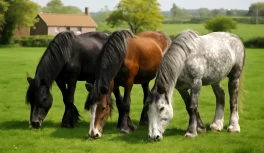
The color of a Shire’s feathering follows the horse’s overall color patterns. On black horses — the most common in show contexts — feathering is typically white or mixed white-and-black, creating the dramatic contrast most associated with the breed. On bay or brown horses, feathering tends to match or lighten slightly relative to the body coat. On roans, feathering reflects the mixed coloring characteristic of that pattern.
Show preparation for feathering is an art form with its own traditions, products, and techniques. It begins days before an event: washing with whitening shampoos for light-feathered horses, intensive conditioning treatments to maximize shine and volume. On the day of showing, feathering is dried, brushed, sometimes treated with a light spray to enhance volume, and worked into its most impressive presentation.
What is feathering braiding and when is it used in Shire horse presentation?
Some handlers braid feathering into decorative patterns — a practice called feathering braiding — particularly for parades and ceremonial occasions. The result is an elaborate, geometric arrangement that transforms the flowing hair into structured decoration, though this practice is more common in public displays than in formal conformation judging.
The Practical Challenge: Care and Skin Health
What skin problems can develop in Shire horses with poorly maintained feathering?
Feathering is beautiful. It is also work. On horses kept outdoors in typical pasture conditions, feathering collects mud, manure, plant material, and moisture constantly. Without regular cleaning, this accumulation creates ideal conditions for skin infections.
The most common condition in Shires with poorly maintained feathering is scratches — also called mud fever or greasy heel — a bacterial or fungal dermatitis affecting the skin on the lower legs. Symptoms include crusty deposits, flaking skin, cracking, and in advanced cases, swelling and lameness. Any Shire kept in wet conditions without proper maintenance is at risk.
How do experienced Shire owners prevent skin infections under the feathering?
Prevention requires regular inspection of the skin under the feathering — which means physically lifting the hair to examine the skin below — combined with drying after prolonged exposure to wet conditions and maintaining adequate hygiene in the horse’s living environment. Some breeders lightly trim the inner feathering to improve air circulation, though this is controversial in breed standards circles and rare in competition animals.
Feathering in the Breed Standard
How does the Shire Horse Society’s breed standard evaluate feathering quality?
The Shire Horse Society’s conformation evaluation specifically assesses feathering quality. The standard calls for abundant, silky hair that begins well above the hoof — not sparse, coarse, or limited to the lower portion of the leg. Quality feathering is considered an indicator of overall breed type, not a separate trait.
A Shire without well-developed feathering looks incomplete — like a crucial visual element is missing. The feathering connects the modern animal to centuries of breeding, to its Flemish ancestors who brought this trait to England, and to the cold, wet, working environment that shaped it into one of the most striking features of any horse breed in the world.