Every year, the Guinness World Records receives candidates for the “world’s tallest horse” category. And nearly every year, the winner is a Shire horse — or a Shire cross. This is not coincidence. The breed that developed the most extreme physical dimensions in all of domesticated horse breeding continues to regularly produce animals that surpass any other in height and weight.
Sampson: The Record That Has Stood for 175 Years
Who was Sampson and how did he reach 21.2 hands — the tallest horse ever recorded?
No documented horse has ever surpassed the dimensions of Sampson — later renamed Mammoth — a Shire born in 1846 at the property of Thomas Cleaver in Toddington Mills, Bedfordshire, England.
Sampson was measured in 1850, at four years of age, and recorded a height of 21.2½ hands — approximately 7 feet 2 inches at the withers. A measurement verified by multiple witnesses and documented by the Shire Horse Society. For reference: a large horse by contemporary standards stands between 16 and 17 hands. Sampson was roughly five hands — nearly twenty inches — taller.
Sampson’s weight was not precisely recorded, but contemporary estimates suggested between 2,600 and 3,300 pounds — approximately three times the weight of a thoroughbred racehorse.
How did Sampson’s genetics shape the modern Shire breed?
Sampson stood at stud, and his influence on the Shire breed was significant. Many modern Shires carry Sampson in their genealogy several generations back. He became the reference standard for what the breed could produce at maximum size — a benchmark that, remarkably, remains unbroken more than 175 years after his measurement.
Big Jake: The Contemporary Record Holder
Who was Big Jake and what made him the world’s tallest horse in modern records?
In the 21st century, the most famous horse for sheer size was Big Jake — a chestnut born in 2000 in Nebraska and owned by Smokey Hollow Farm in Wisconsin.
Big Jake was recognized by Guinness World Records in 2010 as the world’s tallest living horse, standing 20.2¾ hands — just over 6 feet 10 inches at the withers. His estimated weight was 2,500 pounds. To maintain his size, he consumed approximately 40 quarts of oats, 40 pounds of hay, and 30 pounds of mixed grass daily — feed quantities that would sustain several average-sized horses.
Was Big Jake a purebred Shire — and what does that reveal about draft horse genetics?
Big Jake was technically a Belgian Draft (Brabant) rather than a purebred Shire. But the fact that the contemporary record holder was a heavy draft breed confirmed the consistent pattern: the world’s tallest horses are invariably from breeds developed for heavy work rather than speed.
Big Jake died in June 2021 at 20 years of age. Guinness World Records noted his death as the end of a decade-long reign in the category.
Radar: The Tallest Purebred Shire in Modern Records
Who was Radar and how did a Texas farm produce the world’s tallest purebred Shire?
The tallest registered purebred Shire in modern documentation was Radar, born in 2000 in San Antonio, Texas, and owned by Monte and Susan Geer.
Radar stood 19.3½ hands — approximately 6 feet 7 inches at the withers — and weighed approximately 2,400 pounds. He was recognized by Guinness World Records in 2004 as the world’s tallest living horse at the time, before Big Jake surpassed him in 2010. His formal recognition in the breed registry made him one of the most photographed and documented Shires of the period.
What does Radar’s American story reveal about how the Shire was saved from extinction?
Radar’s Texas origin illustrates an often overlooked aspect of the Shire’s survival story. The American enthusiasm for the breed — which was part of what saved the Shire from extinction — produced exceptional animals in geographically unlikely locations. The Midlands climate that shaped the breed’s development is a long way from the Texas Hill Country.
What Produces a Giant: Genetics and Nutrition
What genetic factors determine whether a Shire foal will reach record dimensions?
Reaching the extreme dimensions of a Sampson or a Radar is not merely good genetic luck. It requires a specific combination of factors aligning precisely.
Genetics comes first. The genes responsible for skeletal and muscular size must be present in both parents. Breeders pursuing maximum size select the largest and best-proportioned animals from each generation, prioritizing not just height but bone structure, chest depth, and hip width. Selecting for one dimension without the others produces disproportionate animals that do not remain sound under their own weight.
Why is early nutrition so critical for a Shire foal’s potential size?
Nutrition in the early years is critical. A Shire foal that does not receive adequate protein, minerals, and calories during its growth period will not reach its genetic potential. The largest documented individuals invariably grew up in environments with abundant, high-quality feed, rich pasture, and rigorous veterinary care.
Growth timing also matters. Shires take longer to reach full physical maturity than lighter breeds — approximately five years for the skeleton to fully develop. Forcing heavy work before that age compromises skeletal development and limits the animal’s ultimate size and soundness.
Why Show Judges Value Proportion, Not Just Size
What do Shire Horse Society judges actually evaluate in a championship class?
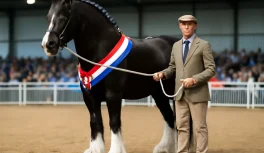
At Shire Horse Society shows, the largest horse is not necessarily the winner. Judges evaluate a combination of conformation, proportion, presentation, and movement — and an animal that is simply large but disproportionate rarely wins over a moderately sized animal with perfect conformation.
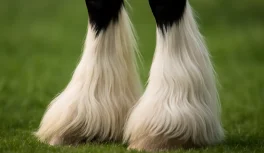
Judging criteria include: shoulder angle and slope, chest depth, loin length and curvature, hip width, lower leg quality (bone, joints, tendons), and feathering quality. Movement at the trot is evaluated as well — a large horse that moves with fluidity, elevation, and consistency impresses more than an enormous animal that drags its feet.
What price can a Shire show champion command at auction?
The ideal champion combines impressive dimensions with structural perfection. These animals achieve extraordinary prices at auction — a championship show Shire can command tens of thousands of pounds or dollars.
The Biological Ceiling
Is there a biological size limit that even centuries of Shire breeding cannot transcend?
The fascination with record-breaking Shire horses is not purely a curiosity. The size records have implications for understanding what selective breeding can achieve in domestic animals — and the biological limits that even centuries of intense selection have not been able to transcend.
The fact that no documented horse has ever surpassed Sampson’s 21.2½ hands suggests this may be close to the anatomical ceiling for a functional equine. Above a certain weight and height, orthopedic and cardiovascular problems become clinically significant — the legs were not designed to support much more than a ton of weight.
It is one of the limits that biology imposes even on the most ambitious breeding program. There is a maximum size beyond which an animal cannot function soundly. The Shire lives — and thrives — very close to that limit.