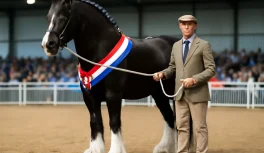
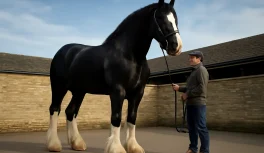
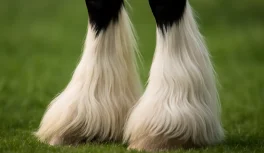
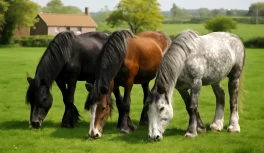
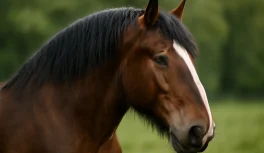
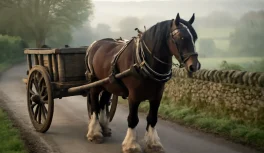
Before refrigerated trucks, before motorized distribution fleets, before the logistics systems that move goods invisibly through modern cities, London had a delivery network that was simultaneously ancient and extraordinarily efficient. It operated on four legs, weighed close to a ton, and was guided by drivers who knew every street, alley, and pub in their territory. For more than two centuries, Shire horses were the circulatory system of the British brewing industry.
The Logic of the Partnership
Why did British breweries choose the Shire horse above all other draft breeds?
To understand why British breweries adopted the Shire as their preferred working animal, you need to understand what they were moving. Victorian-era beer was produced and distributed in wooden casks — barrels that weighed 50 to 100 pounds empty and could exceed 400 pounds when full. A single delivery wagon carried multiple casks, plus the equipment needed to handle them.
The total load on a loaded brewery delivery wagon — vehicle, full casks, handling equipment, driver — regularly exceeded 6,000 pounds. Pulling that weight through London’s cobblestone streets, with their grades, corners, and the unpredictable chaos of urban traffic, required an animal of exceptional strength.
What qualities made the Shire uniquely irreplaceable for urban delivery work?
The Shire was the only breed that did this routinely and reliably. Other heavy breeds existed, but none combined the raw strength required with the calm, predictable temperament that urban work demanded. A nervous or reactive horse in the middle of Victorian-era city traffic — with its trams, pedestrians, street vendors, and competing vehicles — was a genuine danger to everyone around it. The Shire’s famous docility was not a nice-to-have feature; it was an operational requirement.
The Major Breweries and Their Horses
How did Whitbread manage its Shire horse fleet at the Chiswell Street complex?
Whitbread & Co., founded in London in 1742, was among the first major breweries to adopt the Shire at industrial scale. Their stables at the Chiswell Street complex in central London housed dozens of animals simultaneously at peak operation. The routine was precise: horses worked fixed shifts, rested in clean stalls, received calculated feed rations for their energy demands, and were examined regularly by the brewery’s veterinarian.
Bass Brewery in Burton-upon-Trent ran similar operations. By the late 19th century, the largest English breweries collectively maintained hundreds of Shire horses in their delivery fleets. These were working animals, but they were maintained carefully — not out of sentimentality but out of pragmatism. An injured or ill Shire disrupted entire delivery routes, affected customer service, and represented a significant capital loss.
Why did Young’s Brewery keep its Shires until 2006 when all others had switched to trucks?
Young’s Brewery in Wandsworth, London, became the most famous example of brewery loyalty to the Shire. While every other major brewery progressively replaced its horses with motor trucks through the 20th century, Young’s maintained its Shire fleet until 2006 — when the brewery’s relocation to Bedfordshire finally made the operation impractical. For Londoners, Young’s Shires were part of the urban landscape, a living connection to a pre-industrial city that most people knew only through photographs.
A Working Day in the Life
What was the daily routine of a brewery Shire horse?
The daily routine of a brewery Shire began well before dawn. Horses were awakened, fed, and prepared — groomed and harnessed — by stable hands who arrived hours before the first deliveries. Fitting a Shire’s complete working harness was a 20-to-30-minute process involving a padded collar, full draft harness, reins, and all the connecting hardware.
What kind of working relationship did brewery drivers build with their Shire horses?
The working day consisted of fixed routes through the city, with scheduled stops at pubs, hotels, and warehouses. Drivers developed deep working relationships with their animals — learning each horse’s particular responses to traffic situations, its strengths and weak points, how it behaved in different conditions.
At the end of the day, horses were unharnessed, washed down, inspected for injuries, fed, and returned to their stalls. The routine was demanding for both parties — driver and animal — and functioned only on the basis of trust built over months and years of working together.
The Numbers: What a Shire Could Pull
How much weight could a well-matched pair of Shire horses pull through London’s streets?
The working figures from the brewery era were remarkable. A well-matched pair of Shires could pull a load of 6,000 to 8,000 pounds across level ground with what appeared to be relative ease. On grades, the required force increased proportionally — experienced drivers knew to pause at strategic points on steep routes, giving the horses time to recover before continuing.
How many miles did a working brewery Shire cover in a typical day?
Historians have documented brewery delivery routes covering 12 to 15 miles per day, with multiple stops for loading and unloading heavy casks. A Shire doing this work five or six days per week was covering distances and handling loads that would have been physically impossible for any lighter breed.
The hooves of working urban Shires required reshoeing every six to eight weeks, depending on terrain and workload. The major breweries employed full-time farriers — not occasional contract workers but permanent staff members whose sole responsibility was maintaining the feet of the brewery’s horses.
The Cultural Legacy
How did the Shire horse become a symbol of British brewing identity?
The most enduring aspect of the Shire-brewery partnership may be cultural rather than economic. The image of large, dark, immaculately presented horses pulling gleaming wagons through London’s streets became part of the visual identity of British brewing — a picture of tradition, strength, and craftsmanship that no amount of motor truck advertising could replicate.
Budweiser’s Clydesdale campaign made a version of this imagery globally famous in the United States. But the original tradition was British, and it was Shires. Companies like Young’s and Whitbread used their horses in advertising campaigns for decades, recognizing that the animals communicated qualities no marketing copy could quite capture: authenticity, continuity, a connection to a way of doing things that predated the industrial age.
Why did the retirement of Young’s last Shires make national news in Britain?
When Young’s retired its last working Shires in 2006, British media covered the event extensively. It was not merely the end of an operational decision — it was the end of a tradition spanning more than two centuries. The horses were retired to a preservation group and continue to appear at public events and brewery celebrations. They are ambassadors of an era that has passed — but whose traces, thanks to these extraordinary animals, remain visible in the streets of London for those who know to look.