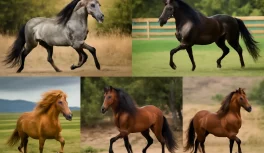
Ask an experienced horseperson the difference between a Lusitano and an Andalusian and prepare for a long — and probably passionate — discussion. The two breeds share the same origin, the same history, and to the untrained eye, nearly identical appearance. Yet Portuguese and Spanish breeders maintain separate studbooks for reasons that go beyond politics: there are real, measurable, and functionally meaningful differences between the two horses.
Lusitano vs. Andalusian is one of the most fascinating comparisons in the equestrian world — not because one is superior to the other, but because the difference reveals how distinct selection choices across just a few decades can produce distinct results from the same genetic foundation.
A Shared Origin: When They Were One
Until 1966, the Lusitano and the Andalusian were, for all practical purposes, the same breed — called the Iberian Horse, or simply the “Spanish Horse” (a term that persisted even for Portuguese horses). The separate studbooks are recent in the history of a breed with more than five thousand years of documented presence on the Iberian Peninsula.
The split was driven by technical disagreements between breeders from the two countries, particularly regarding:
- The degree of subconvex profile considered ideal for the breed standard
- The acceptance of crosses with other breeds (Spanish breeders had introduced Anglo-Arab and Thoroughbred blood in some lines during the 20th century)
- Studbook registration and stallion approval criteria
After the split:
- The Lusitano is registered exclusively by the APSL (Associação Portuguesa de Criadores do Cavalo Puro Sangue Lusitano)
- The Andalusian is registered by the ANCCE as the PRE (Pura Raza Española)
Despite the formal separation, the two studbooks maintain deep historical connection — and exceptional individuals on both sides continue to inform debates about the ideal Iberian standard.
Physical Differences: What Trained Eyes See
To most observers, Lusitano and Andalusian are indistinguishable. To experienced breeders and riders, the differences are visible and consistent.
Head: The Lusitano typically has a more pronounced subconvex profile — a gently arched line from poll to muzzle — and an expression many describe as more “inward” and deep. The PRE tends toward a straighter or mildly subconvex profile, with an expression described as more expressive and outward-facing.
Neck: The Lusitano tends toward a longer, more arched neck set higher on the chest. The PRE typically has a shorter, more muscular neck. The difference affects how each breed carries itself in work.
Hindquarters: The Lusitano has rounder hindquarters with a relatively lower tail set. The modern PRE tends toward slightly flatter hindquarters with a marginally higher tail set.
Hind limbs: The Lusitano has joint angles that facilitate the deep posterior engagement needed for collection-based work — a trait selected for high school training. The PRE tends toward slightly more closed angles.
Size: The modern PRE is frequently slightly taller than the average Lusitano — the result of decades of selection toward the larger-framed horses preferred by the modern European dressage market.
Temperament: Where Lusitano and Andalusian Differ Most
This is the area where the difference between the two breeds is most consistently reported by riders who have worked with both.
The Lusitano is often described as more intense, more sensitive to aids, and more focused on the work. It responds to subtleties that would go unnoticed by other breeds, tends to form deep bonds with specific riders, and can be more challenging for riders with inconsistency in position or emotion.
The Andalusian is often described as slightly more extroverted, with a marginally more forgiving edge of temperament for a wider range of rider types. It retains the intelligence and sensitivity characteristic of Iberian horses but with slightly more tolerance for rider inconsistencies.
This generalization has exceptions in both breeds — and the training each individual horse has received has far more impact on daily behavior than breed alone. But as a tendency of selection, the difference is recognized by specialists from both countries.
How Do the Two Breeds Compare in Sport?
FEI dressage: The Andalusian has slightly greater presence in high-level European FEI dressage, partly because Spain has a stronger tradition in the continental competition circuit and partly because Spanish breeders invested earlier in larger-framed horses suited to the modern dressage market.
Working Equitation: Both breeds are equally dominant — this discipline was created for Iberian breeds, and it is difficult to distinguish advantage of one over the other in this context.
Classical equitation and High School: The Lusitano holds a historical advantage. The Portuguese School of Equestrian Art works exclusively with Lusitanos, and the Portuguese classical tradition is the most publicly active in the world in terms of regular live demonstrations and pedagogical continuity.
Cattle work: Both breeds are used in work with fighting bulls. The Lusitano has greater presence in the Portuguese mounted bullfighting tradition, where rejoneo is central to national equestrian culture.
Lusitano or Andalusian: Which Should You Choose?
The decision depends less on breed and more on the rider, the goal, and the market available in their region.
Choose the Lusitano if:
- You have equestrian experience and are seeking a demanding, deep partnership
- Your primary interest is classical equitation, High School, or Working Equitation
- You are in Brazil, Portugal, or another market where Lusitanos have greater availability and breeder support
Choose the Andalusian (PRE) if:
- You are in Spain or Mexico — markets with strong PRE presence and local support infrastructure
- You want an Iberian horse with a temperament that is slightly more accessible to a wider range of riders
- Your primary focus is modern FEI competition dressage and access to the European sport horse market
In the end, the choice between the two breeds matters less than choosing the right individual horse — with the right temperament, training, and health for the specific rider. A good Lusitano and a good PRE have more in common than any studbook split could separate.