Some creatures challenge every assumption about size without sacrificing any of the qualities that make horses extraordinary. The miniature horse has the proportional structure, intelligence, temperament, and elegance of its larger relatives — but it fits comfortably in a space most dog owners would consider perfectly reasonable. Standing between 30 and 38 inches at the withers, depending on breed and registry standards, these animals have been winning over breeders, therapists, and families around the world for reasons that go far beyond appearance.
But what exactly is a miniature horse? How does it differ from a pony? What are the recognized breeds, what distinguishes one from another, and what should you know before deciding to get one? This article answers all of those questions in full.
Miniature Horse vs. Pony: A Distinction That Matters
The confusion between miniature horses and ponies is understandable, but technically incorrect — and understanding the difference is the essential first step into the miniature horse world.
Ponies are genetically distinct breeds that, over centuries of adaptation to harsh environments — islands, mountains, cold climates, sparse pasture — developed compact, robust bodies with characteristic proportions: relatively short legs compared to the trunk, abundant mane and tail, dense bone structure, and a more independent temperament. Breeds like the Shetland, Welsh, and Haflinger are ponies.
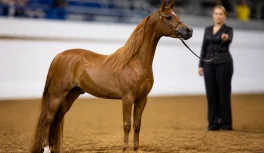
Miniature horses, on the other hand, are intentionally bred to reproduce the proportions of a full-sized horse at a reduced scale. The head should be refined rather than broad, the legs well-proportioned to the trunk, the neck arched and elegant. The goal of breeders is literally a horse in miniature — not a compact, sturdy equine variant.
This distinction is reflected in the registries: organizations like the American Miniature Horse Association (AMHA) and the American Miniature Horse Registry (AMHR) have strict standards that penalize pony-type characteristics, including a wide forehead, heavy bone structure, or short body proportions.
The Major Miniature Horse Breeds
American Miniature Horse
This is the most numerous and best-documented breed among miniature horses worldwide. Developed in the United States through centuries of selective breeding, the American Miniature Horse draws on the bloodlines of the Shetland, Hackney, Welsh Pony, Thoroughbred, and Arabian. The result is an animal of harmonious proportions, docile temperament, and high adaptability.
The AMHA registers only animals up to 34 inches (86 cm) at the withers. The AMHR takes a broader approach, with two divisions: “A” (up to 34 inches) and “B” (between 34 and 38 inches). This is the breed most often found at shows, halter classes, and therapy programs around the world.
Falabella
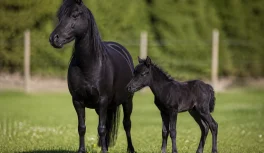
The most famous and one of the rarest miniature horse breeds. Originating in Argentina, the breed was developed by the Falabella family over more than 150 years of selective breeding, starting from horses brought to the South American pampas by Iberian settlers. The result is an animal that can stand below 30 inches at maturity — frequently cited as the world’s smallest horse.
The Falabella is genetically closer to a refined horse breed than to a pony, with the elegant profile and refined proportions that visually distinguish it from other miniatures. These animals are the product of extremely selective breeding, which explains their premium value in international markets.
Other Breeds and Variations
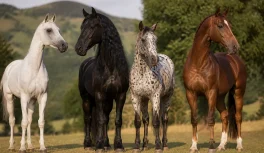
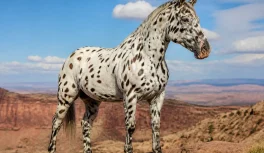
Several other breeds around the world produce miniature-sized individuals or are selectively bred for that purpose. The Miniature Appaloosa (spotted coat pattern in a miniature frame) and Miniature Pinto are examples of variations that combine specific aesthetic standards with reduced size. In all cases, the genetic starting point and breeding objective determine whether the final result is a true miniature horse or a pony variation.
Physical Characteristics
A quality miniature horse — whether American, Falabella, or another registered breed — presents well-defined physical characteristics that breeders and show judges evaluate carefully:
Height: between 30 and 38 inches at the withers in adulthood, depending on breed and registry. Measurement is taken at the last mane, not at the base of the mane.
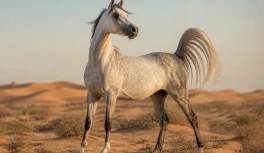
Head: refined, with a straight or slightly concave profile (dish face), large expressive eyes, wide nostrils, small well-set ears. No wide forehead or convex profile.
Neck: well-set, arched, with good musculature. The insertion angle against the shoulder largely determines the animal’s overall carriage and elegance.
Body: proportionally correct — well-developed ribcage, smooth hindquarters, firm topline. No low-hanging belly associated with poorly conditioned or metabolically compromised animals.
Legs and hooves: correct from an orthopedic standpoint, with well-formed, proportional hooves. Conformation faults are penalized at shows and represent genuine long-term health problems.
Coat: accepted in all colors and patterns — solid, pinto, appaloosa, palomino, roan, and more. This variety of coat patterns is one of the great attractions of the miniature horse world.
How the Miniature Horse Behaves
Temperament is, for many breeders and owners, the most surprising aspect of miniature horses. These animals have, proportionally to their size, all the intelligence, curiosity, and need for social interaction of their larger counterparts. They adapt well to human company, respond readily to training, and develop strong emotional bonds with the people who handle them.
This makes them excellent companions for families — particularly in animal-assisted therapy settings, where their gentleness and compact size make them accessible to children, the elderly, and people with limited mobility.
But that positive temperament comes with real needs that owners must understand. Miniature horses are herd animals and must never be kept in isolation. They need company — another miniature, a pony, or even other animals — along with space to move and mental stimulation. A bored or isolated miniature horse can develop problem behaviors including cribbing, weaving, or repetitive pacing.
What to Evaluate Before Choosing Your Miniature Horse
The decision to own a miniature horse requires careful planning across several dimensions:
Space: the minimum recommended is roughly 5,400 square feet per animal, with covered shelter of at least 65 square feet. Though far less than what full-sized horses need, this commitment is still significant for anyone living in an urban area.
Feeding: miniature horses are prone to obesity and equine metabolic syndrome (EMS). Diet must be monitored carefully — low-energy hay, mineral salt, and clean water are the foundation. Concentrate feeds should only be used under veterinary guidance.
Health: they require the same care as full-sized horses — vaccinations, deworming, hoof trimming, and regular veterinary visits. Teeth grow proportionally and need periodic dental work. Hooves should be trimmed every six to eight weeks.
Purpose: clearly defining whether the animal will serve as a companion, a show horse, a therapy horse, or some combination of these guides the choice of breed, physical type, and temperament.
Origin: purchase from registered breeders, with complete documentation, vaccination history, and a health certificate. Animals without provenance documentation may carry genetic problems accumulated through irresponsible breeding.
Where to Find Reputable Breeders
Breed associations are the safest starting point for anyone looking to purchase a miniature horse with verified provenance. They maintain registries of affiliated breeders, breed standards, and in many cases listings of animals available for sale.
In the United States, the AMHA and AMHR are the primary authorities for the American Miniature Horse. For the Falabella, the Falabella family’s Estancia El Cardal in Argentina and breed preservation associations in Argentina and Europe are the reference points internationally.
Specialized equestrian fairs and shows are also excellent opportunities to meet different bloodlines, speak directly with breeders, and compare animals in person — which is irreplaceable before making a purchase decision.