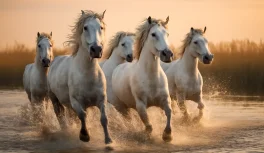
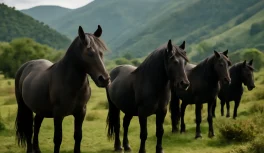
There is a horse breed that holds a record no other has ever threatened: more than 6 million horses registered with the American Quarter Horse Association (AQHA), the largest purebred horse database on the planet. The Quarter Horse is not just popular — it is extraordinary. From Texas to Brazil, from Australia to Japan, from rodeo arenas to family trails, the Quarter Horse is everywhere, doing everything. And doing it well.
This is the story of how an American horse from the 17th century became the most versatile, most widely used, and most registered breed in equestrian history.
From the New World to the World’s Largest Studbook
The Quarter Horse’s story begins in the early centuries of American colonization. English settlers in Virginia and the Carolinas had a simple, intense passion for horse racing — but not the long-distance style of the British model. They preferred the local version: two horses sprinting side by side down the main street of a colonial town. A quarter mile. Whoever gets there first, wins.
For these short sprints, a specific horse type emerged naturally: the best local sprinters, crossed with imported English Thoroughbred stallions. The result was relatively compact horses with impressive hindquarter musculature, explosive starting reflexes, and brutal acceleration in the first few strides. The name came from their favored distance: the Quarter Mile.
The breed was formally recognized in 1940 with the founding of the AQHA, which started with just three employees and barely 100 registered horses. Today, the association employs hundreds of people, manages more than 6 million historical records, and processes tens of thousands of new registrations annually. It is the largest horse studbook in the world, with no close competitor.
Why Is the Quarter Horse the World’s Most Versatile Breed?
The question is legitimate: what transforms a breed created for 400-meter sprints into the most widely used animal in virtually every equestrian context?
The answer lies in a combination of temperament, physical conformation, and natural instinct that few breeds can replicate.
Conformation: the Quarter Horse has an exceptionally muscular hindquarter — its most immediately visible breed characteristic. That musculature does not just serve for racing: it is the engine of every activity requiring explosive power and quick directional change. Cattle work, cutting (separating cattle from a herd), team penning, barrel racing — all require powerful hindquarters and the body balance the Quarter Horse possesses naturally.
Temperament: the breed is considered one of the calmest and most cooperative of all equine breeds. A genuine Quarter Horse has a quality Americans call “cow sense” — a practical, reactive intelligence that works especially well in cattle work. But it also simply means a horse that is easy to handle, does not spook easily, learns quickly, and tolerates mistakes from less experienced riders with unusual patience.
Instinct: the cutting horse functions in the cut without rider intervention — the rider drops the reins and the horse pursues and blocks the cow on its own. This “cow sense” is not trained from scratch — it is genetically present in Quarter Horse working lines. It is one of the most impressive demonstrations of applied equine intelligence that exists.
The Quarter Horse in Equestrian Sport
Quarter Horse Racing: the original discipline still exists as a professional sport in the United States, notably in Texas and New Mexico. The standard distance is 440 yards (402 meters). The best racing Quarter Horses reach 55 mph — making them the fastest horses on the planet at short distances, outpacing any Thoroughbred in a sprint.
Rodeo: the Quarter Horse is the horse of American rodeo. Barrel racing, team roping, tie-down roping, steer wrestling, cutting, reining — virtually every rodeo event is dominated by Quarter Horses. The combination of speed, agility, balance, and reliability is unmatched.
Reining: reining is often called “western dressage” — a discipline that tests the obedience, athleticism, and softness of horse and rider through specific patterns including circles, sliding stops, spins, and backing. The Quarter Horse dominates reining just as the Warmblood dominates classical dressage — it is the right horse for the discipline.
Cutting: arguably the most spectacular western rodeo event. The rider selects a cow from a herd, touches the horse’s neck as a signal, then drops the reins entirely. The horse — on its own, using its instinctive cow sense — pursues and blocks the cow for 2.5 minutes. Judging is about the horse’s work, not the rider’s.
Other disciplines: while less common, the Quarter Horse also competes in show jumping, cross-country, and other traditional equestrian disciplines with considerable success.
The Quarter Horse in Brazil and Beyond
Brazil is the second largest Quarter Horse breeding country in the world, after the United States. The Associação Brasileira de Criadores de Cavalo Quarto de Milha (ABQM) registers hundreds of thousands of animals and manages an extensive calendar of competitions including rodeos, races, and working events.
The rise of the Quarter Horse in Brazil is directly tied to agribusiness culture — it is the horse of the ranch hand, the modern farmer, the cattleman. On beef and dairy operations throughout the country, the Quarter Horse is the preferred working animal precisely for its cattle intelligence, versatility, and reliable temperament.
Outside Brazil and the United States, the breed has expanded significantly to Australia, Canada, Mexico, and Europe. The AQHA operates in dozens of countries with registration and competition programs.
Working Lines vs. Racing Lines: Important Distinctions
An important distinction for anyone choosing a Quarter Horse: very different genetic lines exist within the breed, optimized for different purposes.
Racing Quarter Horses: horses selected for maximum speed, with conformation closer to the Thoroughbred. Longer, more sensitive, less compact than working lines. Excellent sprinters but generally not ideal for cattle work or recreational riding.
Working/rodeo lines: what most people picture when they think of the Quarter Horse. Compact, muscular, with prominent hindquarters, calm temperament, and natural cow sense. Maximum versatility.
Halter lines: lines selected for extreme visual conformation in in-hand (halter) show competitions. Horses with hypertrophied musculature sometimes associated with health problems — a controversial line within the breeder community.
For riders seeking the classic, versatile Quarter Horse, the working and rodeo lines are what earn the breed’s historical reputation.
The Quarter Horse for Recreation and Beginning Riders
One of the great virtues of the Quarter Horse is its suitability for developing riders. The calm temperament, willingness to learn, and tolerance for riding mistakes make the breed an excellent choice for beginners and recreational riders.
Quarter Horses respond well to natural horsemanship and positive reinforcement training methods — their practical intelligence means they do not require excessive repetition to learn something new, and their collaborative nature means they work well with riders who communicate clarity and consistency.
For families with children, the adult, well-trained Quarter Horse is frequently the recommendation of equestrian instructors — the temperament makes the animal predictable and reliable in situations where more sensitive horses might react unpredictably.
Why the Quarter Horse Keeps Growing
In a global landscape where various breeds lost relevance with agricultural mechanization, the Quarter Horse kept growing — and the reason is versatility. A Thoroughbred was created for one thing: to race. A Warmblood was created for elite equestrian sport. The Quarter Horse was created to do everything.
Sprint racing, cattle work, rodeo competitions, family recreation, trail riding, equestrian sport, reining, cutting, barrel racing — and doing them all well. The world’s largest studbook is the simplest and most convincing numerical testimony that exists: when a breed works for everything, the entire world adopts it.