In the delta of the Rhône River, where France meets the Mediterranean, there is a world apart. Brackish marshes, reed grass prairies, pink flamingos skimming low over shallow water, black bulls grazing in open country. Among all the elements of this landscape, there is one that stops every traveler who encounters it for the first time: a herd of white horses galloping through the mud, their hooves throwing up arcing curtains of water, manes streaming in the wind, riderless, seemingly purposeless.
Camargue horses have existed in this landscape for far longer than any historical record can document. And even today, they live here as they always have — free, or close enough to it.
Where Do Camargue Horses Come From?
The exact origin of the Camargue horse is a puzzle that paleontologists and geneticists are still working out. Horse bones found near the delta — at archaeological sites like Solutré in southern France — suggest that equines inhabited this region for tens of thousands of years, possibly before the end of the last Ice Age.
One theory, built on mitochondrial DNA analysis, holds that Camargue horses may be direct descendants of an equine lineage that survived the post-glacial extinction in western Europe — which would make them one of the genetically oldest horse populations in the world. If that hypothesis holds, we’re looking at something extraordinary: a population that endured millennia of climate change, human transformation, and ecological pressure without losing its essential character.
Other analyses point to contributions from Barb and Arabian horses introduced by Moorish invaders during the Islamic expansion into the Iberian Peninsula in the 8th and 9th centuries — animals that arrived in southern France overland and mixed with the local populations.
Why Are Camargue Horses White?
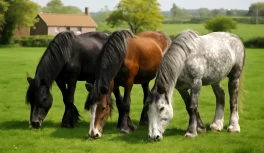
This is one of the most frequently asked questions about the breed — and the answer is full of nuance. Camargue horses are not born white. They’re born dark, typically a dark gray-brown or near-black, and lighten progressively over the first four to six years of life until they reach the silvery white that defines the adult horse.
Genetically, this is a phenomenon called progressive roaning associated with the gray gene — the same gene responsible for the gray coat in breeds like the Lipizzaner and the pure Arabian. Horses carrying this gene grow progressively lighter as pigmented hairs are replaced by white ones, a process that’s complete by around five or six years of age.
The result is paradoxical: the iconic image of the Camargue as a white horse is real, but it’s a phase — a transformation that happens across each individual’s lifetime, not a permanent state from birth.
Life in the Marshes
The Camargue is a hostile environment for most animals. Brackish water covers much of the territory during the rainy season; summer brings the full severity of Mediterranean heat and drought; and salt saturating the soil and vegetation demands specific physiological adaptations. Over centuries, Camargue horses developed a set of characteristics that make them perfectly suited to these conditions.
Their hooves are particularly notable: broader and tougher than those of standard European breeds, they handle waterlogged terrain without developing the problems that plague conventionally bred horses in wet conditions. Their digestive systems are adapted to a diet of nutrient-poor grasses — common reed (Phragmites australis) is a major dietary staple, but it is low in nutritional value and would be insufficient for a larger-bodied breed.
Herd structure follows familiar patterns: a dominant stallion, four to twelve mares, and the year’s foals. Young males form bachelor bands on the edges of established herd territories until they reach the maturity needed to challenge for a dominant position. The oldest mare typically leads the group’s movements.
Are Camargue Horses Truly Wild?
Here an important distinction applies. Camargue horses are semi-wild — technically feral, but subject to a traditional management system that includes an annual roundup called the ferrade. During this event, the year’s foals are branded, counted, and examined by veterinarians. Excess stallions are gelded. Some animals are selected for working purposes or sale.
This work is carried out by the gardians — the traditional horsemen of the Camargue, who work cattle on horseback using techniques passed down over centuries. The gardian mounted on a Camargue horse is as culturally iconic in the region as the cowboy is in the American West.
The breed was officially recognized by France in 1978. A studbook tracks registered animals and maintains breed standards. Camargue horses are exported across Europe, where they’re used for recreational riding, cattle work, and equestrian tourism.
The Camargue as Ecosystem
The region is today a UNESCO Biosphere Reserve and home to one of the largest flamingo colonies in the Mediterranean basin, along with dozens of migratory bird species. The Camargue bull — a local cattle breed also raised semi-wild — shares the pasturelands with the horses.
This coexistence is not incidental. Grazing by both horses and cattle keeps vegetation in check, preventing fast-growing reeds and other plants from completely overtaking the wetlands and eliminating the open habitats that wading birds require. In this context, the horses function as a keystone species — their presence maintains the ecological balance of the entire system.
The Mediterranean climate, however, is changing. Hotter summers, longer droughts, and more intense flood events are altering the delta’s hydrology in ways that directly affect the availability of food and freshwater for the horses. Researchers are closely tracking how the populations respond to these shifts.
What Is the Conservation Status of Camargue Horses Today?
The breed is not threatened with extinction, but it faces pressures. The studbook registers several hundred approved stallions and thousands of enrolled mares. The semi-wild population within the Camargue itself is estimated at around 5,000 to 6,000 animals.
The greater risk is not numerical decline but genetic dilution through crossbreeding with other breeds — a practice some breeders pursue to increase the horses’ size, but one that erodes the specific characteristics that make the Camargue horse singular. The studbook and breeders’ associations work to uphold purity standards against this pressure.
Beyond the Marshes: Cultural Presence
Camargue horses are not simply part of an ecosystem. They are part of a regional cultural identity as deeply rooted as Provençal cuisine or the bullfighting traditions of the delta. The town of Saintes-Maries-de-la-Mer, in the heart of the delta, hosts an annual pilgrimage celebrated by the Roma community that features the gardians riding their horses into the sea — one of the most photographed images in all of France.
Artists touched by the region’s landscape have included Vincent van Gogh, who lived in southern France in the late 19th century. Nature photographers from around the world come specifically to the Camargue to shoot the horses — the delta’s particular quality of light, the morning mist over the marshes, and the white of the horses together produce compositions that look like something out of a dream.
It’s not hard to understand why. In few places on earth is the sensation of standing before something ancient — something almost outside of time — as immediate as on a Camargue morning, when the white horses emerge from the mist rising off the water.