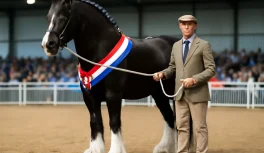
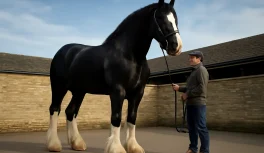
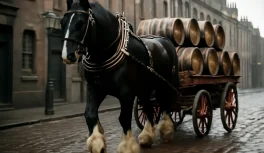
In 1955, the Shire Horse Spring Show in London attracted fewer than 200 animals. Fifty years earlier, in 1905, the Shire Horse Society was registering more than 8,000 new animals per year. The collapse was nearly 97 percent. A breed that had powered industrial Britain for two centuries was disappearing quietly, displaced by engines that never needed feeding and never grew tired.
What happened next — and what nearly did not happen — is one of the most dramatic conservation stories of the 20th century.
How a Breed Goes Extinct
Why do domestic horse breeds disappear when their economic role vanishes?
Domestic breeds do not vanish the way wild species do. There is no catastrophic event, no single outbreak that eliminates a population. The mechanism is slower and more insidious: economic erosion. As long as there was demand for heavy draft horses, there was incentive to breed them. When demand disappeared — gradually through the 1920s and 1930s with the spread of tractors, then sharply in the postwar era — breeders migrated to more marketable animals or left the industry entirely.
The economics were unforgiving. A Shire horse takes four to five years to reach full maturity and complete training — during which time it consumes enormous quantities of feed. Without a buyer at the end of that process, there was no business case for raising Shires. Breeders who had dedicated decades to developing quality bloodlines simply had no one to sell to.
What happened to surplus Shire horses as breeding demand collapsed?
Some donated animals to museums or heritage farms, where they could be preserved as living curiosities. Others, more pragmatically, sold to slaughterhouses.
The First Blow: World War I
How did World War I devastate the Shire horse population?
The First World War (1914–1918) was the initial catastrophic accelerant of the Shire’s decline. The British military requisitioned horses on an unprecedented scale — estimates suggest that over a million British horses were sent to the front, including thousands of Shires used to haul heavy artillery and supply wagons.
The conditions in the trenches were devastating for horses. Mud, cold, disease, wounds, and the impossibility of medical care at the scale required resulted in catastrophic mortality rates. Reports estimate that fewer than 60,000 of the horses sent overseas returned to Britain. The remainder died in combat, were euthanized from injuries, or were sold in Continental Europe rather than transported home — the cost was considered too high.
Why were the Shire’s finest stallions the first to be requisitioned for the war?
For the Shire specifically, the war’s worst damage was to the breeding population. Quality adult stallions — the animals most suited to the heavy military work that was demanded — were the first to be requisitioned. Many of the breed’s finest sires never came home.
The Final Blow: World War II
How did World War II nearly finish the Shire breed entirely?
If World War I was devastating, World War II (1939–1945) came close to being fatal. The combination of factors was lethal: military requisition again; food shortages that incentivized slaughtering non-productive horses; the accelerated mechanization brought by American tractors arriving under the Marshall Plan; and a postwar reconstruction that prioritized speed and mechanical efficiency above everything else.
How low did the Shire population fall by 1960?
By 1946, fewer than 5,000 Shires remained in the United Kingdom. By 1950, the estimate was under 3,000. By 1960, approximately 800 animals — a population geneticists considered dangerously small, barely sufficient to maintain long-term viability.
The Rescue: Passionate Breeders and Dedicated Organizations
Who saved the Shire horse and what motivated them without financial reward?
The turnaround began with a group of British breeders who simply refused to accept the breed’s disappearance. There was no profit motive — only passion combined with a sense of historical responsibility.
These breeders formed informal networks for sharing breeding stock, working to maintain genetic diversity with the few quality animals that remained. Some families had kept Shire bloodlines for generations purely out of tradition and love for the breed, with no expectation of economic return.
The Shire Horse Society, which had survived the 20th century on minimal resources, launched a formal preservation program in the 1970s. The strategy included public outreach, incentives for new breeders, and — crucially — controlled export of quality breeding stock to the United States, Canada, and Australia.
How did American and Australian enthusiasm help save a British breed?
This international dimension was decisive. In the United States, the American Shire Horse Association (founded in 1885 and reorganized in the 1970s) found new enthusiasts willing to breed Shires as show animals, pleasure horses, and living pieces of historical heritage. The American market was, paradoxically, part of what saved a British breed.
The First World Congress and the Turning Point
What was the significance of the First World Shire Horse Congress in 1996?
The First World Shire Horse Congress, held in 1996, marked a symbolic and practical milestone. Breeders from the United Kingdom, United States, Canada, Australia, Netherlands, Germany, and other countries gathered to establish global breed standards, strengthen the international stud book, and coordinate conservation efforts.
In the years that followed, the population grew slowly but consistently. By 2000, approximately 2,000 Shires existed in the United Kingdom. By 2010, perhaps 3,500 worldwide. Current estimates place the global population between 3,000 and 5,000.
Is the Shire horse’s recovery now secure enough to be removed from the at-risk list?
These numbers still place the Shire on the Rare Breeds Survival Trust’s list of “at-risk” breeds — the population remains too small for long-term genetic security. But the trajectory is recovery, not decline. And for a breed that came within a few hundred animals of disappearing entirely, recovery is a genuine achievement.
What the Story Teaches
What is the bottleneck effect and how does it affect Shire breeding programs today?
The Shire’s near-extinction illustrates what geneticists call the bottleneck effect — a dramatic population reduction that leaves permanent genetic marks even after the numbers recover. Populations that pass through severe bottlenecks have less genetic diversity than stable populations of the same size. For the Shire, this means breeders must be especially careful about selecting breeding pairs, avoiding excessive inbreeding within the limited gene pool that survived.
It also demonstrates the value of international conservation networks. A British breed was saved, in part, by American and Australian enthusiasts — a testament to how geographic distribution of at-risk populations increases their chances of survival.
And it demonstrates, above all, that the disappearance of a domestic breed is not inevitable — provided there are people willing to do the necessary work, even without immediate financial reward.