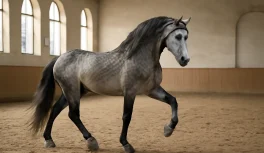
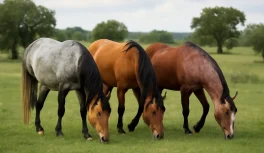
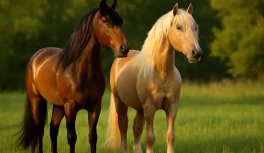
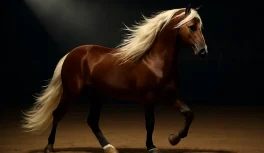
The story of the Lusitano horse’s origin begins before Portugal existed as a nation — before the Romans ever set foot on the Iberian Peninsula. It begins with cave paintings on the walls of Spanish Extremadura and along the banks of Portugal’s Côa River, with Celtic horsemen taming wild horses on Iberian plains, and with ancient civilizations recognizing in this animal something truly extraordinary. Understanding where the Lusitano comes from is understanding why it is what it is — a breed not engineered in a few generations for one specific purpose, but shaped over millennia in a land of unique conditions.
Prehistoric Roots: When Iberian Horses Roamed Wild
The ancestors of the Lusitano have inhabited the Iberian Peninsula for at least 25,000 years. Rock art found at Altamira in Spain and at Côa in Portugal depicts horses with conformation strikingly similar to the modern Lusitano — arched neck, rounded hindquarters, the subtly convex profile that became the breed’s defining feature.
The wild Iberian horse belonged to what researchers call the “primitive Iberian type” — smaller and more agile than the horses of the Asian steppes, with a more refined nervous system and aerobic capacity adapted to the Peninsula’s rugged terrain. This genetic distinction is still visible today: the Lusitano and the Spanish horse (PRE) share characteristics that set them apart from every other European breed.
Phoenicians, Romans, and Moors: What Each Civilization Added
Every civilization that passed through the Iberian Peninsula left genetic traces in the horse that lived there. Each one added a layer to the breed that exists today.
Phoenicians: Arriving on the Iberian coast around 1100 BC, these traders found horses they valued highly for commerce and transport. They introduced animals from the Middle East that contributed refinement and lightness.
Carthaginians: Hannibal crossed the Alps with Iberian horses in his army — a fact that alone speaks volumes about the breed’s reputation more than two thousand years ago.
Romans: Roman conquerors were so impressed by the horses of the Tagus River valley that they wrote about them. Pliny the Elder described Iberian mares said to be fertilized by the west wind — so striking was their reputation for speed and vitality. Romans used them extensively in battle and chariot racing.
Moors: The Moorish occupation of the Iberian Peninsula (711–1492 AD) brought Arab and Barb horses that refined the Iberian horse further still. The Arab influence is visible today in the Lusitano’s elegant neck lines, lightness of movement, and heightened intelligence.
The Studbook Split: Lusitano vs. Andalusian
For centuries, the Iberian horse was effectively one breed — called the Iberian Horse, the Andalusian, or the Lusitano interchangeably depending on the country of origin. The formal split between the Portuguese and Spanish studbooks happened as recently as 1966.
The separation was driven by technical disagreements between breeders from the two countries — particularly over the degree of subconvex profile considered ideal, and over the acceptance of foreign blood in certain lines (Spanish breeders had been more liberal with Anglo-Arab and Thoroughbred crosses).
After the split:
- The Lusitano became registered exclusively by the APSL (Associação Portuguesa de Criadores do Cavalo Puro Sangue Lusitano)
- The Andalusian became registered by the ANCCE as the PRE (Pura Raza Española)
Despite the formal separation, the two studbooks maintain a deep historical connection, and exceptional individuals on both sides continue to influence discussions about the ideal Iberian standard.
The Founding Bloodlines That Define the Lusitano Today
Within the Lusitano studbook, certain breeding families became synonymous with excellence. Their names carry weight in the international market to this day.
Veiga line: Developed by the Veiga family in Portugal throughout the 20th century. Known for extreme elegance, a pronounced subconvex profile, and a natural predisposition for the airs above the ground.
Andrade line: From the Andrade family, focused on high-school horses with conformation suited for collection work. Stallions from this line became references in the European market.
Alter Real: A sub-line bred at the Herdade de Alter do Chão since 1748, developed specifically for high school work. Alter Real horses are used by the Portuguese School of Equestrian Art and are recognized for their exceptional suitability for the airs above the ground.
Palha: A long-standing breeding operation that maintained pure bloodlines across generations, combining movement quality with balanced temperament.
How the Lusitano Nearly Disappeared — and Was Saved
The 20th century brought a threat no war had managed: mechanization. With tractors and military vehicles replacing horses in agriculture and warfare, the practical utility of the horse vanished within decades. The Lusitano population dropped sharply between 1930 and 1960. Traditional farms closed, animals were slaughtered, and the breed came dangerously close to functional extinction.
The turnaround came from two directions simultaneously: the growth of equestrian sport as recreation and competition, and the founding of the Portuguese School of Equestrian Art in 1979. A breed that supplied horses to a UNESCO-recognized school had reason to exist beyond agricultural utility.
The great breeding establishments that survived worked for decades to rebuild quality populations — and their efforts formed the genetic foundation of every Lusitano alive in the world today.
A Breed That Crossed Oceans
From the 1980s onward, the Lusitano began finding buyers outside Europe. Working Equitation — formally organized in 1994 and designed around Iberian breeds — was the primary vehicle of expansion. A discipline built for Iberian horses could have no better ambassador.
Brazil was the first non-European market to import Lusitanos at scale. The Brazilian Association of Lusitano Horse Breeders is today one of the largest outside Portugal. In the United States, the dressage community opened doors for the breed from the 1990s onward. In Germany, the Netherlands, and Scandinavia, growing interest in classical equitation created consistent demand.
The origin of the Lusitano explains why the breed found this global reach. A horse shaped by millennia of selection to work with humans, to respond with sensitivity and intelligence, to remain composed under pressure — that is not a regional horse. It is a universal one.