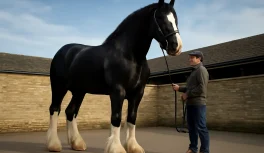
There is a horse that stops time when it enters an arena. It needs no colorful markings, no exotic coat, no acrobatic movements to completely dominate the attention of any audience. It is always black, always with mane and tail flowing like black silk in the wind, always with those abundant feathers on the lower legs — the “feathering” — swaying rhythmically with each stride. This is the Friesian. And its beauty is, quite literally, unique in the equestrian world.
But the Friesian is far more than appearances. Behind that almost medieval image lies a history of near-extinction, salvation by a handful of devoted breeders, and a resurgence that transformed the horse of Friesland into one of the most desired and photographed breeds on the planet.
Friesland: The Land That Named a Breed
The Friesian comes from the province of Friesland in northern Holland — a region of flatlands, canals, and a distinct cultural identity that the Frisians themselves guard with pride. The breed is documented in this region from at least the 13th century, and possibly much earlier: medieval paintings and Flemish tapestries show horses with clearly Friesian silhouettes carrying armor-clad riders.
The Friesian’s original role was unambiguously martial. A fully equipped medieval knight weighed between 330 and 440 pounds. Reliable transport of that weight required robust bone structure, deep musculature, and stable temperament. The Friesian met those requirements with room to spare. Its strong legs, short back, and powerful hindquarters made it ideal for war — and its naturally elevated knee action and spontaneous passage in the trot conferred an imposing visual presence that reinforced the knight’s status.
With the decline of medieval cavalry and the arrival of firearms, the need for a heavy war horse disappeared. The Friesian was repurposed for agricultural traction and carriages — but crossbreeding with lighter, more agile breeds demanded by the new market nearly destroyed the genetic purity of the breed.
The Extinction Crisis: When Only Three Stallions Remained
The Friesian faced two critical near-extinction moments in the 20th century. The first was during World War I, when horses were requisitioned for military use and the number of Dutch Friesians plummeted. The second, and more severe, was in the 1960s, when agricultural mechanization made draft horses practically obsolete.
In 1963, only three Friesian stallions were recognized as approved breeding sires in the official Dutch studbook — the Koninklijk Friesch Paarden Stamboek (KFPS). Three stallions to keep an entire thousand-year-old breed alive. The situation was categorically critical.
What followed was a deliberate and passionate effort by Dutch breeders who refused to let the breed disappear. The conservation program involved rigorous selection, breeding incentives, and festivals that promoted the Friesian as a cultural symbol of Friesland — and gradually, the numbers climbed. By the 1970s, there were dozens of approved stallions. By the 1980s, hundreds. Today, the KFPS maintains tens of thousands of registered horses in more than 60 countries.
The Friesian’s recovery is one of the most successful cases of equine breed rescue in modern history.
The Aesthetic That Conquered the World
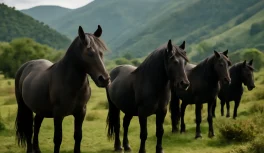
The Friesian has one of the most stringent coat specifications in the equestrian world. The Dutch studbook accepts exclusively black horses. Not gray, not dark brown, not bay — black. White markings are prohibited in the official standard, with the only tolerated exception being a small star on the forehead (and even then, only in mares designated for breeding, not in approved breeding stallions).
This coat uniformity contributes enormously to the breed’s visual impact. A Friesian in motion looks like a creature from another era — an image somewhere between reality and fantasy.
The Friesian’s mane and tail grow exceptionally long and thick. Outstanding horses have manes that reach the knee or beyond, and tails that touch the ground. Mane and tail care is an art in itself — breeders devote hours to conditioning and protecting the hair that defines so much of the breed’s visual identity.
The “feathering” — the long, silky hair on the lower legs — is another emblematic characteristic. Unlike the stiffer “feathers” of breeds such as the Clydesdale or Shire, the Friesian’s feathering is fine and soft, creating that fluid, wave-like visual effect with each movement.
Movement and Dressage: The Natural High-Stepping Action
The Friesian has what riders call “elevated action” — the knee rises visibly with each step, creating a natural high-stepping movement not artificially induced. This elevation is especially striking in the trot, where the Friesian presents an imposing rhythm and cadence.
This naturally elevated movement made the Friesian a successful dressage breed — especially at middle levels, where elevation and expressiveness are valued. The Friesian is not typically a horse for the highest levels of Olympic dressage (where Warmbloods dominate), but in overall movement and choreographic elegance, the breed has few rivals.
For equestrian shows, carriage presentations, and historical fantasy events, the Friesian is simply unmatched. The Ster (Star) and Kroon (Crown) are the highest approval levels in the KFPS studbook, awarded in rigorous inspections that evaluate conformation, movement, and pedigree.
The Friesian in Cinema: The Breed of Epic Productions
Part of the Friesian’s global popularity over the past thirty years owes much to cinema. The combination of dramatic appearance, imposing black coat, and temperament docile enough for camera work made the Friesian the preferred choice of directors of photography and horse coordinators in Hollywood.
Productions that have featured Friesians include Conan the Barbarian, The Mask of Zorro, Ladyhawke, The Man in the Iron Mask, Eragon, and numerous other fantasy and historical period films. When a script calls for “the noble villain’s horse” or “the medieval knight’s black stallion,” the Friesian is the answer directors keep finding.
This cinematic exposure transformed the Friesian into a global cult horse. People who had never had any interest in horse breeds came to know the breed through films — and many became devoted breeders precisely because of that initial visual experience.
Health and Longevity: Breeding Considerations
The Friesian’s recovery from only three stallions left a delicate genetic heritage: the breed has a narrow genetic base, with consequent predisposition to specific conditions that breeders need to know about.
Neonatal alloimmune hemolytic anemia: Friesian foals can develop a condition in which antibodies in the mare’s colostrum attack the foal’s red blood cells in the first hours after birth. It is a veterinary emergency that can be fatal if not treated immediately. Responsible breeders test for compatibility before foaling.
Skin conditions: the abundant feathering, when not properly cared for, can trap moisture and favor the development of dermatitis and fungal infections on the lower legs. Managing the feathering requires regular attention — especially in humid climates.
Megaesophagus: the Friesian has higher incidence of megaesophagus than other breeds — a condition in which the esophagus dilates, causing swallowing difficulties. The condition requires specific dietary management.
Life expectancy: compared to many large breeds, the Friesian has a moderate lifespan — typically 15 to 20 years, somewhat below the general average for equine breeds. The narrow genetic base contributes to this reduction.
The Friesian Today: From Dutch Studfarms to the World
The KFPS remains the supreme authority on the pure Friesian. Every stallion approved for breeding undergoes rigorous evaluation including conformation inspection, movement assessment, and pedigree analysis. Only a fraction of tested stallions receive approval — the process is deliberately selective to protect the breed’s quality.
Outside the Netherlands, the largest breeding operations are in the United States, where the Friesian Horse Association of North America (FHANA) manages registration and competitions. Brazil has a growing nucleus of breeders and enthusiasts, with regular imports of certified animals.
For the vast majority of people who encounter a Friesian for the first time — whether in an arena, at an event, in a film, or in a photograph — the experience has a specific and disconcerting effect: it is difficult to believe the animal is real. That mane, that tail, those lower-leg feathers, that uniformly black coat, that elevated movement — they seem to belong to something from another world.
They do not. And that is the strongest marketing argument any breed could ever have.