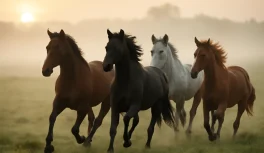
There’s a gait you learn with technique — and one you learn with your whole self. The canter is that second kind. When the horse finds its rhythm, the hoofbeats become music, the body seems to float for a moment, and everything takes on a quality of freedom that’s almost impossible to put into words.
When the Horse “Becomes Music” in Three Beats
There’s a moment in riding when everything shifts: the air feels lighter, the sound of hooves becomes a rhythmic one-two-three, and the horse’s body — and your own — enters a rocking motion that makes you smile without realizing it. That’s the canter — one of the most beautiful gaits to watch and, in time, one of the most satisfying to feel.
One point worth clarifying early: in most everyday equestrian contexts, “canter” refers to the controlled three-beat gait. The full-speed racing version — with different biomechanics and very different demands — is the gallop. The two are distinct, and knowing the difference changes how you ride and how you watch.
What Is the Canter — and Why Does It Feel Different?
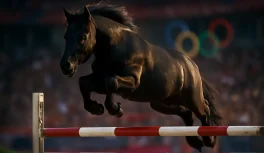
The canter is a natural, asymmetrical, bounding gait with three beats of footfall followed by a moment of suspension — that brief instant when the horse is fully airborne, no hoof touching the ground. This combination is exactly what gives the canter its particular quality: rhythm + impulsion + lightness.
The sound of the canter — one-two-three… (pause)… one-two-three… — comes from that sequence of footfalls followed by suspension. The horse begins with a hind leg, moves through the remaining contacts, and briefly lifts off the ground before repeating the cycle.
What Is the Canter Footfall Sequence?
In a right-lead canter, the sequence begins with the left hind, moves to the diagonal pair (right hind and left fore landing nearly together), then the right foreleg — the lead leg — followed by suspension. On the left lead, the pattern reverses. This asymmetry is precisely what separates the canter from the walk and trot, which follow more symmetrical patterns.
Canter vs. Gallop: The Distinction That Changes Everything
Simply put:
1) The Canter (the “schooling gait”)
Three beats plus suspension. This is the everyday working gait under saddle — the one most riders develop over time: controlled, cadenced, and rideable. In western riding, a similar controlled three-beat gait is often called the lope.
2) The Gallop (the “racing gait”)
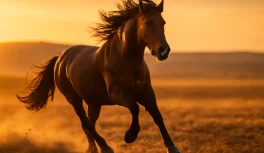
At higher speeds, the footfall pattern can shift to four distinct beats, biomechanical demands increase significantly, and the gait becomes what you see in racing and at full stretch across open ground.
Why does this matter? Because many people hear “canter” and picture something flat-out and racing. In practice, the everyday canter is organized and adjustable — which is exactly the gait most riders are working to develop.
Canter Leads: Correct, Wrong Lead, and What Can Go Wrong
One of the most elegant aspects of the canter is that it has a “side.” When the horse is on the right lead, you can see — and feel — the right side reaching forward and leading each stride. It makes complete sense when the horse is turning right. A simple way to spot it: watch the point of the shoulder — the lead shoulder swings slightly farther forward with every stride.
Correct lead The horse canters on the lead that matches the direction of travel or the rider’s request.
Wrong lead (or counter-canter, when intentional) If the horse departs on the opposite lead by accident, the balance through turns is disrupted. However, when the rider deliberately asks for the outside lead as a schooling exercise, it becomes the counter-canter — a valuable tool that builds straightness, suppleness, and engagement. The distinction is simply intentional vs. accidental.
Disunited canter The front end is on one lead, the hind end is on the other. This breaks the rhythm and can feel choppy or uncomfortable. It typically points to a balance or training issue rather than anything more serious, and reorganizing through a downward transition usually resolves it.
Where Does the Canter’s Engine Come From?
If the canter had a one-sentence summary: the engine is in the back.
The driving force comes from the hindquarters, while the neck provides an oscillating balancing action that allows the gait to flow. Even with the very brief ground contacts of the canter, the horse maintains enough organization in the sequence to stay balanced and rhythmic.
In practice, this explains why a beautiful canter feels “round”: energy originates behind, travels through the back, and arrives at the front without becoming a scramble.
Why the Lead Matters So Much on a Turn
A curve is where the canter reveals itself.
When the horse is on the correct lead, the dynamics of the turn favor an inward lean — the horse can arc through the curve with relative ease and balance. On the wrong lead, the horse tends to lean outward, making it much harder to stay balanced and straight through the bend. That’s the moment when the horse seems to fall through the turn rather than shape it.
How Fast Is the Canter?
Speed varies considerably depending on training, breed, fitness, footing, and intent.
The working canter sits in a moderate, controllable range, with real adjustability between a shorter, collected stride and a longer, more extended one.
The gallop moves at significantly higher speeds, with longer strides and much greater physical demands.
The most important practical point: speed is not the measure of canter quality. Rhythm, balance, impulsion, and a clear three-beat are.
Horses That Became Legends at the Canter and Gallop
Secretariat: The 1973 Legend
Secretariat won the American Triple Crown and at the Belmont Stakes on June 9, 1973, completed the mile and a half (2,400 meters) in 2:24, crossing the finish 31 lengths ahead of the field — a performance that remains one of the most referenced in the sport’s history.
Quarter Horse: Explosive Power in a Straight Line
The Quarter Horse’s genetics and training tradition are synonymous with short, intense acceleration. That explosive capacity over short distances represents one of the most specialized expressions of what the gallop can be.
Criollo: Stamina That Defies Expectation
Horses like the Criollo Lunarejo Cardal, covering vast distances across multiple days, are a reminder that the canter also belongs to endurance and versatility — not only to speed.
How to Feel the Canter Without Depending Only on Your Eyes
For riders just starting out, one of the biggest challenges is identifying the lead and recognizing whether the canter is correct. A simple trick: lower your gaze slightly and watch which shoulder reaches farther forward — that’s the lead shoulder.
There’s also a natural learning progression:
- First you hear it (the one-two-three),
- then you feel it (the rocking motion),
- and only then do you understand it (which lead, what quality, what adjustment).
This progression is entirely normal — and when it clicks, the canter stops being startling and becomes a conversation.
Common Canter Problems (and What They Might Be Saying)
Rushing and Scrambling
Usually points to imbalance, anxiety, too much hand in front, or not enough support from behind.
Disunited Canter
Common in young horses, after jumping efforts, or when a turn asks for more balance than the horse currently has. The usual fix: come back to trot, reorganize, and ask again.
Difficulty Holding the Canter
Could be conditioning, pain, an ill-fitting saddle, hoof issues, or simply lack of strength at this stage of training. If it becomes a pattern, it’s worth reviewing with a trainer — and if needed, a veterinarian.
The Canter That Stays With You
There’s a reason so many riders describe the canter as something that touches them deeply. It blends control and freedom: fast enough to feel like flight, organized enough to feel like dance.
More than speed, the canter is rhythm, impulsion, balance, and a suspended moment that seems to defy gravity. Understanding leads, recognizing the correct canter, distinguishing the working gait from the racing gallop, and feeling how everything originates from the back — all of it changes the experience completely. Both as a spectator and as a rider.