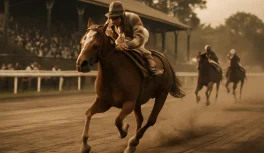
On June 9, 1973, something happened at Belmont Park in New York that equestrian experts still can’t fully explain more than fifty years later. Secretariat, a three-year-old chestnut stallion, covered a mile and a half in 2 minutes and 24 seconds flat — a time no horse has ever matched on any official track in the world. The winning margin was 31 lengths. Photographers had to pull back to fit him and the second-place finisher in the same frame.
The Belmont record from 1973 still stands. Not just in Thoroughbred racing — across any timed equine discipline at an equivalent distance, no animal has come close to that number. Secretariat is not simply the fastest that ever lived: he’s a statistical outlier so extreme that science still debates how a biological organism could have produced that performance.
From Meadow Farm to the Triple Crown
Secretariat was born on March 30, 1970, at Meadow Farm in Virginia, a son of Bold Ruler out of Somethingroyal. From his first months, handlers noticed something different: a muscular structure well beyond the norm, a stride that combined reach with almost mechanical precision, and a drive to run that went beyond instinct — it looked more like a choice.
His trainer, Lucien Laurin — a 66-year-old Canadian who had considered retirement before taking on the horse — spotted the potential early. Jockey Ron Turcotte, who had already ridden Riva Ridge to the Kentucky Derby, took the mount on Secretariat and stayed with him for the rest of the career.
His two-year-old season was promising, but not explosive. It was in 1973, at three — the age of the Triple Crown races — that Secretariat began to show what he actually was.
The 1973 Triple Crown: Three Races, Three Impossible Stories
The American Triple Crown consists of three races over five weeks: the Kentucky Derby (1¼ miles), the Preakness Stakes (1³⁄₁₆ miles), and the Belmont Stakes (1½ miles). It’s a sequence that demands not just speed but consistency, rapid recovery, and the ability to maintain peak form over progressively longer distances.
Secretariat won all three. But what separates his Triple Crown from every other winner is that he got faster with each race — the exact opposite of what’s expected from a horse subjected to that compressed schedule.
In the Kentucky Derby, he completed the distance in 1:59.4 — the track record, which still stands. In the Preakness Stakes, the official timing was disputed by racing historians, but his finishing run was unambiguously dominant. At the Belmont, he produced the race that would define his legend forever.
What Happened at the 1973 Belmont Stakes?
Secretariat broke from the gate and began pulling away almost immediately, increasing his margin at every turn. Television commentators struggled to maintain sports vocabulary as the gap between him and the field grew beyond any meaningful comparison. In the final furlong, CBS announcer Chic Anderson said the line that entered history: “Secretariat is widening now. He is moving like a tremendous machine.”
The final margin of 31 lengths is still the largest winning gap in any of the three Triple Crown races. The time of 2:24 was so extraordinary that clockers checked their equipment before confirming the official result.
The Heart of Secretariat: The Biology of an Anomaly
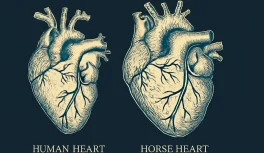
When Secretariat died in October 1989 at age 19 from laminitis — the same hoof condition that ends so many high-performance horses — his necropsy revealed what veterinarians had suspected since Meadow Farm: a heart of extraordinary size.
The average horse heart weighs between 7 and 10 pounds. Secretariat’s weighed approximately 22 pounds — more than double the expected size for an animal of his build. This cardiac hypertrophy means greater blood volume per beat, which translates to more oxygen delivered to working muscles per unit of time.
The curious footnote is that this enlarged heart is genetically heritable. Genealogical studies have traced the trait back to Eclipse, an 18th-century English Thoroughbred considered the ancestor of the vast majority of today’s champion racehorses — roughly 80% of modern champions trace back to him.
Was Secretariat’s Heart the Largest in Equine History?
Not necessarily — other horses have presented large hearts. But the combination of cardiac volume, muscular structure, stride length, and specific biomechanics created a synergy that hasn’t been replicated. Researchers who studied Secretariat’s motion estimated his stride length at up to 28 feet per complete cycle, compared to an average of 20 to 23 feet for elite Thoroughbreds.
Life After Racing: The Stallion Years
Secretariat retired from racing in 1973 to stand at stud at Claiborne Farm in Kentucky — a deal negotiated before the season began, valued at $6 million, a record for any animal at the time.
As a sire, his results were solid but not miraculous. None of his offspring replicated the father’s speed on the track. That’s one of the paradoxes of the turf: the qualities that make a horse extraordinary are rarely transmitted with the same intensity to the next generation, partly because those qualities are rare combinations of many genes in a specific configuration, not single dominant traits.
What Secretariat left as a stallion was more cultural than genetic: he turned Kentucky into the world capital of the Thoroughbred racing industry through the 1970s and elevated the prestige of every Claiborne stallion by proximity.
Why Has Nobody Broken Secretariat’s Record in Fifty Years?
Fifty years is enough time to ask: what’s wrong with modern horses, or what was right about Secretariat that nobody has managed to replicate?
The honest answer is that we don’t know. Breeding techniques have advanced. Training methods are more sophisticated. Equine sports nutrition has reached scientific levels that didn’t exist in the 1970s. And yet the Belmont record of 1973 remains untouched.
One hypothesis is that the American turf, in its pursuit of speed at shorter distances — where betting interest and commercial returns are higher — has gradually stopped selecting for the specific blend of stamina and explosiveness that Belmont demands. Another hypothesis is simply that Secretariat was a biological accident: a genetic combination so statistically improbable that it hasn’t repeated, and may not in another fifty years.
Either way, the number stands: 2:24. And as long as it does, Secretariat remains the final word on what a horse can do on a racetrack.