Some horse breeds stop conversations. The Mangalarga Marchador is one of them — not because of speed or size, but because of the way it moves. Its smooth, rhythmic four-beat gait turns heads at arenas and on trails alike, delivering a ride so effortless it feels like floating.
The Mangalarga Marchador horse is Brazil’s most widely bred equine and one of the most numerous breeds in the world, with more than 600,000 registered animals. But the numbers alone don’t capture why the breed inspires such devoted following — from the hills of Minas Gerais to stables in Germany, the United States, and Portugal.
Where does the Mangalarga Marchador come from?
The story begins in the early 19th century, when the Portuguese royal family fled Napoleon’s armies and relocated to Brazil. Among the horses they brought was the Alter Real stallion Sublime, later placed at a farm in Baependi, in the southern Minas Gerais state.
Sublime was crossed with local mares of Iberian descent, already adapted to Brazil’s climate and terrain. The offspring combined Alter Real elegance and movement with Brazilian ruggedness — and the distinctive ambling gait that would define the breed was born.
The name “Mangalarga” comes from one of the primary early breeding farms. “Marchador” — meaning “one who marches” — was added later to distinguish the breed from the Mangalarga Paulista, a related but distinct breed that developed separately in São Paulo state.
In 1949, the Associação Brasileira dos Criadores do Cavalo Mangalarga Marchador (ABCCMM) was founded to manage breed registration and standardization. Today it is one of the largest equine breed associations in the world by active registrations.
What is the marcha, and why is it so special?
The breed’s defining feature is its gait — the marcha — a four-beat ambling movement in which the horse never has fewer than two hooves on the ground simultaneously. This continuous support eliminates the suspension phase that creates the jarring impact of a trot.
The result for the rider: near-zero vertical movement. No bounce, no impact, no rough transition. Riders with back problems, knee issues, or histories of injury that forced them away from riding regularly discover in the marcha a way back — not as therapy, but as full riding practice without paying a physical price.
Two official variations exist: the marcha batida (closer to a lateral beat) and the marcha picada (a more evenly diagonal sequence). Both are recognized and judged in separate competition categories. Riders typically develop clear preferences after time in the breed.
Physical standard of the breed
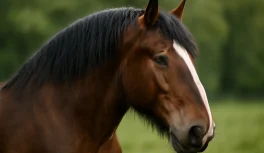
The Mangalarga Marchador is a medium-sized horse, standing 14.2 to 15.2 hands at the withers. The compact scale is intentional — it contributes to the balance and agility the marcha requires.
The head tends toward straight or slightly convex in profile, with well-set ears, expressive eyes, and wide nostrils. The neck is gently arched, harmoniously set into sloping shoulders. The back is short and muscular, the hindquarters rounded and powerful.
Limbs are clean and dry, with well-defined joints and compact hooves — important for a horse traditionally bred to navigate varied terrain. Coat colors include a wide range: grey (tordilho), chestnut (alazão), bay (baio), brown (castanho), roan (ruão), and rarer patterns including paint (pampa) and tobiano.
Temperament: a horse that works with you
Ask any Mangalarga Marchador owner what they appreciate most beyond the gait, and the answer is almost always: the temperament. The breed is known for above-average docility, quick learning, and a calm responsiveness that makes it genuinely pleasant to work.
This isn’t coincidence. Over two centuries of selection, animals with unpredictable or difficult behavior were systematically excluded from breeding. The accumulated result is a horse with a naturally balanced nervous system — alert without being reactive, willing without being dull.
For beginning riders, this means a safer first experience. For advanced riders, it means a foundation that allows rapid refinement of subtle aids and communication.
Competition and trail life
The primary competitive event for the breed is the prova de marcha — a judged competition evaluating gait quality, conformation, and breed type. Regional and national events are held throughout the year in Brazil, with the National Mangalarga Marchador Exposition in Belo Horizonte as the season’s main stage.
Beyond formal competition, the breed dominates the Brazilian trail riding culture. Its endurance in long-distance riding, gait comfort over many hours in the saddle, and even temperament in varied terrain make it the default choice for cavalgadas — multi-day group trail events that are major social gatherings in Brazil’s equestrian communities.
The breed has also expanded into endurance competition, ranch riding, and trail obstacle disciplines as it grows internationally.
Why the Mangalarga Marchador is crossing borders
International demand for the breed has grown steadily since the 1990s. The primary driver is always the gait argument: for riders who value comfort over speed, nothing compares to a well-gaited Mangalarga Marchador.
Riders with spinal conditions, arthritis, or knee injuries who would otherwise need to stop riding often describe the discovery of the marcha as transformative. The absence of vertical impact that the gait provides is, for many, simply a new category of riding experience.
The expansion is still modest compared to the breed’s scale in Brazil — but every time a rider outside of Brazil encounters a properly gaited Mangalarga for the first time, the reaction tends to be the same: genuine surprise, followed by a question that says everything about the breed’s potential — “Why didn’t anyone tell me this existed?”