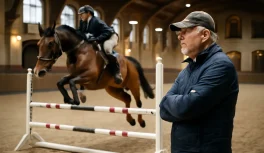
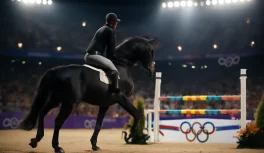
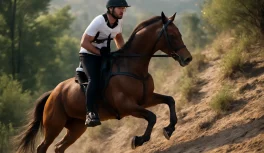
For a first-time viewer, show jumping seems straightforward: the horse clears the obstacles and whoever makes the fewest errors wins. The reality is richer — and far more fascinating. There is a precise system of rules, a variety of obstacles each with its own characteristics, and a scoring system that can turn a clean competition into a tie and resolve everything in a single jump-off fence.
Understanding how show jumping works means understanding why riders spend years perfecting fractions of a second and why a pair of ears visible before an obstacle can be the difference between gold and silver. It is a sport of maximum precision in which the athletes weigh between 400 and 600 kilograms — and every gram of that athleticism matters.
What Is Show Jumping?
Show jumping — also called concurso de saltos in Spanish, saut d’obstacles in French — is one of the three Olympic equestrian disciplines, alongside dressage and cross-country (which forms part of the equestrian three-day event, or eventing).
In the competition, the horse-and-rider pair follows a predefined course with numbered obstacles that must be cleared in order and within a time limit. The objective is to complete the course with the fewest penalty points and, in competitions where time is the deciding factor, as quickly as possible.
The sport is governed by the Fédération Équestre Internationale (FEI), which sets global rules for all recognized competitions, including the Olympic Games, the World Championship, and the European circuit.
What Are the Obstacles?
Obstacles in show jumping come in different forms, and each type demands different skills from the horse-and-rider pair.
Vertical (or wall): The most basic obstacle — a vertical plane the horse must clear without touching. It has no depth, only height. Demands precision and good folding of the front limbs.
Oxer: Made up of two vertical elements side by side, creating an obstacle with depth as well as height. Requires a wider jump — the horse must cover both height and spread.
Triple bar: Three rails in ascending steps, creating an obstacle of increasing width. One of the most visually impressive in competition, it requires a powerful, extended jump.
Liverpool (water tray): An obstacle incorporating a water tray under the rails. The presence of water can distract less experienced horses, making it psychologically challenging.
Wall: Built with wooden blocks painted to resemble brick. Technically similar to a vertical, but visually different — some horses react differently to solid-looking obstacles versus rails.
Combination: A sequence of two or three obstacles separated by one or two strides. The most technically complex, they require the rider to calculate the approach rhythm for each element in the sequence.
How Does the Scoring Work?
The penalty system is simple and clear:
| Infraction | Penalty | |—|—| | Knocking down an element | 4 faults | | Refusal (horse stops at obstacle) | 4 faults | | Second refusal at same obstacle | 4 faults | | Third refusal (elimination) | Elimination | | Rider fall | Elimination | | Exceeding time limit | 1 fault per second over |
A clear round (no faults) means the pair completed the course without knocking any element and without refusals. At Olympic level and other elite competitions, several pairs typically finish with zero faults in the first round — which leads to a jump-off.
How Does the Jump-Off Work?
When multiple pairs finish the first round with zero faults, a jump-off takes place — a shortened course against the clock. The winner is whoever completes the jump-off with the fewest faults and, in case of a tie, in the least time.
The jump-off introduces a fascinating dynamic: the rider must decide how much speed risk to take. Going faster reduces time but increases the risk of knocking fences. The ideal strategy balances aggression on the clock with sufficient control to keep the round clean.
Some of the most dramatic moments in Olympic show jumping history have happened in jump-offs — including the Barcelona 1992 gold in which Ludger Beerbaum and Ratina Z beat their rivals by hundredths of a second.
What Are the Competition Formats?
In Olympic show jumping, the program includes:
Individual: Each rider competes on their own. Ranking is determined by individual performance across rounds — typically one or two qualifying rounds and a final.
Team: Each nation presents three riders, and the team score is the sum of all penalty points. Historically, teams could present four riders and drop the worst score — a rule changed by the FEI to three-member teams, making each performance even more critical.
Grand Prix: The most prestigious format on the international calendar. A demanding course, usually with a jump-off for the top finishers.
Speed Class: No jump-off — the criterion is purely time, with penalties added to the clock.
The Rider’s Role: Strategy and Partnership
Show jumping demands from the rider a combination of skills few sports require simultaneously: physical strength to maintain balance and guide the horse, spatial awareness to calculate distances in a fraction of a second, sensitivity to read the horse’s state during the course, and strategic decision-making to adjust pace, trajectory, and aggression throughout the round.
The rider walks the course on foot before competing — called course walk — to calculate distances, identify difficult sequences, and define the ideal approach line for each obstacle. This walk, typically lasting 30 to 45 minutes, is a fundamental part of competitive strategy.
Execution, however, depends on both rider and horse. An animal that “reads” obstacles well — that assesses distance and angle on its own — is a partner that allows the rider to focus more on overall strategy and less on the detail of each jump. This was precisely the level of reading that made Jappeloup an extraordinary horse: he “understood” obstacles in a way that horses of far greater stature never achieved.