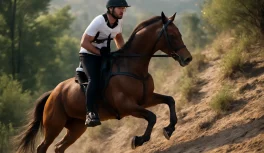
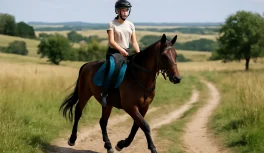
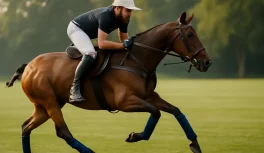
Picture guiding a horse through mountain trails, rocky deserts, or dense forests for ten, twelve, sometimes sixteen straight hours — covering distances between 50 and 100 miles in a single day. No comfort stops. With mandatory veterinary checkpoints where continuing the race depends less on the clock and more on the horse’s heart rate. That is equestrian endurance — arguably the most demanding equestrian sport in existence, and certainly one of the most fascinating.
Unlike classical equestrian disciplines, where competitions last minutes and unfold in controlled arenas, endurance riding takes place in real environments, with real weather, real terrain — and real consequences for every decision the rider makes along the route. Winning does not mean finishing first. It means finishing first with a horse that passes the veterinary inspection.
That one rule changes everything.
What Is Equestrian Endurance?
Equestrian endurance is a discipline in which horse and rider cover long distances on natural trails, within a maximum established time, with mandatory veterinary checks at intervals throughout the course.
The Fédération Équestre Internationale (FEI) recognizes endurance as an Olympic discipline — it featured at the Athens 2004 and Sydney 2000 Games and is contested at the World Equestrian Games. Competitions are classified by distance:
- CEI* (50–74 miles / 80–119 km): basic international competition level
- CEI** (75–93 miles / 120–149 km): intermediate
- CEI*** (93–100 miles / 150–160 km): elite — the maximum distance recognized by the FEI
National and regional events can start at 25 miles (40 km), serving as the entry point for riders and horses new to the sport.
The stated objective in endurance is not simply speed — it is management. Managing the horse’s effort, hydration, feeding, pace, climbs, and descents. Riders who do not understand this start fast and do not finish.
How Does an Endurance Competition Work?
An endurance ride is divided into sections — loops — with mandatory veterinary checkpoints between each one. These checkpoints are called vet gates.
At each vet gate, the horse is presented to the veterinary panel. The vets check:
Recovery heart rate (RHR): the horse must bring its heart rate below a pre-defined threshold — typically 64 beats per minute — within a maximum time after arriving at the checkpoint. Failure to recover means elimination.
Metabolic assessment: evaluation of hydration status, muscle tone, mucous membranes, gut motility, and other parameters indicating the horse’s metabolic condition.
Gait evaluation: the horse is trotted in a straight line in front of a panel of three veterinarians. Any sign of lameness — even subtle — results in immediate elimination. There is no negotiation.
This structure creates a unique dynamic: the rider who goes more slowly may have a strategic advantage over one who goes faster, if the faster horse fails to recover at the vet gates.
Time spent standing at vet gates is counted. The final time is the total elapsed — including stops. The winner is the rider who completes the course in the shortest total time with a horse that passes veterinary inspection.
Where Did Endurance Riding Come From?
The roots of modern equestrian endurance trace to two separate traditions that converged in the twentieth century.
The first is military. Horses served in long marches for centuries, and formal evaluation of equine stamina was a critical component of military readiness. In the United States, the army conducted formal endurance tests in the early 1900s to determine which horses could withstand the demands of war.
The second is the Tevis Cup — the event that defined modern endurance.
In 1955, Wendell Robie completed the Auburn-to-Tahoe route (100 miles) in a single day across California’s Sierra Nevada. The following year, he organized the first Western States Trail Ride. The race — crossing the Sierra Nevada with over 18,000 feet of cumulative elevation — became the world reference for what horse and rider could achieve in terms of stamina.
By the 1960s and 1970s, the sport had spread to Europe and Australia. In 1982, endurance was officially recognized by the FEI as an international competitive discipline.
Today, the sport is practiced in over 60 countries, with a calendar of hundreds of events on every continent.
Which Horse Breeds Excel in Endurance?
The Arabian horse dominates equestrian endurance at the international level with an advantage no other breed has consistently matched. Its anatomical and physiological traits — dense yet light bones, broad lungs, exceptional cardiovascular capacity, rapid cardiac recovery, efficient tendon structure — appear purpose-built for prolonged effort.
FEI data confirms that Arabians or part-bred Arabians represent over 80% of competitors at elite events.
But endurance is not a single-breed sport.
Anglo-Arabs — crosses between Arabian and Thoroughbred — combine the Arabian’s cardiovascular recovery with the Thoroughbred’s size and stride length. They appear increasingly on podiums in events of 75 miles or more.
Regional breeds also appear in local standings: the South American Criollo, developed for stamina under harsh conditions, performs consistently in continental events. The Anglo-Arab is a frequent choice among European riders.
What all these options share is the capacity for cardiovascular recovery — the criterion that separates competitive horses from those eliminated at vet gates.
The Veterinarian’s Role in Endurance
In no other equestrian discipline does the veterinarian occupy such a central position. In endurance, vets are not an emergency presence — they are part of the competitive structure itself.
The veterinary panel has authority to eliminate any horse at any point in the ride, regardless of ranking. A horse leading a race with six miles to the finish can be eliminated at the last vet gate if it shows any sign of metabolic or locomotor compromise.
This creates constant pressure on the rider: speed is not enough. The horse must arrive at each checkpoint still doing well.
The leading causes of elimination in endurance include:
Metabolic problems: severe dehydration, electrolyte imbalance, exertional colic — conditions resulting from prolonged effort without adequate hydration and feeding management.
Lameness: locomotor injuries — tendinitis, ligament damage, muscle strains — that manifest as irregularity in the trot. Terrain, muscle fatigue, and footing variability increase the risk.
Persistent tachycardia: when the horse fails to bring its heart rate within the allowed threshold within the permitted time, it is a sign the cardiovascular system is overtaxed.
Elimination is not punishment — it is protection. Endurance riding is, by design, a sport that prioritizes animal welfare above the result.
The Rider in Endurance: More Than a Pilot
In endurance, the rider is not just the person guiding the horse through the course. They are the primary race manager — responsible for every decision that affects the horse’s condition.
That management begins long before race day.
Rider fitness: ten-hour events demand aerobic endurance, balance, and the ability to maintain position without creating tension in the horse. Out-of-condition riders unnecessarily fatigue the horse.
Course knowledge: before any event, the rider studies the map, identifies the steepest climbs, rocky sections, water points. On race day, that knowledge enables decisions there is no time to think through.
Pace management: knowing when to canter, when to trot, and when to walk is a skill built with experience — and it defines the difference between a horse that finishes well and one that is eliminated.
Team support: unlike many disciplines, endurance riding allows and encourages team support. A competent support crew — preparing electrolytes, positioning water and feed at the right spots, cooling the horse at vet gates — is a genuine competitive advantage.